

Walking and joint health are more closely linked than most people realise — and not just because walking “uses” joints. Walking is one of the most evidence-based, accessible, and effective interventions available for people with osteoarthritis, rheumatoid arthritis, and osteoporosis, reducing pain, improving function, building protective muscle strength, and lowering cardiovascular and metabolic risk simultaneously. It requires no equipment, no gym membership, and no specialist supervision for most people to start. Yet fear of pain, uncertainty about how much is too much, and the widespread belief that walking will accelerate joint damage keep many people unnecessarily sedentary. This guide covers the evidence for walking in joint and bone conditions, how to start safely, how to pace and progress, what footwear matters, and how to adapt walking when conditions are challenging.
The Evidence for Walking in Joint Health
The research supporting walking for joint health is extensive and clinically robust. NICE guidance on osteoarthritis (NG226, 2022) explicitly recommends aerobic exercise — including walking — as first-line management, and a large body of RCT evidence confirms that regular walking reduces knee OA pain by 20–30% compared with no exercise control groups. The Cochrane collaboration’s 2015 systematic review of land-based exercise for knee OA found that aerobic exercise (predominantly walking in many trials) reduces pain and improves physical function with effect sizes comparable to analgesic medication, without the associated side effects.
The mechanisms are well understood. Regular walking strengthens the muscles around the knee, hip, and ankle joints — reducing the compressive forces transmitted to the cartilage surface with each step. It maintains and often improves joint range of motion, preventing the progressive stiffness that develops with inactivity. It provides regular mechanical compression and decompression of cartilage, which is the primary mechanism by which cartilage receives nutrients (cartilage has no direct blood supply). It reduces bodyweight over time — and since each kilogram of weight lost reduces the compressive load on the knee by approximately 4 kg per step, the cumulative benefit of walking-supported weight management is large.
For bone health, walking is a weight-bearing exercise — meaning the skeleton bears the mechanical load of the body’s weight with each step, stimulating bone remodelling and mineral density maintenance through the mechanostat pathway. Non-weight-bearing aerobic exercise (swimming, cycling) produces cardiovascular benefits but does not provide the same bone-loading stimulus. Walking therefore has a dual benefit that swimming cannot replicate: it protects both joints and bones simultaneously.
In rheumatoid arthritis, regular walking — as part of a broader aerobic conditioning programme — improves cardiovascular fitness, reduces fatigue, lowers systemic inflammation (via reduced CRP and IL-6), and improves quality of life. People with RA have significantly elevated cardiovascular risk, and walking is the most accessible intervention for addressing it.
Does Walking Damage Arthritic Joints?
The short answer is no — for the vast majority of people with osteoarthritis and inflammatory arthritis, walking does not damage joints. The longer answer is that appropriate walking (within individually tolerated intensity and duration, with gradual progression) promotes joint health, while abrupt transitions to high mileage or walking on poor surfaces may cause temporary flares that can be mistaken for long-term damage.
The concern about walking causing damage is largely based on a misunderstanding of OA pathophysiology. OA is not simply a result of “wearing out” cartilage through use — it is a complex metabolic and biomechanical condition in which the balance between cartilage breakdown and repair is disrupted. Moderate physical loading through walking is actually essential for cartilage health: it stimulates chondrocyte (cartilage cell) activity, promotes synovial fluid circulation, and maintains the mechanical properties of the tissue. Complete rest causes cartilage atrophy — the opposite of what most people fear exercise will cause.
The evidence on high-impact running is more nuanced: competitive running over very high mileages is associated with some increase in hip and knee OA in those with pre-existing structural abnormalities, but recreational running does not appear to increase OA risk in the general population. Walking, which involves lower joint loading than running, does not carry this concern.
The exception: an acutely inflamed joint — during a flare of RA or during a severe OA episode — should be rested until the acute inflammation settles. But walking can continue with the non-affected joints, and a return to normal walking is appropriate once the flare resolves.
How to Start Walking Safely
Beginning a walking programme requires the same gradual approach as any exercise. Starting too aggressively is the most common cause of setback, and a setback in the first two weeks is often what permanently discourages people from continuing.
Start with what you can do comfortably. For someone who has been mostly sedentary with significant joint pain, that might be five to ten minutes — a short walk around the block or to a nearby landmark. The initial goal is establishing the habit and learning how your joints respond, not distance or pace. Five minutes done consistently is more valuable than twenty minutes done once followed by a week of rest.
Use the 24-hour rule. If your joints are noticeably more painful more than 24 hours after a walk, the walk was too long or too intense. Reduce the next session by 25–30% and rebuild gradually. Pain that settles within 24 hours is a normal adaptation response and generally indicates the session was within tolerance.
Increase by no more than 10% per week. Whether measuring time or distance, weekly increases of around 10% allow the musculoskeletal system to adapt without overload. Going from 15 minutes to 30 minutes in one step is a 100% increase — a much higher jump than most joints can safely absorb in one week.
Warm up before, cool down after. Five minutes of gentle walking at a very easy pace before picking up your normal pace warms joint fluid and loosens muscles. A brief stretch of the calves, quadriceps, and hip flexors after a walk, while muscles are warm, maintains flexibility and reduces post-walk stiffness.
Time of day matters. Most inflammatory arthritis is worst in the morning due to overnight joint stiffness. A short wait after rising (20–30 minutes of light movement, a warm shower) often makes morning walking much more comfortable. Alternatively, late morning or afternoon walks when stiffness has eased are easier starting points for those with significant morning symptoms.
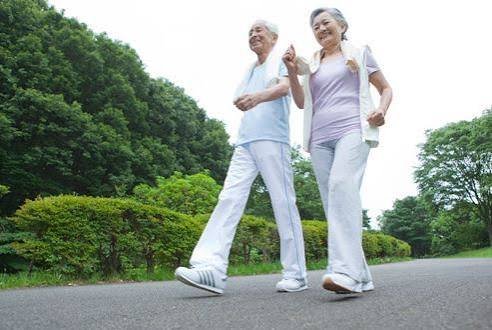
Footwear and Walking Aids
Footwear significantly affects the comfort and joint loading of walking, particularly at the knee and hip. The right shoes are not merely about comfort — they affect the biomechanics of each step.
Cushioned, supportive trainers are the recommended footwear for most people walking for joint health. The key features are: adequate cushioning in the heel and forefoot (to absorb impact forces), a wide toe box (to accommodate any forefoot swelling or deformity, common in RA), good arch support, and a sole that is not excessively rigid. Worn-out shoes — where the cushioning has compressed beyond its functional lifespan — should be replaced; this typically happens at 500–800 km for most running/walking shoes, regardless of visual appearance.
Motion control shoes are designed for people with pronation (inward rolling of the foot) — a common gait pattern in people with pes planus (flat feet) or tibial torsion. Excessive pronation increases knee valgus stress (inward pressure on the knee), which is relevant in medial knee OA. A gait analysis at a running shop can identify whether motion control footwear would help.
Nordic walking poles are increasingly recommended in musculoskeletal conditions and by NHS physiotherapy teams. By distributing some of the body’s weight through the arms and poles, they reduce lower limb joint loading by 10–15% per step. They also increase upper body muscular engagement (engaging arms, shoulders, and core), raising cardiovascular intensity without increasing leg joint stress. For people with severe knee or hip OA whose pain limits normal walking duration, Nordic walking allows longer sessions at lower joint cost. Versus Arthritis and some NHS physiotherapy services offer Nordic walking groups and instruction.
Orthotics (shoe insoles) are prescribed by podiatrists and physiotherapists for specific biomechanical issues — heel spurs, plantar fasciitis, pes planus, metatarsalgia — and for reducing medial knee compartment loading in knee OA (lateral wedge insoles specifically). Off-the-shelf insoles can provide cushioning but are not equivalent to prescribed orthotics for biomechanical correction.
Walking sticks and canes are underused by people with hip and knee OA. A cane, used on the opposite side to the affected joint, unloads the hip or knee significantly during the stance phase of gait. There is a cultural resistance to using canes (associated with “giving in” to disability), but from a joint-protection standpoint they extend walking distance and reduce pain, allowing people to walk more than they otherwise could — the net effect on joint health and fitness is positive.
Walking Programmes: Structured Approaches
Unstructured walking — “I will walk more” without a plan — typically produces less improvement than a structured, progressive programme. Several evidence-based structured walking programmes are available in the UK.
Parkrun is a free, weekly, timed 5km walking and running event at hundreds of UK locations every Saturday morning. It is explicitly inclusive of walkers, and a significant proportion of participants walk the course at their own pace. The social environment, regular timing, and community aspect address both the physical and psychological barriers to maintaining a walking habit. Many people with mild-to-moderate OA, RA in remission, and osteoporosis participate regularly in parkrun. The parkrun website includes a specific guide for participants with health conditions.
Let’s Go Outside and Walking for Health (coordinated by the Ramblers and the Macmillan Cancer Support charity partnership) provide guided group walks across England, specifically designed to be accessible to people with health conditions and low fitness levels. Group walking addresses social isolation alongside the physical benefits, and social support is one of the strongest predictors of long-term exercise adherence.
ESCAPE-pain (Enabling Self-management and Coping with Arthritic Pain through Exercise) is an NHS-approved group rehabilitation programme combining education and progressive exercise including walking, specifically designed for people with chronic knee or hip pain from OA. Studies show ESCAPE-pain participants maintain exercise habits and pain improvements at two-year follow-up. GP and physiotherapy referral is the usual pathway.
Green social prescribing is an emerging NHS initiative that connects patients with community walking groups, nature-based activities, and outdoor exercise programmes as a social prescription alongside or instead of medication. GPs in areas with active green social prescribing can refer patients to supported walking groups directly.
Walking with Specific Conditions
Knee osteoarthritis: Walking is the aerobic exercise most directly supported by evidence in knee OA. The priority is walking regularly rather than fast — 30 minutes of moderate-pace walking (brisk enough to slightly raise breathing, but still comfortable to talk) five days per week achieves the NICE-recommended 150 minutes. Flat surfaces are preferable initially — steep hills increase compressive knee forces significantly. A walking stick held on the unaffected side, or Nordic poles, may extend tolerable walking distance. See our full guide on the four types of exercise for joint health for the complementary strength training that maximises the benefit of walking.
Hip osteoarthritis: Walking is equally well-supported for hip OA. One specific note: avoid prolonged walking at a forced pace on uneven ground in early hip OA — the hip abductors (lateral hip muscles) are often weaker than they should be, causing subtle Trendelenburg gait (hip drop on the opposite side during each step) that increases hip joint stress. A physiotherapist can identify and address this with targeted hip abductor strengthening. Once those muscles are stronger, walking mechanics improve significantly.
Rheumatoid arthritis: Walking is appropriate and recommended between flares and during periods of remission. During an acute flare of a foot or ankle joint (common in RA, due to synovitis of the MTP joints — metatarsophalangeal joints at the ball of the foot), walking may need to be temporarily reduced. Supportive footwear with wide toe boxes is particularly important in RA to accommodate forefoot swelling and deformity. Our guide on how doctors diagnose arthritis covers the RA-specific examination findings in detail.
Osteoporosis: Walking is the most accessible weight-bearing exercise and should be regular and ongoing for anyone with osteoporosis or reduced bone mineral density. Brisk walking (moderate intensity) provides a greater bone-building stimulus than gentle strolling. For those with established osteoporosis and very low bone mineral density, high-impact activities (running, jumping) may be contraindicated due to fracture risk — a physiotherapist or bone specialist can advise. Nordic walking, with its additional upper body loading, provides a modest additional bone stimulus at the wrist and forearm. Falls risk assessment and management are also critical in osteoporosis; see our related guide on vitamin D and bone health.
Ankylosing spondylitis: Walking must be combined with dedicated spinal mobility exercise in AS — walking alone does not preserve spinal range of motion. However, it contributes to cardiovascular fitness and to the general physical conditioning that supports the rest of the AS management programme. Upright walking with good posture (head up, shoulders back, avoiding the tendency to flex forward) is specifically encouraged because it works against the flexion deformity that AS tends to produce. Pool walking and hydrotherapy are also strongly recommended in AS.
Monitoring Progress and Setting Goals
Tracking walking has become much more accessible with smartphones and smartwatches, which can count steps, measure distance, and record pace. The traditional “10,000 steps per day” target has been somewhat modified by more recent research: the evidence actually shows that benefits increase progressively up to about 8,000–10,000 steps, with diminishing additional returns beyond that. For people starting from a sedentary baseline with joint pain, even 2,000–4,000 steps per day is a meaningful and beneficial starting point — the important thing is consistent daily movement, not a fixed number.
Setting specific, measurable goals helps maintain motivation and allows progress to be objectively tracked. Good examples: “I will walk to the post box and back every morning this week” (a habit anchor); “I will reach 20 minutes continuous walking by the end of this month” (a duration goal); “I will walk to the park without stopping three times next week” (a distance/destination goal). The Versus Arthritis website includes goal-setting tools and walking diaries designed for people with joint conditions.
Pain after walking should be distinguished from progress. Some muscle aching (particularly in the thighs and calves) the day after a longer walk is normal adaptation — this is not injury and does not require rest. Joint pain that is significantly worse than baseline and persists beyond 24 hours is the signal to reduce the next session. Keeping a brief diary of walk duration and joint response takes only a minute per day and provides invaluable information for calibrating the programme.
Frequently Asked Questions
Is walking good for osteoarthritis?
Yes — walking is specifically recommended by NICE as a first-line treatment for osteoarthritis of the knee and hip. It reduces pain by 20–30% in clinical trials, improves function, builds protective muscle strength, provides cartilage nutrition through mechanical loading, and supports weight management. Walking does not accelerate cartilage damage in moderate amounts; it actually helps maintain cartilage health by promoting the synovial fluid circulation that feeds it.
How much should I walk with joint pain?
Start with what you can do comfortably — even 5–10 minutes if that is all that is tolerable initially — and increase gradually by no more than 10% per week. The ultimate target is the NHS-recommended 150 minutes per week of moderate-intensity aerobic activity, achievable as 30 minutes five days per week. This can be broken into shorter bouts (three 10-minute walks count the same as one 30-minute walk). Always use the 24-hour rule: if pain is worse than baseline more than 24 hours after a walk, reduce the next session.
What shoes are best for walking with arthritis?
Cushioned, supportive trainers with a wide toe box are generally best. Key features: adequate heel and forefoot cushioning, good arch support, flexible but not flat sole. Replace walking shoes when cushioning compresses (typically 500–800 km of use). For knee OA with significant medial compartment loading, a podiatrist may recommend lateral wedge insoles. For foot involvement in RA, extra-wide fittings and depth-adjustable shoes accommodate deformity and swelling.
Can I walk if I have a knee replacement?
Walking is actually central to knee replacement rehabilitation, beginning typically the day of or day after surgery under physiotherapy guidance. Most people are walking independently within a few days and walking outside within 2–6 weeks depending on the procedure and individual recovery. Walking is the primary recommended activity in the months following knee replacement. Long-distance running and high-impact sports are usually not recommended due to implant longevity concerns, but brisk walking and Nordic walking are explicitly encouraged long-term.
Does walking help rheumatoid arthritis?
Yes — regular walking improves cardiovascular fitness, reduces fatigue, lowers systemic inflammation, and improves quality of life in RA. People with RA have significantly elevated cardiovascular risk, and aerobic exercise including walking is one of the most effective interventions for reducing that risk. During a flare of a lower limb joint, walking may need to be briefly reduced or modified (e.g. pool walking instead). Between flares and in remission, walking and progressive aerobic conditioning are actively encouraged by NICE (NG100).
Is walking enough exercise for arthritis?
Walking is excellent aerobic conditioning and provides cardiovascular, anti-inflammatory, bone-loading, and weight management benefits. However, it primarily works the aerobic system and lower limb endurance — it does not provide the same targeted muscle strengthening as resistance exercises. The most effective programme for joint health combines walking (aerobic component) with strength training for the specific muscles around affected joints. See our complete guide to exercise for joint health for the four-component programme.
Should I walk through joint pain?
Mild-to-moderate joint discomfort that does not worsen during a walk and settles within 24 hours afterwards is generally acceptable to walk through. Pain that significantly worsens during a walk, that involves locking, giving way, or severe swelling, or that persists more than 24 hours after a walk indicates the intensity or duration was too high. Sharp, acute-onset pain during a walk should make you stop immediately. The distinction to make is between muscle discomfort (normal adaptation, acceptable to continue) and joint pain (a signal to reduce load). A physiotherapist can help you calibrate the difference for your specific condition.
Key Takeaways
Walking is one of the most evidence-supported, accessible, and effective interventions available for joint health — reducing OA pain by 20–30%, building protective muscle strength, maintaining cartilage nutrition, supporting bone density through weight-bearing loading, and reducing cardiovascular risk. It does not damage arthritic joints; moderate regular walking promotes their health. Getting started safely means beginning gently, applying the 24-hour rule, and increasing by no more than 10% per week. Good footwear, Nordic walking poles, and structured programmes like parkrun and ESCAPE-pain make walking more sustainable and effective. For people with knee or hip OA, adding targeted strength training to a walking programme produces better outcomes than walking alone. For more on the broader evidence base for exercise in joint health, see our guide to the four types of exercise for joint health, and for the clinical investigations that help monitor joint conditions, our articles on how doctors diagnose arthritis and the physical exam for joint pain.
References and Further Reading
- National Institute for Health and Care Excellence. Osteoarthritis in over 16s: diagnosis and management. NG226, 2022.
- Fransen M et al. Exercise for osteoarthritis of the knee. Cochrane Database of Systematic Reviews 2015.
- Versus Arthritis. Walking and arthritis — Versus Arthritis resource.
- NHS. Walking for health — NHS Live Well. Updated 2023.
- Parkrun. Parkrun for people with health conditions.
- ESCAPE-pain programme. ESCAPE-pain: group rehabilitation for chronic knee and hip pain.
- Ramblers / Walking for Health. Walking for Health — guided group walks across England.
Disclaimer: This article is for educational purposes only and does not constitute medical advice. Always consult a physiotherapist or doctor before starting a new exercise programme if you have a significant joint condition, recent surgery, or unstable cardiovascular disease.
I have knee OA and I was convinced that walking was making things worse because it hurt during the walk. My GP told me to walk more but didn’t explain how or how much. The 24-hour rule has completely changed how I manage my walking – I now know that some discomfort during the walk is okay as long as I’m not worse the next day. And starting with just 10 minutes and building up has meant I can now do 25 minutes without significant pain. The section on footwear was also very helpful – I had been walking in flat canvas shoes which was clearly not helping.
Margaret – the 10-minute starting point and the 24-hour calibration rule are genuinely the two most important practical tools for managing walking with OA. The discomfort during a walk that is tolerated and settled by the next morning is almost always muscle adaptation – your quadriceps and calf muscles working harder than they are used to – rather than joint damage. The cumulative effect of consistent short walks is much greater than most people expect. Flat canvas shoes without cushioning or support are unfortunately very common and your observation is correct – replacing them with a well-cushioned trainer with a wide toe box will make a noticeable difference to comfort and joint loading. Well done on reaching 25 minutes.
Really useful overview of parkrun for people with arthritis. I was hesitant to go because I thought it was only for runners and I can only walk. But I went last Saturday and was genuinely surprised – there were plenty of walkers and the tail walker stayed behind me the whole way. It’s become my weekly highlight. The social aspect is underrated – I’ve met other people managing joint conditions and we encourage each other.