

Shoulder Mobility Exercises: A Complete Guide
Shoulder mobility exercises address the most mobile joint in the human body — which is also, for that same reason, among the most vulnerable to stiffness. The glenohumeral joint sacrifices structural stability for range of motion, relying on the rotator cuff muscles and capsular soft tissues to maintain it. When those tissues tighten — from desk posture, overuse, frozen shoulder, or simply from years of reduced movement — the shoulder loses the range needed for dressing, reaching overhead, and the dozens of daily tasks that require unrestricted arm movement.
This guide covers seven shoulder mobility exercises with evidence behind them, their application to the most common shoulder conditions, and how to build a sustainable daily routine. Whether the goal is managing frozen shoulder, addressing the posterior capsule tightness that drives impingement, or simply counteracting the forward-rounded posture of extended computer use, the exercises here provide a clinically grounded starting point.
Why the Shoulder Loses Mobility
The shoulder complex is not a single joint — it is a system of four articulations (glenohumeral, acromioclavicular, sternoclavicular, and scapulothoracic) that must work together for the arm to reach overhead, reach behind the back, or rotate freely. When any component of this system loses mobility, the others are forced to compensate, and the compensations produce the impingement, tendinopathy, and capsular restriction that present as shoulder pain and stiffness.
The most common cause of shoulder stiffness in desk-working adults is posterior capsule tightening. The posterior capsule — the back of the joint’s fibrous sleeve — thickens and shortens from years of forward-reaching posture and the loss of the overhead and behind-the-back movements that would normally maintain it. When the posterior capsule is tight, it pushes the humeral head forward and upward in the glenoid, narrowing the subacromial space through which the rotator cuff tendons travel. This is the mechanism that produces the repetitive microtrauma of impingement syndrome. The glenohumeral internal rotation deficit (GIRD) — a significant asymmetry in internal rotation between sides — is a measurable manifestation of this posterior capsule tightness.
Frozen shoulder (adhesive capsulitis) is a different process: an inflammatory condition in which the entire joint capsule thickens and contracts, progressively limiting movement in all planes. It affects 2–5% of the general population, is most common between ages 40–60, and has a strongly elevated prevalence in people with diabetes (10–20%), thyroid disorders, and other autoimmune conditions. It follows a natural history of three phases — freezing (painful restriction), frozen (less pain but maximum restriction), and thawing (gradual recovery) — over a period typically lasting 18 months to 4 years.
Desk posture shortens the pectoralis minor muscle, which attaches to the coracoid process of the scapula. A tight pec minor tips the scapula’s coracoid forward and downward, reducing the scapula’s ability to upwardly rotate during arm elevation — the movement that opens the subacromial space as the arm rises. This is why thoracic mobility and pectoral stretching are important components of shoulder rehabilitation, not just shoulder-specific exercises.
Shoulder Mobility Exercises — 7 Key Exercises
The following exercises address the most common mobility deficits: posterior capsule tightness (internal rotation), anterior capsule and pectoral shortening, active-assisted range in frozen shoulder, and thoracic extension. They are ordered from most gentle to most active.
1. Pendulum Swings
Pendulum swings use gravity-assisted traction to gently mobilise the glenohumeral joint with minimal active muscle contraction. They are the standard starting point for frozen shoulder rehabilitation and for any shoulder too painful for active exercise.
- Lean forward, supporting your weight on the non-affected arm on a table or chair back
- Let the affected arm hang freely, completely relaxed
- Use your body momentum (not the arm muscles) to create gentle circular swings — 10 clockwise, 10 counter-clockwise — and gentle forward-back and side-to-side swings
- The movement comes from the trunk, not the shoulder muscles — the shoulder is a passive passenger
- Perform twice daily; increase the diameter of the circles gradually over days
2. Doorframe Pectoral Stretch
The doorframe stretch opens the anterior capsule and stretches pectoralis major and minor — the muscles most shortened by desk posture and forward-reaching activities. It directly addresses the anterior capsule tightness that contributes to impingement.
- Stand in a doorway; place both forearms on the doorframe at 90° (elbows level with or below shoulder height to begin)
- Gently lean through the doorway until a stretch is felt across the chest and front of the shoulders
- Hold 30 seconds; repeat 3 times. Vary the arm position (lower = lower pec; higher = upper pec + anterior deltoid)
- Avoid this stretch if it reproduces shoulder pain (may indicate anterior instability)
3. Sleeper Stretch (Posterior Capsule)
The sleeper stretch is the most specific exercise for posterior capsule tightness and GIRD. Multiple RCTs have demonstrated that regular sleeper stretch practice reduces GIRD, improves shoulder internal rotation, and reduces impingement symptoms in throwing athletes and overhead workers alike.
- Lie on your side on the affected shoulder; the shoulder should be at 90° of flexion (arm pointing forward), elbow bent at 90°
- With the opposite hand, gently press the wrist of the bottom arm toward the floor, rotating the shoulder into internal rotation
- Hold 30–45 seconds; perform 3 repetitions; do twice daily
- Important: If this causes pain in the shoulder joint (not just stretch in the back of the shoulder), reduce the range or discontinue — some people with impingement find the side-lying position uncomfortable; the cross-body stretch (exercise 4) may be better tolerated
4. Cross-Body Stretch (Horizontal Adduction)
The cross-body stretch targets the posterior capsule and posterior rotator cuff from a different angle than the sleeper stretch — horizontal adduction rather than internal rotation. It is accessible in sitting or standing and is gentler for people who find the sleeper stretch too intense.
- Bring one arm across the body at shoulder height
- Use the opposite hand or forearm to gently pull the arm further across the body, adding a few degrees of horizontal adduction
- Hold 30 seconds; feel the stretch in the back of the shoulder; 3 repetitions each side
- If you feel an AC joint click or pain at the top of the shoulder when performing this, discontinue — AC joint pathology is a contraindication to horizontal adduction stretching
5. Wall Slide (Active Shoulder Flexion)
Wall slides train active shoulder flexion through increasing range while simultaneously training scapular upward rotation — the movement that keeps the subacromial space open as the arm rises. They are particularly useful for impingement, where the goal is to restore active overhead reach.
- Stand facing a wall; place the forearms on the wall with elbows bent at 90°, hands at forehead height
- Slowly slide both arms upward along the wall while maintaining light forearm contact
- Go as high as comfortable; hold 3 seconds at the top; slide back down; 10–12 repetitions, 3 sets
- Feel the shoulder blades rotating upward as the arms rise — this is the scapular movement the exercise is training
6. Thoracic Extension Over Foam Roller
Thoracic kyphosis (upper back rounding) directly reduces available shoulder elevation range. When the thoracic spine cannot extend, the shoulder cannot reach fully overhead without the arm substituting by impinging at the subacromial level. Thoracic extension over a foam roller addresses this root cause.
- Place a foam roller horizontally at mid-back level (around T6–T8); lie back over it with hands supported behind the head
- Let the weight of the upper body gently extend the thoracic spine over the roller; hold 30–60 seconds
- Move the roller to a slightly different level and repeat; 3–4 positions from mid-back to upper back
- Avoid rolling directly on the cervical spine (neck) or lumbar spine (lower back)
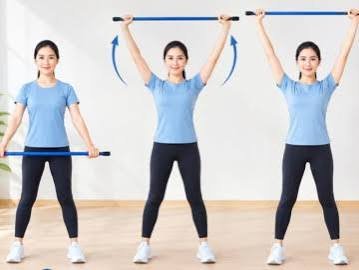
7. Wand / Stick Exercises (Active Assisted)
Wand exercises use a stick, cane, or broomstick to allow the stronger, less affected side to assist the restricted side through range. They are the primary active-assisted exercise for frozen shoulder rehabilitation and are suitable throughout all three phases.
- Forward elevation: hold the wand with both hands at hip width; use the unaffected arm to lift the wand (and thus the affected arm) forward and upward toward the ceiling; hold 2–3 seconds at the top; 10 repetitions
- Side elevation: same action with the wand moving out to the side rather than forward; 10 repetitions
- Internal rotation: hold the wand behind the back with both hands; use the unaffected arm to gently slide the wand upward, carrying the affected arm into IR; 10 repetitions
- Perform twice daily; increase range gradually as tolerated
Shoulder Mobility for Specific Conditions
Frozen Shoulder (Adhesive Capsulitis)
Frozen shoulder is managed differently depending on its phase. In the painful freezing phase, gentle pendulum swings, assisted exercises at or below the pain threshold, and anti-inflammatory management (corticosteroid injection, NSAIDs) are the priority. Active stretching into painful range in the freezing phase can worsen inflammation. In the frozen phase, when pain has reduced but restriction is maximum, gentle progressive stretching — including the sleeper stretch, wand exercises, and cross-body stretch — can be performed more aggressively. In the thawing phase, the shoulder progressively recovers with or without treatment; maintaining movement during this phase preserves the gains. People with diabetes should expect a longer natural history. Hydrodilatation (injecting saline to distend the capsule) is an option in the frozen phase when physiotherapy alone is insufficient.
Rotator Cuff Impingement and Tendinopathy
The primary mobility target in impingement is the posterior capsule. Sleeper stretch and cross-body stretch are the priority. Wall slides simultaneously address the active component — training the scapular upward rotation that keeps the subacromial space open during arm elevation. Thoracic extension over the foam roller addresses the thoracic component. People with rotator cuff impingement should combine these mobility exercises with rotator cuff strengthening (external and internal rotation resistance exercises) — mobility without strengthening rarely produces lasting improvement in impingement.
Desk Posture and Forward Head
The combination most commonly needed for desk posture-related shoulder restriction: doorframe pec stretch (anterior capsule and pec minor), thoracic extension over foam roller (thoracic kyphosis), and wall slides (active scapular recruitment). These three exercises, done daily, progressively reverse the postural pattern that accumulates over years of desk work. The thoracic component is often the most important — improving thoracic extension can improve overhead shoulder range without any direct shoulder stretching at all.
Post-Surgical Shoulder
Post-arthroplasty and post-rotator cuff repair rehabilitation should always follow the specific protocol prescribed by the surgical team and physiotherapist, as range restrictions and precautions vary significantly by procedure. Generally, pendulum swings and wand-assisted forward elevation are introduced in the early weeks, with active exercises added as healing allows. Attempting to push range beyond what the tissue can tolerate in the early healing phase risks disrupting the repair.
Building a Daily Shoulder Mobility Routine
Ten to fifteen minutes of daily shoulder mobility work is sufficient to maintain or progressively improve range. The key is consistency — the shoulder capsule responds to sustained, moderate daily stretch stimulus, not to infrequent intensive sessions.
The optimal time is after a warm shower, when tissue temperature is elevated. For people with frozen shoulder, performing exercises in a warm bath or shortly after applying heat to the shoulder (10 minutes with a heat pack) substantially increases the pliability of the capsule and makes the stretches more comfortable and effective.
A practical daily routine for general shoulder mobility maintenance:
- Doorframe pec stretch: 3×30 seconds
- Thoracic extension over foam roller: 3–4 positions, 30 seconds each
- Sleeper stretch (or cross-body): 3×30 seconds each side
- Wall slides: 3×10 repetitions
Total time: approximately 12 minutes. For frozen shoulder rehabilitation, add pendulum swings and wand exercises to this routine, and increase frequency to twice daily.
What the Research Says About Shoulder Mobility Exercises
The evidence for specific shoulder mobility exercises varies by condition. For frozen shoulder, a Cochrane review found that no single conservative treatment was clearly superior, but that corticosteroid injection combined with physiotherapy (including mobilisation and exercise) produced better short-term outcomes than either alone. Exercise is recommended throughout all phases — the question is how aggressively to stretch, which depends on the phase.
For impingement syndrome, multiple randomised controlled trials have demonstrated that the sleeper stretch reduces GIRD and improves impingement symptoms. A 2009 study by McClure and colleagues found that both the sleeper stretch and the cross-body stretch effectively reduced posterior shoulder tightness, with the sleeper stretch producing greater improvements in internal rotation range.
The role of thoracic mobility in shoulder function is supported by clinical evidence showing that thoracic extension exercises improve shoulder elevation range even without direct shoulder treatment — because restoring the thoracic extension needed for scapular upward rotation removes a proximal constraint on overhead reach. For people with desk-related shoulder restriction, this means that thoracic work often produces faster gains than shoulder-specific stretching alone.
NICE and the Versus Arthritis guidance on frozen shoulder recommends physiotherapy including exercise and mobilisation, with corticosteroid injection considered in the painful freezing phase. Surgery (arthroscopic capsular release) is reserved for cases unresponsive to 12 months of conservative management.
Shoulder mobility: the thoracic connection
Full shoulder elevation (reaching overhead) requires the thoracic spine to extend. In people with significant thoracic kyphosis from desk posture, improving thoracic extension can improve overhead shoulder range by 10–20° without any direct shoulder stretching. Always include thoracic extension alongside shoulder-specific exercises.
Common Mistakes When Doing Shoulder Mobility Exercises
Forcing through joint pain (rather than muscle stretch): Shoulder mobility exercises should produce a sensation of stretch or mild tension in the surrounding muscles and posterior capsule — not pain inside the joint. If an exercise produces a sharp pain, a painful click, or joint pain that persists after the exercise, it is either being performed incorrectly or is contraindicated for the specific pathology present. Reduce range or seek assessment.
Ignoring the thoracic spine: Shoulder mobility exercises performed in isolation — without addressing the thoracic extension and scapular upward rotation that shoulder overhead reach depends on — produce limited and short-lived improvements. The thoracic foam roller and wall slide should be part of every shoulder mobility programme.
Only doing mobility, not strengthening: Stretching and mobility work increases passive range; but if the rotator cuff muscles are too weak to control the joint through that new range, the improved mobility will not translate into pain-free function. External rotation resistance exercises (using a resistance band) should accompany shoulder mobility work for impingement and rotator cuff presentations.
Asymmetric stretching without assessment: Some people stretch only the symptomatic side. But the posterior capsule tightness that drives impingement is often bilateral in desk workers, and the contralateral shoulder may have similar restrictions without yet being symptomatic. Performing the sleeper stretch bilaterally is appropriate for most people with impingement.
Frequently Asked Questions
How do I know if I have a frozen shoulder?
Frozen shoulder is characterised by a gradual loss of shoulder movement in all planes — reaching forward, out to the side, overhead, and behind the back — accompanied by significant pain in the early stages. The restriction is typically worst in the night, with the shoulder intensely painful when rolled onto. The diagnosis is clinical (based on history and physical examination) and does not require imaging. A GP can make the diagnosis and refer for physiotherapy or corticosteroid injection depending on the phase. Conditions that can mimic frozen shoulder include severe rotator cuff tears and glenohumeral OA — both of which may require imaging to distinguish.
How long does it take to improve shoulder mobility?
For general postural restriction from desk work, meaningful improvements in shoulder mobility can begin within 2–4 weeks of daily practice. Posterior capsule tightness (GIRD) typically responds over 6–12 weeks of consistent sleeper stretch practice. Frozen shoulder follows a different timeline — improvement during the frozen phase is measured in months, not weeks, and the thawing phase may take 12–18 months. Consistency is more important than intensity: daily moderate stretching produces better outcomes than infrequent aggressive sessions.
Should I exercise a frozen shoulder?
Yes, with important phase-specific adjustments. In the painful freezing phase, gentle exercises within a pain-free or minimally painful range are appropriate — pendulum swings and wand-assisted exercises below the pain threshold maintain some movement without aggravating the inflammation. Forcing range in this phase can worsen the inflammatory response. In the frozen phase, more progressive stretching can be applied. In the thawing phase, active range restoration is the primary goal. A physiotherapist experienced with frozen shoulder can guide the appropriate intensity for each phase.
Can shoulder mobility exercises help with rotator cuff pain?
Yes, particularly when the mechanism involves posterior capsule tightness (which drives impingement). The sleeper stretch and cross-body stretch directly address this mechanism. However, mobility exercises alone are not sufficient for rotator cuff tendinopathy — the tendons also need progressive loading (strengthening) to remodel and regain their capacity. For people with rotator cuff pain, combining the mobility exercises here with external rotation strengthening produces significantly better outcomes than either alone.
Is the sleeper stretch safe for everyone?
The sleeper stretch is safe for most people with posterior capsule tightness and impingement. It is not appropriate for people with anterior shoulder instability (hypermobility, previous dislocations), certain SLAP lesions, or during the painful freezing phase of frozen shoulder. If you experience pain inside the shoulder joint (not just the stretch sensation at the back of the shoulder) during the sleeper stretch, stop and use the cross-body stretch as an alternative. A physiotherapist can advise on appropriateness for specific pathologies.
How do I stretch my shoulder at home without equipment?
No equipment is needed for any of the primary shoulder mobility exercises in this guide. Pendulum swings require only a chair or table edge. The doorframe pec stretch requires a doorframe. The sleeper stretch, cross-body stretch, and wall slide require only a wall and a flat surface. A towel can substitute for a foam roller (though less effectively) for thoracic extension. The only exercise that requires any equipment is the wand exercise, for which a broom handle, umbrella, or walking stick works perfectly.
When should I see a physiotherapist for shoulder stiffness?
If shoulder stiffness: began suddenly or following an injury, is accompanied by significant pain at rest, is accompanied by weakness (possible rotator cuff tear), does not improve after 4–6 weeks of daily mobility exercise, or is worsening rather than improving — physiotherapy assessment is warranted. A physiotherapist can distinguish between the different causes of shoulder stiffness, identify whether mobility or strengthening is the primary need, and prescribe a tailored programme. NHS physiotherapy is available via GP referral, and many areas now offer self-referral MSK physiotherapy without requiring a GP appointment.
When to See a Doctor or Physiotherapist
- Significant acute loss of shoulder movement following a fall or injury — possible fracture or full-thickness rotator cuff tear
- Night pain that is severe and constant — may indicate significant rotator cuff tear, glenohumeral OA, or referred pain from a cervical spine problem
- Progressive restriction without pain — glenohumeral OA can present with painless restriction in end-range movement in older adults; imaging helpful for diagnosis
- Shoulder restriction plus diabetes, thyroid condition, or recent cardiovascular surgery — higher risk of frozen shoulder; early corticosteroid injection produces better outcomes when started in the freezing phase
- Weakness alongside restriction — may indicate rotator cuff tear requiring ultrasound or MRI
Conclusion
Shoulder mobility exercises address a range of common conditions — frozen shoulder, impingement, rotator cuff tightness, and desk posture-related restriction — through targeted daily work on the capsular structures and musculature that limit shoulder range. The posterior capsule (sleeper stretch), anterior capsule (doorframe pec stretch), thoracic spine (foam roller extension), and active range (wall slides, wand exercises) together cover the main components of the shoulder mobility system.
Ten to fifteen minutes daily, consistently applied, produces meaningful improvement over 4–12 weeks for most shoulder mobility restrictions. For frozen shoulder, the timeline is longer but the principle is the same: consistent daily exercise, adapted to the phase of the condition, is the most effective conservative approach available.
For related reading, explore our guide on mobility exercises for older adults and our overview of resistance training after age 50.
Medical Disclaimer: This article is for informational purposes only and does not constitute medical advice. Always consult a qualified healthcare professional before starting a new exercise programme, particularly if you have frozen shoulder, rotator cuff pathology, or have had recent shoulder surgery.
References
- National Institute for Health and Care Excellence. Osteoarthritis in over 16s. NG226. 2022. nice.org.uk
- McClure P, et al. A randomized controlled comparison of stretching procedures for posterior shoulder tightness. Journal of Orthopaedic & Sports Physical Therapy. 2007. pubmed.ncbi.nlm.nih.gov
- Versus Arthritis. Frozen shoulder. versusarthritis.org
- Cochrane Library. Frozen shoulder reviews. cochranelibrary.com
- NHS. Frozen shoulder. nhs.uk
- Ludewig PM, Reynolds JF. The association of scapular kinematics and glenohumeral joint pathologies. Journal of Orthopaedic & Sports Physical Therapy. 2009.
I was diagnosed with frozen shoulder four months ago and was told to wait it out as the natural history is 2-4 years. Nobody explained the phase distinction or that there is a difference in how aggressively to stretch depending on whether you are in the freezing versus frozen phase. I have been trying to push through range aggressively in what is apparently still the freezing phase, which may be why I have been having significant pain flare-ups after exercises. The guidance here about keeping the freezing phase gentle and working within a pain-free range is genuinely useful clinical information that I did not receive from the GP.
Patricia – the freezing phase distinction is one of the most clinically important things to understand about frozen shoulder, and unfortunately it is rarely communicated in brief consultations. The inflammatory driver in the freezing phase means that aggressive stretching can genuinely worsen the condition by provoking more inflammation – which is the opposite of what happens in the frozen phase where the capsule is maximally contracted but the inflammation has settled. Switching to pendulum swings and gentle wand exercises within a comfortable range, and considering a corticosteroid injection (which targets the inflammatory phase specifically), would be worth discussing with your GP or asking for a physiotherapy referral to clarify the phase and appropriate treatment approach.
The point about the thoracic spine connection was something I had never considered. I work at a desk for 9-10 hours daily and have had restricted overhead shoulder movement for years but no acute shoulder pathology. Reading that thoracic extension restriction directly limits how far the arm can go overhead – because the scapula cannot rotate correctly without thoracic extension – explains why my overhead range improved meaningfully after just two weeks of foam roller work, even before I started the specific shoulder exercises.