

Hip replacement has been called “the operation of the century,” and for good reason — few interventions in medicine so reliably transform a person’s quality of life. For someone whose hip arthritis has reached the point of constant pain, disturbed sleep, and a shrinking world, a hip replacement can restore the ability to walk, sleep, and live with freedom many had given up on. This guide gives adults a clear, balanced picture of what hip replacement involves: the surgical approaches, the recovery timeline, the famous “hip precautions,” and what you can realistically expect from one of modern surgery’s great successes.
Hip replacement surgery replaces the worn ball-and-socket hip joint with an artificial ball (on a stem in the thigh bone) and a socket (in the pelvis). It is the most successful and reliable of all joint replacements, with around 90% of patients reporting good or excellent outcomes and dramatic pain relief. Recovery is generally faster and smoother than knee replacement: walking with aids for 2–6 weeks, most activities by 6–12 weeks, and full recovery within 3–6 months. Depending on the surgical approach, you may need to follow “hip precautions” early on to protect against dislocation.
What a Hip Replacement Actually Involves
The hip is a ball-and-socket joint: the ball is the head of the femur (thigh bone), and the socket is the acetabulum, a cup-shaped part of the pelvis. Both surfaces are normally covered in smooth cartilage. In osteoarthritis — the most common reason for hip replacement — this cartilage wears away, leaving bone grinding on bone deep in the groin, producing pain that is often felt in the groin, thigh, or even the knee, along with stiffness and a limp.
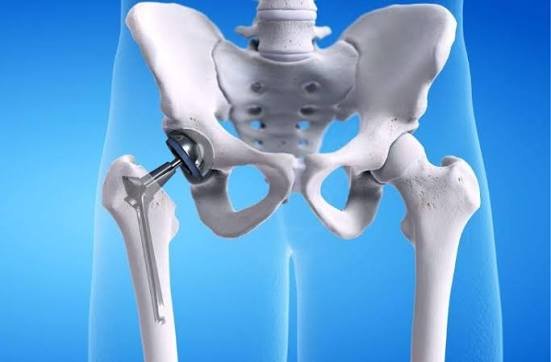
A total hip replacement removes the worn ball and socket and replaces them with artificial components: a metal or ceramic ball mounted on a stem that fits into the hollow centre of the thigh bone, and a cup that is fixed into the pelvis, usually with a durable plastic (polyethylene) or ceramic liner. Together these recreate a smooth, pain-free ball-and-socket joint. For the broader principles of how all joint implants work — the materials, fixation, and longevity — see our joint replacement surgery overview.
In 2007, a landmark article in The Lancet (Learmonth et al.) described total hip replacement as “the operation of the century” — a striking phrase for a surgical procedure, but a justified one. The hip is a relatively simple ball-and-socket mechanism, which makes it well suited to replacement with an artificial equivalent. The results are more uniformly excellent than for the knee: pain relief is usually rapid and near-complete, recovery of movement comes naturally without the intensive exercise battle that knee replacement demands, and satisfaction rates are among the highest of any operation in medicine.
Why People Need a Hip Replacement
Osteoarthritis accounts for the large majority of hip replacements, but several other conditions can damage the hip badly enough to require one.
As with all joint replacement, surgery is considered only after non-surgical treatment has been genuinely tried. Our guide on when surgery may be considered for joint problems explains the thresholds, and NICE CG177 covers the overall management of osteoarthritis.
Surgical Approaches: Posterior, Anterior, and Lateral
There is more than one way to reach and replace a hip, and the “approach” — the direction from which the surgeon accesses the joint — affects early recovery, the precautions you need, and the small risk of dislocation. The choice depends on your anatomy, your surgeon’s expertise, and local practice.
| Approach | How It Works | Key Points |
|---|---|---|
| Posterior | Access from the back/side of the hip | Most common in the UK; reliable and versatile; traditionally needs hip precautions; small early dislocation risk |
| Direct anterior | Access from the front, between muscles | Muscle-sparing; often faster early recovery; fewer precautions; requires specific surgeon expertise; not suitable for everyone |
| Lateral / anterolateral | Access from the side | Low dislocation risk; small chance of a temporary limp from muscle involvement |
| Source: British Orthopaedic Association; NICE NG157 | ||
No single approach is universally “best” — each has trade-offs, and an experienced surgeon using the approach they know well tends to produce excellent results regardless of which it is. The direct anterior approach has become popular for its faster early recovery and reduced need for precautions, but it is technically demanding and not appropriate for all patients or all hips. It is a reasonable question to ask your surgeon which approach they plan to use and why.
The Operation and Hospital Stay
A hip replacement typically takes around an hour to an hour and a half. Like knee replacement, it is increasingly done under spinal (regional) anaesthesia, and modern enhanced recovery programmes mean most people stay in hospital just 1–3 days — some go home the same day. You will usually be helped to stand and take a few steps with a physiotherapist on the day of surgery or the following morning.
One of the striking things about hip replacement is how quickly many people feel the benefit. Because the hip is a simple ball-and-socket joint and the operation does not require the patient to battle to regain a specific range of movement (as the knee does with flexion), the pain relief is often rapid and the return to walking comfortable within weeks rather than months. Many people describe the arthritic pain being gone immediately on waking from surgery — replaced by surgical soreness that settles steadily. This is a real and well-documented difference from knee replacement, which our knee replacement guide explains in detail.
Hip Precautions: Protecting the New Joint Early On
If you have a posterior approach hip replacement, you will usually be given a set of “hip precautions” to follow for the first several weeks. These are temporary movement restrictions designed to prevent the new ball from slipping out of the socket (dislocation) while the tissues heal and tighten around the joint.
- Do not bend the hip more than 90° — avoid low chairs, deep sofas, squatting, and bending forward to reach your feet.
- Do not cross your legs at the knee or ankle, whether sitting or lying.
- Do not twist the leg inward or pivot on the operated leg.
- Use helpful equipment: a raised toilet seat, a firm chair with a cushion to keep hips above knees, a grabber/reacher, a long-handled shoe horn, and a sock aid make daily life easier and safer.
- Sleep on your back early on, often with a pillow between the knees if advised.
It is worth knowing that these precautions are evolving. Growing evidence suggests that for many patients — particularly with the anterior approach or well-positioned implants — the traditional restrictions can be relaxed sooner than was once thought, and some units now use fewer precautions. Always follow the specific advice your own surgical team gives you, as it is tailored to your approach and implant.
Recovery Timeline: What to Expect
| Timepoint | What to Expect |
|---|---|
| Day 0–1 | Stand and walk a few steps with aids; physiotherapy begins; arthritic pain often already gone. |
| Week 1–2 | Walking with crutches or a frame; wound healing; following hip precautions; daily gentle exercises. |
| Week 2–6 | Reducing reliance on walking aids; increasing walking distance; precautions continue. |
| Week 6 | Many precautions relax (per your team); driving often possible; return to light work. |
| Week 6–12 | Most daily activities comfortable; walking well; growing confidence. |
| 3–6 months | Full recovery for most people; back to low-impact activities and an active life. |
| Source: NHS; Chartered Society of Physiotherapy; National Joint Registry | |
Leg Length and Other Common Questions
Two things people frequently worry about with hip replacement are leg length and what they will be allowed to do afterwards.
Surgeons plan carefully before and during the operation to match your leg lengths as closely as possible, and in some cases a small lengthening is actually intentional, to restore stability and correct a limp caused by years of arthritis. A small difference in leg length is possible and is usually either unnoticeable or easily managed with a thin shoe insole. Significant, troublesome leg length differences are uncommon. If you notice a difference early after surgery, mention it to your team — perceived differences often settle as swelling reduces and muscles rebalance over the first few months.
Life After a Hip Replacement: Activities
Once recovered, a hip replacement allows a genuinely active life. As with any implant, the principle is that low-impact activities are encouraged and high-impact ones are limited to protect the joint over the long term.
- Walking, hiking, and rambling
- Swimming and water exercise
- Cycling (static and on the road once confident)
- Golf, bowls, doubles tennis, dancing
- Gym and controlled strength work
- Running and jogging as regular exercise
- Jumping and contact sports
- Repetitive heavy impact through the hip
Staying active and maintaining strength around the hip supports the long-term result — our guide to physical therapy for joint and muscle problems explains how exercise underpins every joint procedure. Versus Arthritis and the Chartered Society of Physiotherapy offer further patient resources.
Risks and Complications
| Risk | Frequency / Note | Management |
|---|---|---|
| Dislocation | ~1–2% (posterior > anterior early on) | Hip precautions; correct implant positioning; usually relocated non-surgically if it occurs |
| Infection | ~1% | Antibiotics; sterile technique; may need revision |
| Blood clots (DVT/PE) | Reduced by prophylaxis | Blood thinners; early movement |
| Leg length difference | Usually small | Careful planning; shoe insole if needed |
| Nerve injury (sciatic) | Rare | Careful surgical technique |
| Periprosthetic fracture | Uncommon | Usually after a fall; may need surgery |
| Source: National Joint Registry; British Orthopaedic Association; NICE NG157 | ||
Contact your surgical team, GP, or NHS 111 urgently — or attend A&E — if after your hip replacement you develop: sudden severe hip or groin pain with the leg appearing shortened, rotated, or unable to bear weight (possible dislocation); increasing wound redness, heat, swelling, or discharge, especially with fever (possible infection); or calf pain and swelling, or sudden breathlessness and chest pain (possible blood clot or pulmonary embolism). A dislocation in particular needs prompt assessment, usually to put the joint back in place.
How Long Will a Hip Replacement Last?
Hip implants are highly durable. National Joint Registry data shows around 93% are still functioning at 15 years, and a 2019 Lancet study (Evans et al.) estimated around 58% last 25 years. For most people having a hip replacement in their 60s, 70s, or beyond, the implant is very likely to last the rest of their life. Younger and more active patients carry a somewhat higher lifetime chance of needing a revision operation, which is one reason low-impact activity is recommended for the long term. The NICE NG157 guideline sets the national standards for the procedure, and the Lancet has published the key long-term outcome data.
Getting the Best Result
Frequently Asked Questions: Hip Replacement
- NHS. Hip replacement. Available at: nhs.uk
- National Institute for Health and Care Excellence. Joint replacement (primary): hip, knee and shoulder. NG157. 2020. Available at: nice.org.uk/guidance/ng157
- National Joint Registry. Annual Report. Available at: njrcentre.org.uk
- Learmonth ID, Young C, Rorabeck C. The operation of the century: total hip replacement. Lancet. 2007. Available at: thelancet.com
- Evans JT et al. How long does a hip replacement last? A systematic review and meta-analysis. Lancet. 2019.
- National Institute for Health and Care Excellence. Osteoarthritis: care and management. CG177. 2014. Available at: nice.org.uk/guidance/cg177
- Versus Arthritis. Hip replacement surgery. Available at: versusarthritis.org
- Chartered Society of Physiotherapy. Available at: csp.org.uk
- British Orthopaedic Association. Available at: boa.ac.uk
- NHS. Osteoarthritis. Available at: nhs.uk
Summary: Hip Replacement in Perspective
Hip replacement earns its reputation as “the operation of the century”: it is the most reliable and successful of all joint replacements, with around 90% of people reporting good or excellent outcomes and often dramatic, near-immediate pain relief. Recovery is generally quicker and smoother than knee replacement, because the hip does not demand the same battle to regain movement. The main things to understand are the surgical approach your surgeon will use, the hip precautions you follow in the early weeks to protect against dislocation, and the reassurance that leg length differences are usually small and manageable. Within sensible low-impact limits, a well-recovered hip replacement restores an active, independent life, and modern implants last most people the rest of their lifetime. Following your precautions early and staying active long-term are the two things most within your control.
I can confirm the point about the arthritic pain being gone immediately. I had my left hip replaced three months ago and the deep grinding groin pain that had kept me awake for two years was simply not there when I woke from the anaesthetic. There was surgical soreness, of course, but that is a completely different kind of pain and it settled week by week exactly as described. I had been dreading the operation for years and put it off far too long. If I had understood how transformative it would be and how manageable the recovery was, I would have had it done much sooner. The hip precautions took some getting used to but the equipment list in this article is exactly what made daily life workable.
Brian – thank you for sharing this, because the experience you describe is exactly why hip replacement has the reputation it does, and why we think it is worth being clear that the arthritic pain and the surgical soreness are two entirely different things. So many people, like you, put the operation off for years out of fear, only to wish afterwards they had done it sooner. Your point about the equipment is an important practical one: the raised toilet seat, grabber, and sock aid are what make the precaution period genuinely manageable rather than frustrating, and we would encourage anyone awaiting surgery to get these in place before the operation rather than scrambling afterwards. Wishing you a continued smooth recovery – and if the right hip ever needs doing, you now know what to expect.
The section comparing the anterior and posterior approaches was helpful because my surgeon offered me the anterior approach and I had not understood why. Reading that it is muscle-sparing with faster early recovery and fewer precautions explained the recommendation, and the honest note that it is technically demanding and not suitable for everyone reassured me that it was a considered choice rather than a fashion. I was able to go back and ask why it suited my particular hip, which was a much more productive conversation than simply accepting it. I had my operation six weeks ago and the reduced precautions did make the early weeks considerably easier than my sister experienced with her posterior approach.