
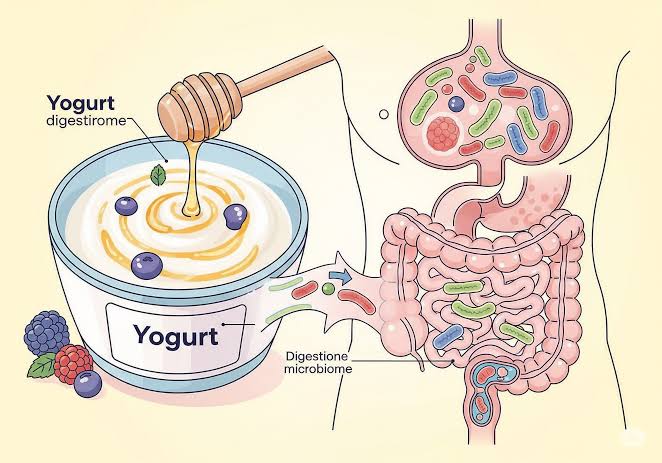
Yoghurt is one of the most accessible, well-evidenced, and widely consumed fermented foods in the world — and one of the most frequently misunderstood in terms of its actual digestive health benefits. The distinction between live yoghurt and pasteurised yoghurt, the significance of which bacterial species are present, and the specific conditions for which clinical evidence exists are all critical to understanding how yogurt and digestive health are genuinely connected.
Not all yoghurt is equal. A live natural yoghurt with multiple probiotic species is categorically different from a high-sugar flavoured product that has been heat-treated after fermentation. This guide covers the evidence by specific outcome — lactose tolerance, IBS, antibiotic-associated diarrhoea — and explains which yoghurt types provide genuine gut health benefit.
The Bacteria That Make Yoghurt Work
Standard yoghurt must legally contain two bacterial species: Lactobacillus delbrueckii subsp. bulgaricus and Streptococcus thermophilus. These two organisms work synergistically — each enhances the growth of the other — and are responsible for the acidification, texture development, and core probiotic activity of yoghurt.
L. bulgaricus is the primary lactase-producing organism in yoghurt — critically important for lactose intolerance. During fermentation, it produces its own lactase enzyme and continues to produce it as it transits through the small intestine, digesting lactose in situ. This in-transit lactase delivery is the confirmed mechanism by which live yoghurt consistently improves lactose digestion in lactose-intolerant individuals — a finding confirmed by multiple systematic reviews measuring breath hydrogen (a direct marker of lactose malabsorption).
S. thermophilus synthesises folate and B12 during fermentation, contributes to immune modulation at the gut mucosal level, and produces exopolysaccharides that contribute to yoghurt texture while also acting as prebiotic substrates for other gut bacteria. Beyond the minimum two species, higher-quality yoghurts add:
- Bifidobacterium animalis subsp. lactis (also called B. lactis or B. animalis): the most studied additional species in commercial yoghurt; multiple RCTs demonstrate reduced IBS bloating, accelerated gut transit, and improved stool consistency with regular consumption
- Lactobacillus acidophilus: supports intestinal pH balance; evidence for reduced bloating and improved stool frequency in IBS-C
- Lactobacillus rhamnosus GG (LGG): the most studied probiotic strain globally; specific RCT evidence for antibiotic-associated diarrhoea prevention and IBS-C
- Lactobacillus casei: well-evidenced for immune modulation and traveller’s diarrhoea prevention
Yoghurt and Lactose Intolerance
Lactose intolerance — the inability to fully digest lactose due to reduced lactase enzyme production in the small intestinal brush border — affects approximately 65% of the global population and up to 20% of Northern Europeans. For these individuals, most dairy products cause bloating, cramping, gas, and diarrhoea due to undigested lactose reaching the colon and being fermented by bacteria there.
Live yoghurt is the notable exception. A 2014 systematic review (Savaiano et al.) confirmed that live yoghurt consistently and significantly improves lactose digestion in lactose-intolerant individuals, producing meaningful reductions in breath hydrogen (the standard objective measure of lactose malabsorption) and subjective symptom scores. The mechanism is the in-transit lactase activity of L. bulgaricus described above — live bacteria delivering the enzyme their host lacks.
Greek yoghurt provides an additional advantage for lactose-intolerant individuals: concentration during production removes much of the whey (which carries most of the lactose), and the extended acidification during fermentation hydrolyses additional lactose through acid chemistry. The result is that Greek yoghurt typically contains 40–50% less lactose per gram than standard live yoghurt, while retaining the same probiotic organisms. The lower lactose content combined with in-transit lactase activity makes Greek yoghurt one of the most well-tolerated dairy products for lactose-intolerant individuals.
Pasteurised yoghurt (heat-treated after fermentation) does NOT improve lactose tolerance — the bacteria are killed, and with them the in-transit lactase activity. This is a critical distinction when advising lactose-intolerant individuals about which yoghurt to choose.
Yoghurt and IBS
Irritable bowel syndrome affects 10–15% of the population and is characterised by chronic abdominal pain, bloating, and altered bowel habit in the absence of structural disease. Multiple randomised trials have evaluated specific yoghurt strains for IBS management, with the strongest evidence centring on Bifidobacterium animalis subsp. lactis (B. lactis DN-173010).
The Activia brand clinical programme produced two well-designed RCTs demonstrating that daily consumption of yoghurt containing B. lactis DN-173010 accelerated orocaecal transit time and significantly reduced bloating scores in IBS patients compared with placebo yoghurt. A 2007 trial (Guyonnet et al., Aliment Pharmacol Ther) specifically found significant reduction in bloating — the symptom most consistently bothersome in IBS-C — after 4 weeks of daily consumption. The mechanism involves the effect of B. lactis on colonic motility signalling and its anti-inflammatory activity at the gut epithelium.
A 2014 meta-analysis (Ford et al., Am J Gastroenterol) found that probiotic-containing foods and supplements, including yoghurt, were associated with meaningful IBS symptom improvement across multiple studies. The evidence is consistent but not uniform — individual response varies substantially, and identifying which specific strain works for a given individual requires a trial of at least 4 weeks of consistent daily consumption.
Practical guidance for IBS: choose a yoghurt that names additional probiotic species beyond the minimum L. bulgaricus + S. thermophilus. Eat 125–200g daily, consistently, for at least 4 weeks before assessing response. Plain yoghurt is preferable to flavoured (sugar can worsen dysbiosis in some IBS patients). For broader IBS dietary management, see our guide on foods to limit for digestive comfort.
Yoghurt During and After Antibiotics
Antibiotic-associated diarrhoea (AAD) affects 5–35% of patients taking oral antibiotics, depending on the antibiotic class. AAD occurs because antibiotics disrupt the normal gut microbiome — reducing protective bacterial populations and creating an environment where opportunistic pathogens (particularly Clostridioides difficile) can proliferate.
Lactobacillus rhamnosus GG has the strongest clinical evidence for AAD prevention in both children and adults, with multiple high-quality RCTs and meta-analyses showing a 50–60% reduction in AAD incidence when LGG is taken concurrently with antibiotics. The mechanism combines direct competitive exclusion (LGG competes with opportunistic pathogens for adhesion sites) with bacteriocin production and the restoration of colonocyte energy supply through SCFA production in a disrupted microbiome.
Not all yoghurts contain LGG — check the label specifically for Lactobacillus rhamnosus GG or L. rhamnosus if AAD prevention is the primary goal. Standard yoghurts with only L. bulgaricus and S. thermophilus have weaker evidence for AAD prevention. Kefir — with its 30–50 species — also has evidence for AAD prevention and microbiome restoration post-antibiotics, and may be a superior option given its greater species diversity. For a broader overview of how fermented foods work, see our fermented foods and gut health guide.

Yoghurt Types — A Practical Guide
The yoghurt category is wide and varied; not all products provide equal gut health benefit:
Live natural yoghurt (plain, full-fat or low-fat): the most evidence-consistent choice for gut health. Provides the minimum two species with full in-transit lactase activity. Choose brands that add additional species (B. lactis, L. acidophilus) for broader benefit.
Greek yoghurt: Strained to remove whey — higher protein (10g/100g vs 4–5g in regular), lower lactose, creamier texture. Same or better probiotic species profile. The higher protein concentration makes it particularly useful as a protein-rich meal base for those increasing gut-healthy protein intake.
Skyr: Icelandic-style fermented dairy, similar processing to Greek but using different starter cultures. Extremely high protein (10–11g/100g), very low fat, live cultures. Nutritionally superior to most yoghurt types; gaining availability in UK supermarkets.
Sheep’s and goat’s milk yoghurt: Produced from A2 beta-casein dominant milk (compared with A1 dominant cow’s milk). Some individuals who experience digestive discomfort with standard cow’s milk yoghurt find sheep’s or goat’s yoghurt better tolerated — a finding with some mechanistic support around A1 vs A2 protein digestion kinetics. The probiotic organisms are the same as cow’s milk yoghurt.
Plant-based yoghurts (soy, coconut, oat, almond): probiotic cultures are added externally to the plant base, not produced by fermentation of the base itself. Species choice and viability vary widely by manufacturer. Soy-based plant yoghurts are nutritionally closest to dairy yoghurt (protein content comparable); coconut and almond-based are much lower in protein. Check labels carefully for live culture labelling — some plant-based “yoghurts” are not fermented at all.
Avoid: products labelled “heat treated after fermentation,” fruit yoghurts with very high sugar content (>12g sugar per 100g), and yoghurt-style desserts or mousse products (typically high sugar, low or no live cultures).
How to Include Yoghurt in a Daily Gut Health Routine
One to two servings of live yoghurt daily is the dose range used in most clinical studies. Practical integration:
- Breakfast: 150g plain live yoghurt with berries and ground flaxseed — combining probiotic bacteria, prebiotic fibre (berries), and soluble fibre (flaxseed) in one meal
- Lunch: Greek yoghurt as a dressing base (with lemon and herbs) or as a protein topping on grain bowls
- Snack: 125g live yoghurt with a small piece of fruit — a practical low-sugar afternoon snack combining protein and probiotics
Consistency over a minimum of 4 weeks is required to observe IBS symptom effects. For antibiotic prophylaxis, start immediately with the first antibiotic dose. Variety between yoghurt types over the week introduces slightly different species profiles, contributing to the 30 plant/fermented food diversity target. Pair daily yoghurt with a high-fibre diet as the prebiotic substrate that sustains the introduced probiotic populations — see our guide on high-fiber foods for better digestion. For the full digestive health dietary picture, see digestive health diet: a practical guide.
Yoghurt and the Gut Microbiome — What the Science Shows
Regular live yoghurt consumption produces measurable, consistent shifts in gut microbiome composition. Multiple observational studies and intervention trials have documented these shifts using modern 16S rRNA sequencing, moving beyond older culture-based methods that could only detect cultivable species.
The most consistently documented microbiome effects of daily live yoghurt consumption include: increased relative abundance of Bifidobacterium species (the predominant beneficial species in the human colon, reduced in IBS, IBD, and ageing); increased Lactobacillus populations (partially from the introduced species, partially from the fermentation-induced environmental changes that favour LAB growth); and reduced relative abundance of Enterobacteriaceae — the gram-negative family that includes opportunistic pathogens such as Escherichia coli, Klebsiella, and Proteus.
The gut barrier effect is a second and clinically significant microbiome-adjacent benefit. Several Lactobacillus species found in live yoghurt — particularly L. acidophilus and L. rhamnosus — have demonstrated the ability to upregulate tight junction protein expression (ZO-1, occludin) in intestinal epithelial cells in human clinical studies. This translates to reduced intestinal permeability — the “leaky gut” state associated with systemic low-grade inflammation, food sensitivities, and autoimmune conditions. The gut barrier repair effect of live yoghurt is additional to and independent from its direct microbiome effects.
Immune modulation is the third documented systemic effect. Lactic acid bacteria in live yoghurt interact with gut-associated lymphoid tissue (GALT), consistently driving a shift from pro-inflammatory cytokine profiles (elevated TNF-α, IL-6, IL-1β) towards regulatory immune states (increased IL-10, regulatory T cells). This immune-modulating effect has been measured in healthy adults, in IBS patients, in elderly populations (whose immune activation tends to increase with age), and in individuals receiving antibiotic courses. The anti-inflammatory dimension of live yoghurt consumption may partly explain the consistent epidemiological associations between high yoghurt consumption and reduced incidence of type 2 diabetes, metabolic syndrome, and cardiovascular disease.
Reading Yoghurt Labels — A Practical Checklist
The difference between a yoghurt that actively supports gut health and one that does not often comes down to label details that most consumers overlook. A practical checklist for selecting gut-healthy yoghurt:
1. Live cultures confirmation: Look for “contains live cultures,” “contains active cultures,” “live bacteria,” or “bio” on the label. This indicates viable bacteria are present. Absence of this labelling in a standard yoghurt typically means it has been heat-treated post-fermentation.
2. Named species: The minimum (L. bulgaricus + S. thermophilus) is present in all fermented yoghurt. Additional named species (Bifidobacterium animalis subsp. lactis, L. acidophilus, L. rhamnosus, L. casei) indicate a broader probiotic profile. For IBS, look specifically for B. lactis. For antibiotic-associated diarrhoea prevention, look specifically for L. rhamnosus GG.
3. Sugar content: Plain yoghurt should contain minimal added sugar (typically 4–5g per 100g, which is the naturally occurring lactose that fermentation only partially converts). Added sugar above 8g per 100g indicates a flavoured, sweetened product. For gut health, plain yoghurt with fruit added separately is preferable to pre-flavoured versions.
4. Fat content: Full-fat yoghurt is not inferior to low-fat for gut health purposes — the fat content affects satiety and fat-soluble vitamin bioavailability but does not change the probiotic benefit. The fermentation organisms survive and are equally active in full-fat and low-fat versions.
5. Expiry date and storage: Live bacteria populations decline over time in storage. A yoghurt closer to its production date contains more viable bacteria than one near its expiry date. Always store live yoghurt in the refrigerator — room-temperature storage accelerates bacterial die-off. Check that it is refrigerated in-store, not shelf-stable — genuinely live yoghurt requires refrigeration.
6. “Heat treated after fermentation”: This phrase explicitly means all bacteria have been killed post-production. Avoid for gut health purposes; it is a standard fermented dairy product with no probiotic benefit.
Yoghurt Versus Other Probiotic Foods — How It Compares
Yoghurt sits within a spectrum of fermented and probiotic foods, each with distinct properties. Understanding how it compares helps with building a varied gut health dietary pattern rather than relying on any single source.
Compared with kefir, live yoghurt is less diverse in species (2–6 species versus 30–50 in kefir) but is more widely available, lower in cost, and has a longer tradition of clinical study for specific outcomes such as IBS and lactose tolerance. Kefir also contains beneficial yeasts that yoghurt does not. For most people, daily live yoghurt plus occasional kefir provides a practical combination of the clinical evidence base for both.
Compared with unpasteurised kimchi and sauerkraut, yoghurt provides a different and complementary microbial spectrum. The lactic acid bacteria in fermented vegetables (L. plantarum, L. kimchii) are different species from those in dairy yoghurt, feeding different niches in the gut microbiome. Including both dairy and vegetable fermented foods achieves greater overall microbiome diversity than either category alone. For the full evidence on fermented vegetables, see our fermented foods and gut health guide.
Compared with probiotic capsule supplements, live yoghurt is a food — it provides protein, calcium, B vitamins, and a protective food matrix alongside the probiotic organisms. The food matrix may improve bacterial survival through the acidic stomach environment compared with bare capsule delivery. Most systematic reviews find that food-based probiotics and supplement probiotics are broadly comparable for general gut health outcomes; supplements have advantages only for specific high-dose, strain-specific clinical indications.
Frequently Asked Questions
References:
- Savaiano DA. “Lactose digestion from yoghurt: mechanism and relevance.” Am J Clin Nutr. 2014. AJCN 2014;99(5):1251S
- Guyonnet D, et al. “Effect of a fermented milk containing Bifidobacterium animalis DN-173010 on the health-related quality of life and symptoms in IBS.” Aliment Pharmacol Ther. 2007. APT 2007;26(3)
- Ford AC, et al. “Efficacy of prebiotics, probiotics, and synbiotics in IBS.” Am J Gastroenterol. 2014. AJG 2014
- NHS. “Probiotics.” NHS.uk
- British Dietetic Association. “Gut health and microbiome.” BDA Food Fact Sheet
The label reading section was really eye-opening. I always assumed all yoghurt was live but apparently many products in the supermarket are heat-treated after fermentation and have no bacteria at all. I checked my usual brand and it doesn’t say ‘live cultures’ anywhere — I’m going to switch. The practical checklist was exactly what I needed.
Glad the checklist helped, Nina! It’s a surprisingly common issue — many well-known yoghurt brands produce both live and heat-treated lines, sometimes with very similar packaging. The ‘live cultures’ or named species labelling is the only reliable indicator. Look for Activia (Danone), Yeo Valley, or own-brand ‘bio’ ranges — these consistently carry live cultures labelling and species lists. Good luck with the switch!
I’m on my third antibiotic course this year and my digestion has been a mess each time. This is the first article I’ve found that explains the timing properly — I didn’t know you need to start the yoghurt the same day as the antibiotics, not wait until you have symptoms. Trying L. rhamnosus GG specifically for the next course.