
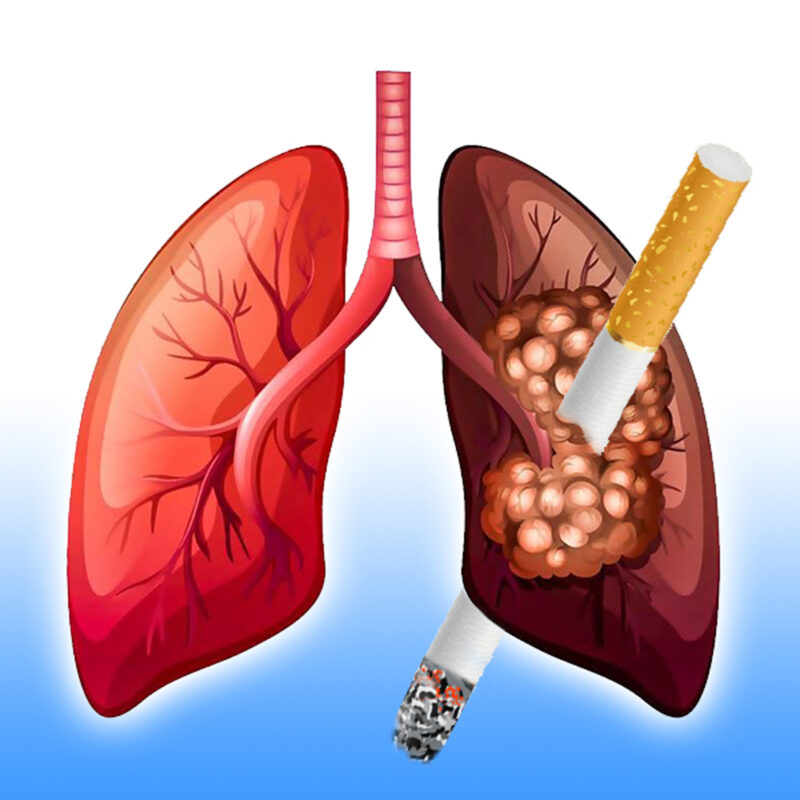
The relationship between lung cancer and smoking is one of the most thoroughly documented in all of medicine. Smoking is responsible for approximately 80 to 85% of all lung cancer cases in the United States — making it by far the single largest preventable cause of cancer death. This association was first documented in landmark 1950 studies by Doll and Hill in the United Kingdom and Wynder and Graham in the United States, and was officially confirmed by the U.S. Surgeon General’s report in 1964.
Despite decades of public health messaging, lung cancer remains the number-one cancer killer in the U.S. — claiming more lives each year than breast, colorectal, and prostate cancer combined. Understanding the precise relationship between lung cancer and smoking — how tobacco damages DNA, how risk accumulates, how quickly risk falls after quitting, and what secondhand smoke does to people who have never smoked — is essential for anyone who smokes, has smoked, or lives with someone who does.
How Smoking Causes Lung Cancer — The Biology
Cigarette smoke contains more than 70 known carcinogens — chemical compounds that directly damage DNA. Understanding how these carcinogens act explains why lung cancer risk increases with every year of continued smoking, and why the damage from smoking does not fully reverse even after decades of abstinence.
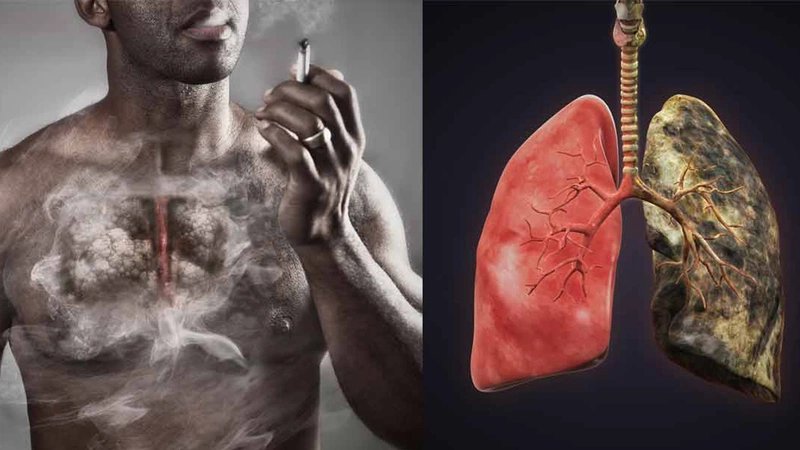
Benzo[a]pyrene (PAH)
Formed by incomplete tobacco combustion. After metabolic activation, benzo[a]pyrene forms covalent DNA adducts at guanine residues — particularly in TP53 and KRAS, the genes most commonly mutated in lung cancer. Among the most studied tobacco carcinogens.
NNK (Tobacco Nitrosamine)
A lung-specific carcinogen formed during tobacco curing and combustion. NNK causes O6-methylguanine adducts that produce G-to-A transition mutations — the signature mutation at KRAS codon 12 in smoking-related lung adenocarcinoma.
Benzene, Formaldehyde, Cadmium
Additional carcinogens in tobacco smoke. Benzene is associated with leukemia and possibly lung cancer. Formaldehyde and acrolein cause direct DNA strand damage. Cadmium (a heavy metal) accumulates in lung tissue and is a Group 1 human carcinogen.
Polonium-210 (Radioactive)
A naturally occurring radioactive isotope in tobacco leaves that emits alpha particles when burned. Alpha particles cause direct ionizing damage to bronchial epithelium — one reason why tobacco is uniquely carcinogenic compared to many other inhaled substances.
Mutation accumulation: Research published in Science in 2016 by Alexandrov and colleagues quantified the mutagenic burden of smoking: each pack-year adds approximately 150 mutations to lung epithelial cells. A 30-pack-year smoker accumulates approximately 4,500 tobacco-attributable mutations. The critical mutations are those in driver genes — TP53, KRAS, RB1, STK11 — that confer growth advantages, triggering clonal expansion and eventually malignant transformation.
Squamous Cell Carcinoma (SCC)
Central, endobronchial location where carcinogens directly contact airway epithelium. Develops through squamous metaplasia → dysplasia → carcinoma in situ → invasion. Strongly associated with heavy smoking; rare in never-smokers.
Small Cell Lung Cancer (SCLC)
~99% occur in smokers. Near-universal TP53 and RB1 mutations; neuroendocrine differentiation; rapidly growing and early-metastasizing. Almost entirely a disease of tobacco exposure.
Adenocarcinoma (Smokers vs. Never-Smokers)
Now the most common histological type in the U.S. Smokers: predominantly KRAS mutations. Never-smokers: EGFR, ALK, or ROS1 alterations — which are targetable with specific drugs. Peripheral location in both groups.
Smoking Dose and Lung Cancer Risk
Lung cancer risk scales with cumulative smoking exposure. The most important factors are:
Duration (Years Smoked)
The strongest predictor. Smoking 1 pack/day for 40 years carries more risk than smoking 2 packs/day for 20 years — despite identical pack-years. Duration is raised to approximately the 4th power in risk models; intensity only the 2nd power.
Cigarettes Per Day
Important but less dominant than duration. Relative risk approximately 3–10× at low pack-years, rising to 20–30× for heavy long-term smokers.
Age at First Cigarette
Starting smoking as an adolescent results in more cumulative lifetime exposure and may confer additional risk beyond pack-years, possibly related to carcinogen exposure during lung development.
Depth of Inhalation
Deep inhalation deposits carcinogens further into the peripheral lung — one factor in the epidemiological shift from squamous cell to adenocarcinoma as the most common lung cancer type.
How Quickly Does Risk Fall After Quitting?
Quitting is the single most important step a smoker can take. Risk falls progressively after cessation — but does NOT return to never-smoker level, because driver mutations and epigenetic changes from carcinogen exposure are permanent.
The permanent residual risk reflects two realities: the key TP53, KRAS, and RB1 mutations acquired from carcinogen exposure remain in lung cells for life; and smoking induces stable epigenetic changes in bronchial epithelial cells that persist for decades. However, the trajectory is always downward after quitting — cessation at any age provides meaningful benefit.
Secondhand Smoke and Lung Cancer
Secondhand Smoke Is a Proven Lung Carcinogen — Not Just an Irritant
The International Agency for Research on Cancer (IARC) classifies secondhand smoke (SHS) as a Group 1 human carcinogen — meaning there is sufficient evidence in humans that it causes cancer. Non-smoking adults who live with a smoker have approximately 20 to 30% increased risk of developing lung cancer compared to those with no SHS exposure.
In the United States, SHS is estimated to cause approximately 7,000 lung cancer deaths per year in non-smokers (CDC/EPA estimates).
Why sidestream smoke is especially dangerous: The smoke emitted from the burning end of a cigarette (sidestream smoke) actually contains higher concentrations of some carcinogens — including NNK and benzo[a]pyrene — than the mainstream smoke inhaled by the smoker, because sidestream smoke burns at lower temperatures and undergoes less complete combustion.
Smoke-free air laws in homes, workplaces, restaurants, and bars have meaningfully reduced SHS-related cancer risk at a population level.
Other Tobacco Products
Cigars and Pipe Tobacco
Cigar and pipe smokers typically inhale less deeply but are not protected. Heavy cigar/pipe smokers have approximately 5–10× the lung cancer risk of never-smokers. The lungs are exposed to carcinogens even without deep inhalation.
Hookah (Water Pipe)
A dangerous misconception: the water does NOT filter carcinogens. A typical 1-hour hookah session delivers smoke equivalent to approximately 100+ cigarettes in carcinogen exposure. Hookah carries substantial lung cancer risk — not a “safe” alternative to cigarettes.
E-cigarettes / Vaping
Long-term lung cancer risk is unknown — insufficient time has passed since widespread adoption. E-cigarettes do contain some carcinogens at lower concentrations. Dual use (vaping + smoking) does not meaningfully reduce cigarette carcinogen exposure. Complete cessation remains the safest option.
Radon — The Second-Leading Cause of Lung Cancer
After smoking, radon is the second-leading cause of lung cancer in the United States — responsible for approximately 21,000 deaths per year (U.S. EPA). Radon is a colorless, odorless, radioactive gas produced by the natural decay of uranium in soil and rock. It seeps into homes through foundation cracks and can accumulate to dangerous concentrations, particularly in basements.
The critical point for smokers: radon and smoking interact synergistically. A smoker living in a high-radon home has a dramatically elevated lung cancer risk — far greater than the sum of either risk alone. Smokers in high-radon environments face the highest lung cancer risk of any identified population group. The EPA recommends testing all homes for radon; affordable mitigation systems can reduce indoor levels to acceptable limits.
Lung Cancer in Never-Smokers
Approximately 15% of U.S. lung cancer cases occur in people who have never smoked. The major causes in never-smokers:
- Radon exposure: The most significant preventable cause in non-smokers; affects anyone in a high-radon environment
- Secondhand smoke: Long-term chronic SHS exposure, particularly in childhood or during years of cohabitation with a heavy smoker
- Occupational carcinogens: Asbestos (particularly synergistic with smoking), arsenic, hexavalent chromium, beryllium, nickel compounds, and diesel exhaust — all Group 1 carcinogens per IARC
- Air pollution (PM2.5): Classified as a Group 1 carcinogen by IARC in 2013; estimated to cause ~200,000 lung cancer deaths worldwide per year
- Genetics: EGFR mutations in adenocarcinoma are more common in Asian women, younger patients, and never-smokers; family history of lung cancer confers elevated risk independent of smoking
- Prior radiation therapy: Mantle radiation for Hodgkin lymphoma; chest radiation for breast cancer — both associated with small but measurable increases in subsequent lung cancer risk
Quitting Smoking to Reduce Lung Cancer Risk
Quitting is the single most effective action available to reduce lung cancer risk. For eligible former or current smokers, combining cessation with lung cancer screening provides both maximum risk reduction (cessation) and the best chance of early detection (LDCT).
Nicotine Replacement Therapy (NRT)
Patches, gums, lozenges, inhaler, nasal spray — available OTC. Reduces withdrawal symptoms by providing nicotine without carcinogens. Approximately doubles quit rates compared to unassisted attempts.
Varenicline (Chantix / Champix)
Prescription partial nicotinic receptor agonist. Most effective single pharmacotherapy — quit rates approximately 20–35% at 6 months. Reduces craving and blocks the pleasurable effects of cigarettes.
Bupropion (Wellbutrin / Zyban)
Prescription antidepressant with anti-craving properties. Quit rates approximately 15–20% at 6 months. An effective option, particularly for smokers with concurrent depression or anxiety.
Counseling + Quitlines
Behavioral counseling combined with pharmacotherapy consistently outperforms either approach alone. Free telephone quitlines available in all U.S. states: 1-800-QUIT-NOW. LDCT screening participants have higher quit rates than non-screened smokers.
Frequently Asked Questions
Can I get lung cancer from social smoking or occasional cigarettes?
Any amount of smoking increases lung cancer risk — there is no proven safe level of tobacco smoke exposure. Risk scales with cumulative exposure: an occasional social smoker with a small number of pack-years has meaningfully less risk than a daily smoker with 30 pack-years. The USPSTF screening threshold of 20 pack-years is set based on where screening benefit outweighs harm — not as a threshold below which cancer becomes impossible.
Does smoking marijuana cause lung cancer?
The evidence is less clear than for tobacco. Marijuana smoke contains many of the same carcinogens as tobacco smoke. However, heavy marijuana smokers typically inhale far fewer exposures per day/year than cigarette smokers, and studies are confounded by concurrent tobacco use. Current evidence is insufficient to definitively establish an independent association, though it cannot be excluded.
I smoked for 10 years and quit 20 years ago — am I still at risk?
Yes, though your risk has dropped substantially. With 10 pack-years and 20 years since cessation, your risk is considerably below a current smoker’s but remains somewhat elevated above never-smoker baseline. With only 10 pack-years, you likely do not meet the USPSTF screening criteria (≥20 pack-years). Discuss your individual risk with your physician.
My parent smoked heavily. Does that increase my lung cancer risk?
Potentially in two ways: first, if you were exposed to significant secondhand smoke during childhood, that exposure is a documented risk factor. Second, family history of lung cancer is associated with a modest independent increase in risk, likely reflecting both shared environmental exposures and possible genetic susceptibility. If you are also a current or former smoker, your combined risk profile warrants discussion with your provider.
Does vaping instead of smoking protect against lung cancer?
The long-term lung cancer impact of vaping is unknown — insufficient time since widespread adoption. E-cigarettes do contain some carcinogens at lower concentrations than combustibles. Complete cessation of all nicotine products remains the best option. If you want to understand the importance of early detection even with a reduced smoking history, see our guide on low dose CT lung cancer screening.
Sources
- U.S. Surgeon General — The Health Consequences of Smoking: 50 Years of Progress; 2014
- Alexandrov LB et al. — Mutational signatures associated with tobacco smoking in human cancer; Science 2016;354(6312):618–622
- Doll R, Hill AB — Smoking and carcinoma of the lung; BMJ 1950;2(4682):739–748
- American Cancer Society — Lung cancer risk factors
- IARC — Tobacco Smoke and Involuntary Smoking; IARC Monographs Vol. 83; 2004
- U.S. EPA — Health Risk of Radon; EPA 402/K-15/001
Related reading: Lung cancer symptoms | Lung cancer screening — who qualifies | Low dose CT lung cancer screening

As someone dealing with this personally, the lung cancer and smoking: risk, mechanisms, section was very helpful. The practical tips at the end made this immediately actionable, not just theoretical. Keep up this kind of thorough health journalism — it genuinely helps patients like me.

Thank you for covering lung cancer and smoking: risk, mechanisms, so thoroughly without being overly technical. The section on managing this condition day-to-day was especially useful for meal planning. Exactly the kind of evidence-based information that is hard to find in one place.

This is one of the clearest explanations of lung cancer and smoking: risk, mechanisms, I have found. I have tried following advice from several sources but this is most consistent with what my specialist told me. Exactly the kind of evidence-based information that is hard to find in one place.

I never fully understood lung cancer and smoking: risk, mechanisms, until I read this. What I liked most was that the article didn’t just say what to avoid — it also gave alternatives. This gave me real confidence going into my next specialist appointment.
As someone dealing with this personally, the lung cancer and smoking: risk, mechanisms, section was very helpful. I especially valued the explanation of why these recommendations exist, not just what they are. This is exactly why I prefer this website over generic health platforms.