The decade around age 50 is the most consequential turning point for musculoskeletal health. Muscle loss accelerates, hormone shifts begin their impact on bone density, and the cumulative effects of decades of physical activity — or inactivity — begin to manifest as joint pain, reduced function, and increased falls risk. Yet resistance training after age 50 is among the most effective interventions available at precisely this life stage: research consistently shows that older adults achieve muscle strength and mass gains comparable, as a percentage, to those in younger people, and the consequences of not training — progressive sarcopenia, fracture risk, metabolic dysfunction — are directly reversible through progressive resistance exercise. The decision about whether to begin resistance training is not really a question of whether you are “too old.” Research involving participants in their eighties and nineties confirms that it is never too late to start.
Why Muscle Loss After 50 Is a Health Emergency
The loss of muscle mass with ageing — sarcopenia — is among the most underrecognised and clinically significant changes in the body after midlife. From around age 35, adults lose approximately 1% of lean muscle mass per year in the absence of resistance training. From 50, this loss accelerates. Muscle strength declines faster than mass — at approximately 3% per year — because the largest, most forceful type II (fast-twitch) muscle fibres are selectively lost. By age 70, many untrained people have lost 30–40% of the peak muscle mass they had in early adulthood.
The clinical consequences of this loss are substantial and interconnected. Reduced quadriceps strength allows more force to reach the cartilage surface of the knee with each step, accelerating OA progression. Reduced hip abductor strength causes the Trendelenburg gait pattern that increases hip joint loading and falls risk. Reduced grip strength — a proxy for whole-body muscle health — is one of the strongest predictors of all-cause mortality in middle-aged and older adults. Sarcopenic people have higher rates of insulin resistance, metabolic syndrome, and cardiovascular disease, independent of body composition. They fall more often, fracture more severely, and recover from illness and surgery more slowly.
The good news — the piece of information that is not widely known — is that sarcopenia is not inevitable and not irreversible. Skeletal muscle retains its capacity for hypertrophy and strength gain at any age. Studies of resistance training in people aged 60, 70, 80, and 90 consistently show significant strength and muscle mass gains within 8–16 weeks of progressive resistance exercise. The magnitude of percentage gain is comparable to that achieved by younger adults following the same programme. The muscle does not “forget” how to grow — it simply stops receiving the stimulus it needs.
How Resistance Training Changes After Age 50
While the fundamental principles of resistance training — progressive overload, specificity, recovery — remain the same at any age, several adaptations in how training is structured and executed are important for over 50s.
Recovery takes longer. Muscle repair and adaptation after a resistance training session takes 48–72 hours in older adults, compared with 48 hours in younger adults. This means that sessions targeting the same muscle group should be separated by at least 48 hours — and often 72 hours is more appropriate, particularly in the first months of training. Two well-structured sessions per week, spread across the week, is both evidence-based and appropriately paced for most people starting resistance training after 50.
Connective tissue adapts more slowly than muscle. Tendons and ligaments strengthen with training but lag behind muscle adaptation. Older tendons are less compliant and more susceptible to overload injuries if training load is increased too rapidly. This is why load progression after 50 should be more conservative — 5% increases in load per week are more appropriate than the 10% that might be suitable for younger adults. The body’s signal to increase load is the same: when the last 2 repetitions of a set become comfortably achievable, increase load — but do it incrementally.
Warming up is not optional. At 50+, joints are meaningfully stiffer at the start of activity than they were at 30. A 10–15 minute warm-up of gentle aerobic movement (slow cycling, easy walking) followed by joint-specific range-of-motion exercises before loading is not a luxurious preamble — it is an injury prevention measure. Cold tendon and cartilage tissue tolerate load less well than warmed tissue. The warm-up also provides an opportunity to assess how the joints feel that day and to modify the session accordingly.
Technique matters more, not less. As the body’s capacity to tolerate poor movement patterns under load decreases with age, the risk of injury from lifting with poor form increases. Prioritising technique — learning movement patterns correctly before adding load — is the most important investment a beginner over 50 can make. A session or two with a qualified personal trainer or physiotherapist to establish correct form for the squat, hinge, press, and row patterns is worth the cost.
The Best Resistance Exercises for Over 50s
The most valuable exercises for older adults are those that build the muscle groups most important for joint protection, functional independence, and falls prevention — and that can be performed safely across a range of ability levels.
Chair squat → goblet squat → barbell squat. The squat pattern (knees bend as hips lower) is the single most functional movement for lower limb independence. Chair squats (sitting and standing from a chair) build quadriceps, gluteals, and hip muscles in a controlled, safe pattern. As strength improves, holding a dumbbell or weight at the chest (goblet squat) adds load without requiring a barbell. The full barbell back squat is the most loaded version but not necessary — a strong goblet squat provides excellent training stimulus for most older adults’ needs.
Hip hinge (Romanian deadlift). The hip hinge — bending forward from the hips while keeping the back neutral, then driving back to upright — trains the posterior chain: gluteals, hamstrings, and lower back extensors. These muscles are critical for rising from a chair, picking things up from the floor, and climbing stairs. Poor posterior chain strength is one of the primary contributors to both lower back pain and falls. Starting with a bodyweight hinge and progressing to a light dumbbell deadlift (or kettlebell) builds these muscles safely.
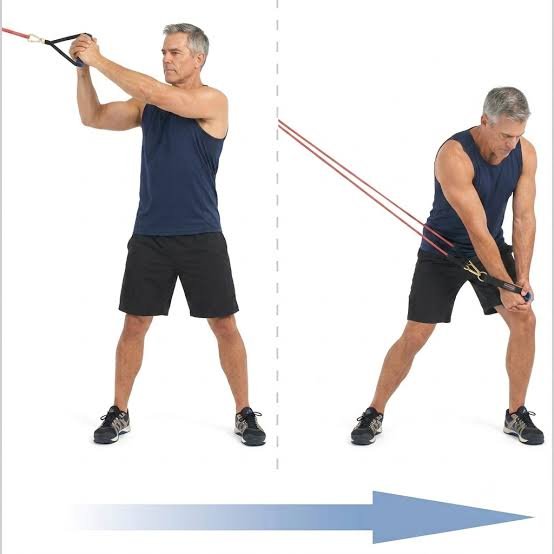
Seated cable row or resistance band row. Pulling movements — rows — train the mid-back muscles (rhomboids, trapezius, rear deltoids) that maintain upright posture and counteract the forward-flexed, kyphotic posture that develops with age. These muscles are particularly important in people with osteoporosis (where thoracic kyphosis from vertebral compression fractures further rounds the back) and in ankylosing spondylitis. Resistance bands allow effective rowing from a chair with no equipment cost.
Press-up (wall, incline, or floor). Pushing movements train the chest (pectoralis major), anterior shoulders, and triceps. Wall press-ups are the appropriate starting point for many people over 50 returning to upper body training; progressing to incline (hands on a bench or step) and then floor press-ups as strength improves. These movements also engage core stability and shoulder girdle stabilisers.
Single-leg exercises (split squat, lunge). Single-leg movements simultaneously build strength and balance — two of the most important physical capacities for older adults. A split squat (one foot forward, one back, lowering the rear knee toward the floor) is challenging for most beginners and can be modified by reducing the range of motion and holding a support. Single-leg exercises are more directly functional than bilateral squats because most daily activities — walking, stair climbing — involve loading each leg independently.

Resistance Training and Bone Density
Bone mineral density (BMD) peaks in early adulthood and then declines progressively with age, accelerating significantly at menopause in women due to oestrogen withdrawal. By the time osteoporosis is diagnosed on a DEXA scan, substantial bone has already been lost. Resistance training is one of the most effective interventions available to slow this decline and, in some cases, reverse it.
The mechanism is the mechanostat — the bone’s response to mechanical loading. When muscle contracts forcefully against a load, it pulls on the bone at the muscle attachment sites. This tensile stress signals osteoblasts (bone-forming cells) to increase bone formation at those sites, increasing local bone density. The stimulus is site-specific: hip exercises build hip bone density; spine loading exercises (overhead press, deadlift) build spinal bone density — the two sites most important for fracture prevention in osteoporosis.
The LIFTMOR (Lifting Intervention for Training Muscle and Osteoporosis Rehabilitation) trial, conducted by Watson and colleagues in post-menopausal women with low bone mass, is the most important recent evidence in this area. It demonstrated that high-intensity progressive resistance training (back squat, deadlift, overhead press) plus impact exercises (jumping chin-ups) significantly increased lumbar spine BMD (+2.9%) and femoral neck BMD (+0.3%) compared with a low-intensity control group, without causing fractures. This was a landmark finding: it showed that high-intensity loading is safe in women with osteoporosis or osteopenia when properly supervised, and produces meaningful BMD improvements.
For people with established osteoporosis, starting with a supervised programme is strongly recommended. The Royal Osteoporosis Society (ROS) provides condition-specific exercise guidance and is working to expand access to supervised strength programmes based on the LIFTMOR model. A DEXA scan result showing low bone density is not a contraindication to resistance training — it is a reason to begin. Our article on vitamin D test and bone health covers the medical monitoring and supplementation context for managing bone density alongside exercise.
Training with Joint Conditions
The presence of osteoarthritis or inflammatory arthritis is not a contraindication to resistance training — it is a reason to do it. Multiple RCTs confirm the safety and efficacy of progressive resistance training in knee OA, hip OA, and RA at any stage. The approach is adapted to work around painful joints rather than avoiding resistance training entirely.
For knee OA, quadriceps strengthening is the primary target. Chair squats performed to whatever depth is comfortable (not necessarily 90 degrees), straight leg raises, and light cycling are effective first-stage exercises. Hip abductor exercises (side-lying leg raises, resistance band hip abduction) reduce valgus knee stress. As strength builds, the range of motion can be gradually increased and load added. Pain during exercise that settles within 24 hours is generally acceptable — a sign of muscle adaptation rather than joint damage.
For rheumatoid arthritis, the Häkkinen trials (2001, 2004) established that progressive resistance training is safe in RA regardless of disease activity, does not worsen synovitis on imaging, and produces significant strength improvements. The programme is modified during flares: rest the actively inflamed joint, exercise unaffected muscle groups. Between flares, progressive resistance exercise of all major muscle groups is appropriate and recommended. See our guide on how doctors diagnose arthritis for the clinical assessment context.
Common Mistakes Over 50s Make
Starting too heavy. The most common cause of early setback. The ego (or impatience) pushes for more weight than the connective tissue can safely handle in the first weeks. The guideline is clear: start lighter than you think you need to, for longer than you think you need to. The first 4–6 weeks of training are about learning movement patterns and allowing connective tissue to begin adapting — not about maximising load.
Avoiding compound movements. Many older beginners default to machine-based isolation exercises (leg extension, bicep curl) because they feel safer. While these are not harmful, they miss the most valuable training stimulus — multi-joint compound movements (squat, hinge, row, press) that train multiple muscle groups simultaneously and are directly functional. A well-coached goblet squat or hip hinge provides far more value than a leg extension machine.
Neglecting the posterior chain. The muscles of the back, gluteals, and hamstrings are consistently undertrained in older adults who focus on the muscles they can see (chest, biceps). The posterior chain is critical for back pain prevention, hip stability, fall prevention, and joint protection. Including at least one pulling exercise (row) and one hip extension exercise (hip hinge or bridge) in every session addresses this imbalance.
Insufficient protein. Muscle protein synthesis after resistance training in older adults requires adequate dietary protein. Younger adults can build muscle on relatively lower protein intakes; older adults experience “anabolic resistance” — a blunting of the muscle growth signal — that makes higher protein intake necessary to achieve the same response. Current evidence supports approximately 1.2–1.6 g of protein per kg of body weight per day for active adults over 50, compared with the RDA of 0.8 g/kg/day which was set for sedentary populations. Distributing protein across meals (20–30 g per meal) rather than concentrating it in one large serving is particularly important for maximising muscle protein synthesis in older adults.
Protein and Recovery After 50
Protein deserves its own section because inadequate protein is one of the most common and consequential nutritional mistakes that undermines resistance training outcomes in older adults. The muscle’s response to the training stimulus depends on amino acids — the building blocks of muscle protein — being available in the bloodstream during the hours following exercise.
Animal proteins (meat, fish, eggs, dairy) provide all essential amino acids in the proportions needed for muscle protein synthesis. Plant proteins (legumes, soy, tofu, tempeh, pea protein) can meet requirements but typically require larger quantities and more dietary planning to achieve a full essential amino acid profile. Leucine is the amino acid most important for triggering muscle protein synthesis; foods with high leucine content include whey protein, eggs, milk, chicken, and soy.
Practical targets for a 70 kg active adult over 50 aiming for 1.4 g/kg/day: 98 g of protein per day. Spread across three meals, that is approximately 33 g per meal — achievable from a 120 g chicken breast (35g), two eggs plus 200 g Greek yogurt (30g), or 150 g tinned salmon (35g). A post-exercise protein source within 1–2 hours of training — a glass of milk, a small chicken breast, or a protein shake — is particularly effective for maximising the training adaptation.
Frequently Asked Questions
Is it safe to start resistance training after 50 with no experience?
Yes — and it is strongly recommended. Starting with bodyweight exercises (chair squats, wall press-ups, bridges) allows learning correct movement patterns before adding load. The most valuable investment is one or two sessions with a qualified personal trainer or physiotherapist to establish correct technique for the key movement patterns (squat, hinge, row, press). Starting conservatively and progressing gradually are the key safety principles. Existing health conditions (cardiovascular disease, osteoporosis, joint replacement) warrant a GP check before beginning vigorous exercise but rarely contraindicate resistance training altogether.
How many times per week should I do resistance training after 50?
The NHS recommends a minimum of two muscle-strengthening sessions per week. For over 50s, this is also the sweet spot — two well-structured sessions allow adequate recovery (48–72 hours between sessions targeting the same muscles) while providing sufficient training stimulus for meaningful strength and muscle gains. Three sessions per week provides additional benefit for those who adapt well and recover adequately. Training the same muscles every day is not appropriate at any age and counterproductive after 50.
Can resistance training help with arthritis pain after 50?
Yes — consistently. Multiple RCTs in knee OA, hip OA, and RA demonstrate that progressive resistance training significantly reduces pain and improves function, regardless of age. The mechanism is clear: stronger muscles around affected joints absorb more force before it reaches the cartilage and bone, reducing the pain-generating mechanical stress. The evidence for resistance training in OA specifically is covered in our guide on strength training for bones and muscles.
Will resistance training help me lose weight after 50?
Resistance training contributes to weight management by building muscle mass, which increases resting metabolic rate (muscle is metabolically more active than fat at rest). It also improves insulin sensitivity, which helps regulate blood sugar and reduce metabolic fat accumulation. However, resistance training’s primary role is body composition improvement — increasing muscle and reducing fat — rather than weight loss per se. For joint health, the most important weight effect is reducing the load on the knee joint: every kilogram lost reduces knee loading by approximately 4 kg per step.
Do I need a gym for resistance training after 50?
No. Bodyweight exercises (chair squats, press-ups, bridges, step-ups) and resistance bands (£10–20 for a full set) provide an effective resistance training programme at home. Gyms offer more variety and the ability to increase load precisely, but are not necessary, particularly in the first 6–12 months. A set of two dumbbells — one light pair and one medium pair — expands the home programme significantly for approximately £30–60 and fits easily in a small space.
How long before I see results from resistance training after 50?
Early strength improvements (weeks 2–4) are primarily neural — the nervous system learns to recruit muscle fibres more efficiently without any change in muscle size. Measurable strength gains are typically evident within 4–6 weeks. Visible increases in muscle mass are noticeable at 8–12 weeks with consistent twice-weekly training and adequate protein. Pain reduction in OA typically reaches clinical significance by 8–12 weeks. These timelines require consistency — two sessions per week, every week — rather than sporadic intense efforts.
Is it safe to do resistance training with osteoporosis?
Yes — with appropriate guidance, progressive resistance training is not only safe but specifically recommended for osteoporosis. The LIFTMOR trial demonstrated that high-intensity resistance training is safe in post-menopausal women with osteoporosis or osteopenia and produces meaningful improvements in bone mineral density. For people with established severe osteoporosis, a supervised programme with a physiotherapist experienced in bone health is recommended before training independently. The Royal Osteoporosis Society provides detailed exercise guidance including resistance training recommendations. Avoid heavy forward flexion under load (e.g., deadlifts with poor form) if vertebral fracture is present — a physiotherapist will advise on specific modifications.
Key Takeaways
Resistance training after age 50 is one of the most evidence-supported interventions for reversing sarcopenia, protecting joints from OA progression, building the bone density that prevents fractures, reducing cardiovascular risk, and maintaining the functional independence that quality of life depends on. Older adults achieve strength and muscle gains comparable to younger people. Training differs after 50 in its pacing — longer recovery, more conservative progression, more thorough warm-up — but not in its fundamental principles. Start with bodyweight and resistance bands, master technique before adding load, train two to three times per week with adequate recovery, and consume sufficient protein (1.2–1.6 g/kg/day). For the broader exercise programme, see our guides on exercise for joint health, walking and joint health, and balance training and fall prevention. For bone health monitoring alongside resistance training, our article on vitamin D test and bone health covers the relevant investigations.
References and Further Reading
- National Institute for Health and Care Excellence. Osteoarthritis in over 16s: diagnosis and management. NG226, 2022.
- Watson SL et al. High-intensity resistance and impact training improves bone mineral density and physical function in postmenopausal women with osteoporosis and osteopenia: the LIFTMOR randomized controlled trial. Journal of Bone and Mineral Research 2018;33(2):211–20.
- Royal Osteoporosis Society. Exercise for bones — Royal Osteoporosis Society guidance.
- NHS. Strength and flexibility exercises — NHS Live Well.
- Versus Arthritis. Strengthening exercises for arthritis — Versus Arthritis.
- Häkkinen A et al. A randomized two-year study of dynamic strength training in early rheumatoid arthritis. Arthritis & Rheumatism 2001;44(3):515–22.
- Borst SE. Interventions for sarcopenia and muscle weakness in older people. Age and Ageing 2004;33(6):548–55.
Disclaimer: This article is for educational purposes only and does not constitute medical advice. Consult a GP before beginning vigorous resistance training if you have established cardiovascular disease, severe osteoporosis, recent joint replacement, or any condition for which exercise may need to be specifically modified.
I am 62 and was diagnosed with osteopenia two years ago. My GP told me to do weight-bearing exercise but didn’t elaborate and I had assumed that meant walking. Reading about the LIFTMOR trial – that high-intensity resistance training actually increased bone density in women with osteoporosis, not just slowed the decline – was genuinely surprising to me. I have started with chair squats and resistance band rows at home and have booked an appointment with a physiotherapist to get my technique checked. Thank you for actually explaining the evidence rather than just saying ‘exercise more’.
Barbara – the LIFTMOR finding genuinely was surprising to many clinicians as well as patients, because the intuitive concern had always been that high-intensity loading in osteoporosis might cause fractures rather than prevent them. The evidence reversed that assumption. The combination of having your technique checked by a physiotherapist and starting with the home-based exercises you’ve described is exactly the right approach – building the movement patterns correctly first, then adding load progressively. Osteopenia is the ideal stage to intervene with resistance training because the bone loss is still meaningful but not yet at the point where fractures become likely with normal activity.
The protein section was news to me. I had no idea that protein requirements actually increase as you get older rather than decrease. I have been eating the same diet I ate at 35 but I am now 58 and apparently need considerably more protein to support the same muscle response. I have started adding an egg to breakfast and a glass of milk after training. Seems simple but apparently it makes a real difference to whether the training actually produces results.