

A hoarse voice is one of the most common symptoms in medicine, and most of the time it means nothing more than a viral infection or a day of too much talking. Acute laryngitis resolves on its own within one to two weeks, and for most people, that is the end of it.
But there is a clinical rule that every physician and every patient should know: hoarseness that persists beyond three weeks — especially in a current or former smoker, or in anyone over the age of 45 to 50 — requires laryngoscopy to rule out malignancy. This is not an overly cautious precaution. It is one of the most established alarm-symptom rules in head and neck medicine, endorsed by both the American Academy of Otolaryngology and UK NICE guidelines, because the cancers that cause persistent hoarseness are frequently curable when caught early and often lethal when found late.
Hoarseness can signal a primary tumor on the vocal cords — laryngeal cancer — or it can reflect damage to the recurrent laryngeal nerve from a tumor in the lung, thyroid, or mediastinum. A tumor in the chest can change your voice without ever touching your throat. Early-stage laryngeal cancer carries a 5-year survival rate exceeding 85%. Advanced-stage disease falls below 40%.
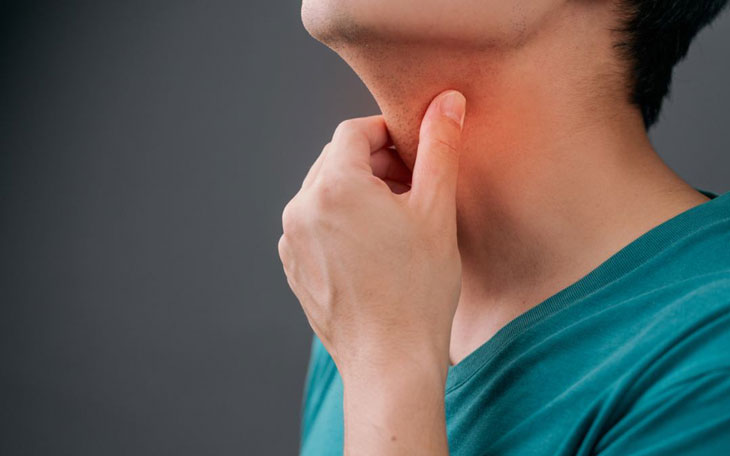
What Hoarseness Actually Means
Hoarseness — the medical term is dysphonia — refers to any abnormal change in voice quality: a voice that sounds raspy, rough, breathy, strained, or lower in pitch than usual. Normal voice production depends on the two vocal cords vibrating symmetrically with every exhaled breath. Any disruption to their structure, movement, or contact produces an audible change.
That disruption comes from one of two fundamentally different sources:
- Primary laryngeal pathology — a tumor, inflammation, nodule, or polyp directly affecting the vocal cord surface or the joint controlling cord movement
- Extrinsic nerve damage — the recurrent laryngeal nerve (RLN), which carries the motor signal to the vocal cord muscles, is compressed or invaded by a tumor somewhere along its long course through the neck and chest. The cord does not move because the nerve signal cannot reach it — not because the cord itself is diseased. This is vocal cord paralysis.
Understanding this distinction matters because vocal cord paralysis from a distant tumor requires entirely different imaging than a primary laryngeal lesion. The practical question: how long has the hoarseness been present, and is it getting worse?
Laryngeal Cancer: The Most Direct Cause
Laryngeal cancer is the malignancy most directly associated with hoarseness. Approximately 12,620 Americans are diagnosed each year, and approximately 3,770 die from it. That mortality figure obscures a critical fact: when laryngeal cancer is found early, it is among the most curable cancers in existence.
About 95% of laryngeal cancers are squamous cell carcinoma. The disease is four times more common in men than women, with peak incidence between 55 and 74 years.
| Subtype | Location | Hoarseness Timing & Prognosis |
|---|---|---|
| Glottic | True vocal cords | Early — 2–3mm tumor on cord → immediate voice change. Best prognosis: >90% local control at Stage I |
| Supraglottic | Epiglottis, aryepiglottic folds | Late — hoarseness appears only when cords involved. Presents with dysphagia + referred ear pain first. Worse prognosis |
| Subglottic | Below vocal cords | Late — causes airway obstruction before hoarseness. Rarest; poorest prognosis |
The clinical lesson: for glottic cancer, hoarseness is not just a symptom — it is a biological early warning system. Even a tiny tumor on the cord cannot grow in silence.
Risk Factors
- Tobacco smoking: attributed to ~85% of laryngeal cancer cases; 5–10× increased risk
- Heavy alcohol: ~2–3× increased risk independently; combined with tobacco: up to 30× increased risk
- HPV-16: identified in a subset of laryngeal SCC
- Laryngopharyngeal reflux (LPR): chronic acid exposure contributes to laryngeal irritation
- Male sex: 4× more common; Age >50
- Occupational exposures: asbestos, wood dust, paint fumes
Staging and Survival
| Stage | Description | 5-yr Survival |
|---|---|---|
| I | Tumor limited to subsite, normal cord mobility | ~85% |
| II | Extends to adjacent subsite or impairs cord mobility | ~70–75% |
| III | Fixed vocal cord or limited laryngeal invasion | ~55% |
| IVA | Invades through thyroid cartilage | ~40% |
| IVB/IVC | Unresectable or distant metastasis | <30% |
The RLN Pathway: When Hoarseness Signals Something Far Away
One of the most important but underappreciated causes of hoarseness is injury to the recurrent laryngeal nerve (RLN) by a tumor that has nothing to do with the larynx. A lung tumor in the chest can paralyze a vocal cord in the throat — and the anatomy explains exactly why.
The left RLN branches from the vagus nerve at the level of the aortic arch, loops underneath it in the mediastinum, then ascends through the tracheoesophageal groove to reach the larynx. This long intrathoracic course makes it vulnerable to any left-sided lung tumor, hilar lymph node, or mediastinal mass.
The right RLN branches at the right subclavian artery — shorter course, mainly upper chest and neck — vulnerable to right-sided Pancoast tumors, upper mediastinal lymphadenopathy, and thyroid disease.
When either nerve is damaged, the corresponding vocal cord becomes paralyzed — fixed in a position where it cannot close properly. The result is unilateral vocal cord paralysis (UVCP): a breathy, weak, airy voice, an ineffective cough, and sometimes aspiration of liquids when swallowing.
Approximately 25–30% of unilateral vocal cord paralysis in adults is caused by malignancy, and lung cancer is the most common malignant cause — not laryngeal cancer. Any new UVCP without an obvious benign explanation requires CT from the skull base to the diaphragm to trace the entire anatomical course of both RLNs.
Other Cancers That Cause Hoarseness
Thyroid Cancer
Invasive thyroid cancer extending beyond the capsule can directly invade the RLN. In AJCC staging, RLN invasion constitutes T4a disease — a significant upstaging finding. Any thyroid nodule accompanied by hoarseness requires urgent laryngoscopy and cross-sectional imaging. The hoarseness is evidence that the tumor has already escaped the thyroid.
Hypopharyngeal and Esophageal Cancer
Hypopharyngeal SCC grows adjacent to the larynx — presenting with dysphagia first, then hoarseness when the larynx is directly invaded or the RLN compressed. Upper esophageal cancer can invade the posterior larynx directly; mid-esophageal tumors with mediastinal spread can compress the left RLN. The combination of progressive dysphagia + hoarseness together always warrants evaluation of both structures.
Mediastinal Lymphoma
Hodgkin lymphoma with bulky mediastinal disease can compress the left RLN. The clinical picture is distinctive: hoarseness + B symptoms (fever, drenching night sweats, unexplained weight loss) + rapidly enlarging mediastinal or supraclavicular nodes.
Alarm Symptoms: When Hoarseness Cannot Wait
- Hoarseness persisting beyond 3 weeks in a current or former smoker
- Hoarseness persisting beyond 3 weeks in anyone older than 45–50
- Hoarseness + visible or palpable neck mass
- Hoarseness + hemoptysis (coughing blood)
- Hoarseness + progressive difficulty swallowing
- Hoarseness + unexplained weight loss ≥5% over 6 months
- Hoarseness + referred ear pain (otalgia without ear infection)
- Hoarseness + night sweats and fever
- Hoarseness + stridor (high-pitched breathing sound) — potential airway obstruction
- Breathy, airy, weak voice — cord is not closing against its partner
- Bovine cough — an ineffective, low-pressure cough
- Aspiration of thin liquids when swallowing
- Diplophonia (a two-toned, double-quality voice)
The Diagnostic Pathway
Flexible nasolaryngoscopy is the essential first step — an outpatient procedure taking 3–5 minutes. A thin fiber-optic scope passes through the anesthetized nostril and is positioned above the larynx. The clinician immediately sees whether the cords are moving normally (primary laryngeal lesion) or whether one is paralyzed (nerve injury from a distant source). This single finding directs the entire subsequent workup.
Microlaryngoscopy under general anesthesia follows when a mucosal lesion requires biopsy — a rigid laryngoscope passed through the mouth for detailed visualization and tissue sampling under magnification.
CT of the neck and chest assesses cartilage invasion, cervical lymphadenopathy, and pulmonary masses. For vocal cord paralysis: CT from the skull base to the diaphragm covers the entire anatomical course of both RLNs.
PET-CT stages confirmed laryngeal cancer and identifies occult primary tumors. Thyroid ultrasound and FNA when thyroid pathology is suspected. Upper endoscopy if dysphagia accompanies hoarseness.
Treatment: How Laryngeal Cancer Is Managed
Early glottic (Tis–T1a): Two approaches achieve equivalent cure rates exceeding 90% with excellent voice preservation: CO2 laser excision (transoral laser microsurgery) — precise, outpatient, minimal surrounding tissue damage; or Radiotherapy (5–6 weeks) — preferred when endoscopic excision is not feasible or when voice quality is the priority.
T1b–T2 glottic: Radiotherapy remains the organ-preservation standard.
T3 laryngeal cancer: The landmark RTOG 91-11 trial established concurrent cisplatin + radiation as the standard for larynx preservation in Stage III disease — superior to induction chemotherapy followed by radiation, without sacrificing survival. This trial preserved the ability of many patients to keep their own voices.
T4a / advanced disease: Total laryngectomy + adjuvant radiation ± cisplatin. Voice is restored through a tracheoesophageal puncture (TEP) prosthesis — a small one-way valve that redirects exhaled air into the esophagus to produce speech — or through esophageal speech or an electrolarynx.
Recurrent/metastatic: Pembrolizumab (KEYNOTE-048) improved overall survival vs. standard chemotherapy for recurrent/metastatic head and neck SCC with high PD-L1 expression. Nivolumab (CheckMate 141) demonstrated benefit as second-line therapy.
Benign Causes: The Vast Majority of Hoarseness
Most hoarseness is not cancer. The crucial distinguishing feature is behavior over time: benign causes fluctuate, worsen with voice use, or resolve spontaneously; malignancy produces persistent, progressive hoarseness that does not improve with rest or time.
- Acute infectious laryngitis: Most common cause overall. Viral; resolves in 1–2 weeks. If it does not resolve, evaluation is warranted.
- Voice overuse: Teachers, singers, coaches. Worse at end of day; better after voice rest. Same pattern for months to years — not progressively worsening.
- Vocal cord nodules: Bilateral, symmetric thickenings at the point of maximum cord vibration. Respond to voice therapy; not premalignant.
- Laryngopharyngeal reflux (LPR): Acid reaching the larynx → morning hoarseness, throat clearing, globus sensation. Responds to PPI therapy.
- Hypothyroidism: Myxedematous infiltration of cord mucosa. Accompanied by fatigue, weight gain, cold intolerance, bradycardia. TSH diagnoses it.
The cancer pattern: a single continuous decline in voice quality over weeks to months, without fluctuation, without improvement on rest or after infection clears.
Frequently Asked Questions
How long can hoarseness last before I need to worry?
For most adults, hoarseness from a cold or voice overuse resolves within one to two weeks. If it persists beyond three weeks — particularly in a smoker or anyone over 50 — a laryngoscopy is indicated. Don’t wait past that threshold expecting it to resolve on its own.
Can a cold cause hoarseness that lasts several weeks?
Viral laryngitis typically resolves in 7–14 days. Hoarseness persisting beyond two weeks after a respiratory infection warrants evaluation. Post-viral inflammation can occasionally prolong recovery, but three weeks without improvement requires laryngoscopy to be safe.
Does hoarseness from lung cancer feel different from ordinary hoarseness?
The voice quality from vocal cord paralysis (caused by lung cancer compressing the RLN) is characteristically breathy and weak — an airy, effortful sound with a weak cough. Ordinary laryngitis tends to be rough and raspy. But voice quality alone cannot reliably distinguish benign from malignant causes — only laryngoscopy can.
Is hoarseness always caused by something in the throat?
No — and this is one of the most important points in this article. Hoarseness from vocal cord paralysis can originate entirely from a tumor in the chest — lung cancer, mediastinal lymphoma — without the larynx itself being involved at all. This is why CT imaging from the skull base to the diaphragm is standard when vocal cord paralysis is found on laryngoscopy.
What does a laryngoscopy feel like?
Flexible nasolaryngoscopy is an outpatient procedure taking 3–5 minutes. Local anesthetic spray is applied to the nasal passage. A thin, flexible scope passes through the nose — slightly uncomfortable but not painful. The procedure is well tolerated by most patients and provides immediate results about cord structure and movement.
What is a TEP prosthesis after laryngectomy?
A tracheoesophageal puncture (TEP) prosthesis is a small, one-way silicone valve inserted between the trachea and esophagus after total laryngectomy. When the patient covers their tracheostoma and exhales, air is redirected through the valve into the esophagus, causing its walls to vibrate and produce sound — which the mouth shapes into speech. Most patients can communicate effectively within weeks of surgery. It is the most natural-sounding voice restoration option after laryngectomy.
The Bottom Line
Hoarseness is one of the most useful early warning symptoms in cancer medicine — at least for glottic laryngeal cancer, where a tumor the size of a grain of rice changes the voice enough that the patient notices within days. That early symptom is biologically important: glottic cancer caught at Stage I is curable in the vast majority of cases.
The three-week rule exists because that advantage disappears when the disease is found late. A laryngoscopy is not a painful procedure — it takes minutes, is done in the office, and provides immediate information. If your voice has been changed for more than three weeks — and especially if you smoke, or ever did — that conversation with a doctor cannot wait.
This article is for educational purposes only and does not constitute medical advice. Persistent hoarseness lasting more than three weeks requires evaluation by a physician or otolaryngologist. Do not delay seeking medical care based on information in this article.
- American Cancer Society. Cancer Facts & Figures 2024.
- NCCN Guidelines: Head and Neck Cancers. Version 2.2024.
- Forastiere AA, et al. (RTOG 91-11). Concurrent chemotherapy and radiotherapy for organ preservation in advanced laryngeal cancer. NEJM. 2003.
- Burtness B, et al. (KEYNOTE-048). Pembrolizumab for recurrent/metastatic HNSCC. Lancet. 2019.
- Ferris RL, et al. (CheckMate 141). Nivolumab for recurrent HNSCC. NEJM. 2016.
- Myssiorek D. Recurrent laryngeal nerve paralysis: anatomy and etiology. Otolaryngol Clin North Am. 2004.
- AAO-HNS Clinical Practice Guideline: Hoarseness (Dysphonia). Otolaryngol Head Neck Surg. 2018.
- NICE Guidelines NG12: Suspected cancer — recognition and referral. 2023.
As someone dealing with this personally, the hoarseness and cancer: what a changed section was very helpful. I have tried following advice from several sources but this is the most consistent with what my specialist told me. Thank you for making complex medical information accessible without dumbing it down.
As someone dealing with this personally, the hoarseness and cancer: what a changed section was very helpful. I especially valued the explanation of why these recommendations exist, not just what they are. Looking forward to reading more articles from this website.
Bookmarked this article on hoarseness and cancer: what a changed immediately — going to reference it regularly. It is refreshing to see an article that acknowledges individual variation rather than giving one-size-fits-all advice. Thank you for making complex medical information accessible without dumbing it down.
I shared this article on hoarseness and cancer: what a changed with my doctor and they appreciated the level of detail. This is the kind of evidence-based writing that actually changes how people approach their health. Shared this with three friends who are dealing with related issues. Very useful resource.
This is one of the clearest explanations of hoarseness and cancer: what a changed I have found. The practical tips made this immediately actionable, not just theoretical. This is exactly why I prefer this website over generic health platforms.
This breakdown of hoarseness and cancer: what a changed is exactly what patients need before a specialist appointment. What I liked most was that the article didn’t just say what to avoid — it also gave alternatives. Thank you for making complex medical information accessible without dumbing it down.