

Ovarian Cancer Bloating: The Most Commonly Reported Symptom
Ovarian cancer bloating is the single most commonly reported symptom in women who are ultimately diagnosed with ovarian cancer — present in approximately 72% of cases in the landmark Goff et al. 2007 study that established the ovarian cancer symptom index. Yet bloating is also one of the most common symptoms in the general population, experienced episodically by nearly everyone at some point. The result is a diagnostic paradox: the most common early warning sign of ovarian cancer is also one of the most commonly attributed to benign, functional causes.
Understanding what distinguishes ovarian cancer bloating from ordinary, benign bloating is essential for both patients and clinicians. The difference does not lie in the symptom itself — the sensation of abdominal fullness and distension is similar regardless of cause — but in its pattern: how frequently it occurs, whether it is new and different from prior experience, whether it is progressive, and whether it responds to the usual interventions that relieve benign bloating.
What Makes Ovarian Cancer Bloating Different
The Goff et al. 2007 ovarian cancer symptom index identified a clinically meaningful threshold: bloating (and the other three key symptoms) that is new within the past year and occurs more than 12 times per month is significantly more likely to be associated with ovarian cancer than the same symptom at lower frequency or in the context of a long-standing history. This distinction — novel, frequent, persistent — is the core clinical tool for separating concerning from benign bloating.
Ovarian cancer bloating has several characteristic features that set it apart from functional or dietary causes:
- Persistent rather than intermittent: Ovarian cancer bloating tends to be present most days, rather than occurring after specific meals or at particular times of day. Women often describe it as a baseline feeling of abdominal fullness that does not fully resolve between episodes.
- Progressive over weeks to months: Rather than fluctuating unpredictably, ovarian cancer-related abdominal distension tends to worsen progressively over time — the abdomen becomes gradually larger, clothing that fit previously no longer fits at the waist, and the symptom intensifies rather than following the waxing-and-waning pattern of IBS.
- Not relieved by passing gas, having a bowel movement, or changing diet: Benign bloating often has identifiable triggers (high-FODMAP foods, carbonated beverages, swallowed air) and is at least partially relieved by defecation or gas passage. Ovarian cancer bloating does not consistently respond to these measures — the distension persists regardless of dietary modification or bowel pattern.
- New and different from prior experience: Women with ovarian cancer frequently describe the bloating as categorically different from any bloating they have experienced before — more constant, more severe, and unresponsive to their usual strategies for managing abdominal discomfort.
- Associated with visible abdominal distension: As disease progresses (particularly with ascites), the abdominal distension becomes visible — the abdomen appears rounded and larger than usual, particularly in the lower abdomen, and may be firm or tense on examination.
Three Causes of Bloating in Ovarian Cancer
Abdominal bloating in ovarian cancer can result from several distinct mechanisms, which may occur alone or in combination depending on the stage and extent of disease:
1. Tumor Mass Effect
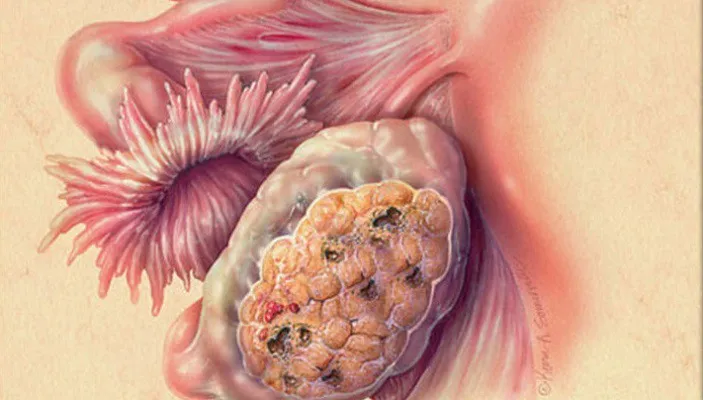
In early-stage ovarian cancer, when disease is still confined to one or both ovaries, a growing pelvic mass can cause pressure and fullness in the lower abdomen. Even a mass of 5–10 cm — not large enough to be obvious externally — can create a sensation of pelvic heaviness, pressure, and abdominal fullness. This is the primary mechanism of bloating-type symptoms in Stage I and Stage II disease, before peritoneal spread has occurred. Pelvic examination and transvaginal ultrasound can detect these masses.
2. Ascites (Peritoneal Fluid Accumulation)
Ascites — the accumulation of fluid in the peritoneal (abdominal) cavity — is the most significant and visually dramatic cause of bloating in advanced ovarian cancer. When ovarian cancer spreads to the peritoneum (the lining that covers the internal abdominal organs and the inner surface of the abdominal wall), cancer cells seed the peritoneal surface and disrupt normal fluid balance in the abdominal cavity.
Normally, a small amount of peritoneal fluid is continuously produced and reabsorbed, maintaining a near-zero net volume. In malignant ascites, cancer cells on the peritoneum do two things simultaneously: they stimulate increased fluid production (partly via vascular endothelial growth factor, VEGF) and impair the normal lymphatic mechanisms by which fluid is reabsorbed. The result is progressive accumulation of fluid in the abdominal cavity that can eventually reach 10–20 liters in volume. At these volumes, the abdomen is visibly distended, firm, and compresses adjacent structures — the stomach (causing early satiety), the diaphragm (causing shortness of breath), and the bladder (causing urinary frequency).
Ascites is present in approximately 37% of ovarian cancer patients at the time of initial diagnosis. In patients with Stage III or IV disease, ascites develops at some point during the disease course in nearly all patients.
3. Bowel and Omental Involvement
As ovarian cancer spreads across the peritoneal surface, it commonly involves the greater omentum — the fatty apron that hangs from the stomach and covers the transverse colon and loops of small bowel. Diffuse tumor infiltration of the omentum, called omental cake (visible on CT as a thickened, nodular soft-tissue mass replacing the normal fatty omentum), contributes to a sense of diffuse abdominal fullness and a palpable upper abdominal mass. Peritoneal implants on the surface of the small and large bowel can impair normal peristalsis, leading to constipation, slowed gastric emptying, and gas accumulation.
What Is Ascites? A Closer Look
Ascites is the term for abnormal fluid accumulation in the peritoneal cavity — the space between the organs inside the abdomen and the abdominal wall. It is not unique to ovarian cancer; benign ascites can occur in liver cirrhosis, heart failure, nephrotic syndrome, and other conditions. Distinguishing malignant from benign ascites is clinically important because the treatment approach differs completely.
The key laboratory distinction is the serum-ascites albumin gradient (SAAG): ascites from liver cirrhosis or portal hypertension has a SAAG of 1.1 g/dL or higher (transudate), while malignant ascites from ovarian cancer typically has a SAAG below 1.1 g/dL (exudate, reflecting protein-rich inflammatory fluid). Fluid cytology (examining cells in the ascitic fluid) can directly demonstrate malignant cells in malignant ascites.
Symptoms of significant ascites include:
- Visible abdominal distension — the abdomen appears swollen, rounded, and larger than usual
- A sense of pressure or tightness throughout the abdomen
- Early satiety — feeling full after only a few bites of food due to gastric compression
- Shortness of breath — particularly when lying flat, from diaphragmatic compression by the elevated fluid volume
- Lower extremity edema (ankle swelling), from inferior vena cava compression by large-volume ascites
- Nausea, difficulty eating, and weight gain despite poor appetite (the weight gain is fluid, while lean body mass is being lost)
Ovarian Cancer Bloating vs. IBS Bloating
Irritable bowel syndrome (IBS) is the most common condition that causes ovarian cancer symptoms — including bloating — to be misattributed. The following comparison can help distinguish the two:
| Feature | Ovarian Cancer Bloating | IBS Bloating |
|---|---|---|
| Duration of history | New, developed within the past year | Often chronic, years-long history |
| Frequency | Daily or near-daily (>12x/month) | Variable, often episodic |
| Pattern over time | Progressive — worsens over weeks to months | Fluctuating — better and worse days |
| Response to bowel movement | Not relieved by defecation | Often partially relieved after defecation |
| Response to dietary change | Minimal improvement | Improves with low-FODMAP diet or trigger avoidance |
| Associated with diarrhea/constipation | May cause constipation (mass effect); no alternating pattern | Alternating constipation/diarrhea is characteristic |
| Nocturnal symptoms | May be present | IBS rarely causes nocturnal symptoms that wake from sleep |
| Visible abdominal distension | Common in advanced disease (ascites) | Uncommon; if present, usually ends of day only |
A critical clinical point: IBS is typically diagnosed in younger women (20s–40s) who have had chronic bowel complaints for years. New onset of IBS-like symptoms in a woman over 50 — particularly postmenopause — should prompt evaluation for ovarian pathology rather than a functional diagnosis.
Other Causes of Persistent Abdominal Bloating
While the concern with persistent, new bloating in women is appropriately ovarian cancer, a thorough evaluation must also consider other serious causes of ascites and abdominal distension:
- Liver cirrhosis and portal hypertension: The most common cause of non-malignant ascites. Accompanied by other signs of liver disease (jaundice, spider angiomata, splenomegaly) and a SAAG ≥1.1.
- Heart failure: Right-sided heart failure can cause ascites along with peripheral edema and elevated jugular venous pressure. Distinguished by cardiac history and echocardiogram.
- Peritoneal carcinomatosis from other primaries: Colon, stomach, pancreatic, endometrial, and breast cancers can all spread to the peritoneum and produce ascites indistinguishable from ovarian cancer ascites on clinical examination. CT imaging and cytology help distinguish the primary site.
- Celiac disease: Causes chronic bloating and malabsorption; responds to a gluten-free diet. Serology (anti-tTG IgA) and small bowel biopsy are diagnostic.
- Hypothyroidism: Severely undertreated hypothyroidism can cause generalized bloating and constipation along with other systemic features (fatigue, cold intolerance, weight gain). TSH is the screening test.
When to See a Doctor for Bloating
Seek evaluation if bloating is:
- New — a change from your normal pattern
- Present more than 12 times per month
- Persisting for more than 2–4 weeks without clear explanation
- Progressive — worsening over time rather than resolving
- Not relieved by dietary change or bowel movements
- Accompanied by pelvic pain, early satiety, or urinary changes
- Associated with visible abdominal distension or weight change
When you see your doctor, specifically ask whether a pelvic examination, transvaginal ultrasound, and CA-125 blood test are indicated. Do not accept “it’s probably IBS” without these tests if your symptoms are new and persistent.
How Doctors Evaluate Persistent Bloating
When a woman presents with persistent, new bloating concerning for ovarian pathology, the evaluation typically includes:
- History: Duration, frequency, severity, associated symptoms (pelvic pain, urinary changes, early satiety, weight change); menstrual history; family history of ovarian or breast cancer.
- Physical examination: Pelvic examination to assess for adnexal mass; abdominal examination for distension, ascites (percussion, fluid wave), or palpable mass.
- Transvaginal ultrasound (TVUS): Primary imaging for ovarian evaluation; identifies masses and their characteristics; may detect early ascites.
- CA-125 blood test: In combination with TVUS, significantly increases sensitivity and specificity for ovarian malignancy. Elevated in most advanced ovarian cancers but not reliable for early-stage detection. Learn more about what this test measures and its limitations in our article on the CA-125 test.
- CT abdomen and pelvis: Best cross-sectional imaging for characterizing peritoneal disease, omental involvement, lymphadenopathy, and ascites extent. Used when TVUS identifies a concerning mass or when ascites is present.
- Paracentesis: If ascites is present, a sample of peritoneal fluid is obtained by needle aspiration and sent for cell count, protein, albumin (to calculate SAAG), culture, and cytology. Malignant cells in the fluid confirm peritoneal carcinomatosis.
Bloating During and After Ovarian Cancer Treatment
Bloating related to ascites is a significant management challenge throughout the course of ovarian cancer treatment and follow-up:
During chemotherapy: Effective platinum-based chemotherapy (carboplatin + paclitaxel) typically causes rapid reduction in ascites volume as peritoneal disease responds to treatment. Patients often report that their abdominal distension improves within the first 1–2 cycles of chemotherapy.
Therapeutic paracentesis: In patients with symptomatic large-volume ascites, needle drainage of the ascitic fluid (paracentesis) provides immediate symptomatic relief — reducing abdominal pressure, improving respiratory comfort, and alleviating early satiety. However, fluid reaccumulates within days to weeks in the absence of effective systemic treatment. Repeated paracentesis can cause protein depletion and electrolyte imbalance with frequent use.
Bevacizumab (anti-VEGF therapy): The anti-angiogenic agent bevacizumab (Avastin), which blocks vascular endothelial growth factor (VEGF) — the primary driver of ascites production in ovarian cancer — has been shown to significantly reduce ascites reaccumulation rates in platinum-resistant recurrent ovarian cancer. It is used in combination with chemotherapy for this indication and as maintenance therapy in newly diagnosed advanced ovarian cancer.
Recurrence surveillance: Return of bloating in a woman who has completed ovarian cancer treatment and achieved remission is a concerning symptom that warrants evaluation for disease recurrence, including CA-125 measurement and CT imaging. For women who have previously had bloating as a primary symptom, recognizing this pattern is important for early detection of recurrence.
For a broader overview of ovarian cancer including staging, treatment options, and prognosis, see our main article on ovarian cancer. For information about other warning signs beyond bloating, including pelvic pain, early satiety, and urinary changes, visit our article on ovarian cancer symptoms.
Frequently Asked Questions
Can bloating be the only symptom of ovarian cancer?
It can be the most prominent symptom, but ovarian cancer rarely presents with truly isolated bloating. The Goff et al. symptom index found that most women with ovarian cancer experience multiple symptoms (bloating plus at least one of: pelvic pain, early satiety, or urinary urgency). However, bloating can be so prominent that it overshadows the others. If bloating is new, daily, and progressive, ask yourself whether you are also experiencing any of the other three symptoms, even mildly.
My bloating is worse after eating. Could that still be ovarian cancer?
Worsening after eating could reflect either benign dietary sensitivity or ovarian cancer-related early satiety (the tumor or ascites reducing gastric capacity). The key distinction is whether the bloating is new for you, whether it is present between meals as well as after eating, and whether it is progressive. IBS bloating tends to resolve well between meals and after bowel movements; ovarian cancer bloating tends to be a more constant baseline of fullness.
How quickly does ascites develop in ovarian cancer?
The rate varies. In aggressive high-grade serous carcinoma with widespread peritoneal disease, significant ascites can accumulate over weeks to a few months. In slower-growing subtypes or earlier-stage disease, it may develop more gradually. In some women, ascites is already present at the time of initial diagnosis; in others, it develops with disease progression or recurrence.
What does malignant ascites look like on CT?
On CT, malignant ascites appears as homogeneous fluid surrounding the abdominal organs — most prominently in the dependent portions of the abdomen, the pelvis, and the flanks. In ovarian cancer, CT typically also shows the primary ovarian mass, peritoneal implants (small nodular deposits on the peritoneal surface), and omental cake — a thickened, nodular mass replacing normal omental fat — when these are present.
Sources
- Goff BA, et al. Development of an ovarian cancer symptom index. Cancer. 2007;109(2):221–227.
- American Cancer Society. Signs and Symptoms of Ovarian Cancer.
- National Cancer Institute. Ovarian Epithelial Cancer Treatment (PDQ).
- Kipps E, et al. Management of malignant ascites. BMJ. 2013;347:f6152.
- Ovarian Cancer Research Alliance. Ovarian Cancer Symptoms.
The Psychological Impact of Unexplained Bloating
One dimension of ovarian cancer bloating that is rarely discussed in clinical contexts is the psychological toll of living with persistent, unexplained abdominal symptoms that are repeatedly attributed to stress, diet, or functional causes. Many women who are eventually diagnosed with ovarian cancer report that they sought medical evaluation for their symptoms multiple times before receiving a diagnosis, and that the experience of being dismissed or reassured without appropriate testing was deeply frustrating — and, in retrospect, contributed to diagnostic delay.
Studies of ovarian cancer diagnosis delays have found that women with ovarian cancer see an average of 2–3 physicians before receiving a correct diagnosis, and that a significant proportion report having their symptoms attributed to anxiety, IBS, dietary intolerance, or other functional causes before appropriate imaging was performed. The median time from symptom onset to diagnosis is approximately 12 weeks, but many women experience delays of 6 months or longer.
If you have been experiencing new, persistent bloating that has not responded to empirical treatment for IBS or dietary modification, it is appropriate and necessary to advocate for evaluation. This does not mean demanding an ovarian cancer workup for every episode of bloating — it means asking specifically whether your symptoms warrant a transvaginal ultrasound and CA-125 test, particularly if they are new, progressive, and daily. You know your body. A pattern of symptoms that is new and different from anything you have previously experienced deserves investigation, not reassurance without evaluation.
Bloating and Ovarian Cancer Risk Factors
Not all persistent bloating carries the same level of concern for ovarian cancer. Certain risk factors significantly increase the probability that new, persistent bloating represents ovarian malignancy rather than a benign functional condition:
- Age over 50: The median age of ovarian cancer diagnosis is 63 years. Postmenopausal women who develop new, persistent bloating warrant particular attention because IBS — the most common alternative explanation — is significantly more common in younger women and rarely presents for the first time after menopause.
- BRCA1 or BRCA2 mutation: Carriers of these mutations have substantially elevated lifetime risk of ovarian cancer (35–46% for BRCA1 carriers, 13–23% for BRCA2 carriers) and should have a lower threshold for evaluation of any pelvic or abdominal symptoms.
- Family history of ovarian cancer: Having a first-degree relative (mother, sister, daughter) with ovarian cancer increases lifetime risk approximately 2–3 fold above the general population.
- Personal history of breast cancer: Particularly ER-negative breast cancer, which shares genetic associations with high-grade serous ovarian cancer.
- Endometriosis: A risk factor for endometrioid and clear cell ovarian carcinoma. Women with endometriosis who develop new or worsening bloating should have pelvic imaging performed.
- Nulliparity (never having been pregnant): One of several hormonal and reproductive factors associated with modestly increased ovarian cancer risk.
For a complete review of who is at elevated risk for ovarian cancer and what surveillance and risk-reduction options are available, see our guide to ovarian cancer risk factors. For information on the CA-125 blood test — including what the test measures, what causes false positives, and how it is used in combination with imaging — see our article on the CA-125 test. And for guidance on the full spectrum of ovarian cancer symptoms beyond bloating, including pelvic pain, early satiety, and urinary urgency, see our comprehensive symptom guide.
I have been reading about ovarian cancer bloating: causes, signs, and for weeks and this is the most thorough guide I have found. The connection between diet, lifestyle, and long-term outcomes is explained clearly here. Thank you for making complex medical information accessible without dumbing it down.
My cardiologist recommended I look into ovarian cancer bloating: causes, signs, and and this article covered it perfectly. The section on managing this condition day-to-day was especially useful for meal planning. Looking forward to reading more articles from this website.
Thank you for covering ovarian cancer bloating: causes, signs, and so thoroughly without being overly technical. I especially valued the explanation of why these recommendations exist, not just what they are. Will definitely be coming back to this site for more health information.
My doctor recommended I look into ovarian cancer bloating: causes, signs, and and this article covered it perfectly. The section on managing this condition day-to-day was especially useful for planning. This gave me real confidence going into my next specialist appointment.
Bookmarked this article on ovarian cancer bloating: causes, signs, and immediately — going to reference it regularly. The connection between lifestyle choices and long-term outcomes is explained clearly here. Keep up this kind of thorough health journalism — it genuinely helps patients like me.
I shared this article on ovarian cancer bloating: causes, signs, and with my doctor and they appreciated the level of detail. The practical tips made this immediately actionable, not just theoretical. Exactly the kind of evidence-based information that is hard to find in one place.