
When patients learn that a parent or sibling has been diagnosed with cancer, one of the first questions that follows is: “Does this mean I’ll get it too?” It is one of the most natural questions in oncology — and one of the most consistently misunderstood. The answer depends on which cancer, how many relatives are affected, at what ages, on which side of the family — and it is almost never a simple yes or no.
A useful starting point is a statistic that surprises most people: 85–90% of breast cancer cases occur in women with no first-degree family history of the disease. Family history genuinely raises risk — and for a specific subset of families it carries very high risk indeed — but the absence of family history does not mean protection, and its presence does not mean certainty.
This article explains the three categories of cancer by origin, how to read your family history in practical terms, which patterns suggest a hereditary syndrome requiring action, the major hereditary cancer syndromes and their actual lifetime risks, and what the evidence says about surveillance and prevention.
Sporadic, Familial, and Hereditary — The Three Categories
Understanding how cancers cluster in families requires distinguishing three fundamentally different situations, each calling for a different clinical response.
- Sporadic cancer (~70–80%). Arises from somatic mutations acquired during a person’s lifetime — from carcinogens, random DNA replication errors, and aging. These mutations occur in a single cell in a single person and are not inherited. Two sisters each developing breast cancer does not automatically mean a hereditary syndrome — it may simply reflect that both are postmenopausal women sharing similar lifestyle and reproductive histories.
- Familial cancer (~15–20%). Describes cancer clustering at above-average rates without a single identifiable high-penetrance germline mutation. Risk comes from combinations of common low-risk genetic variants (polygenic susceptibility), shared environmental factors, and shared lifestyle. Risk elevation is real but typically modest: 1.5–3 times population risk.
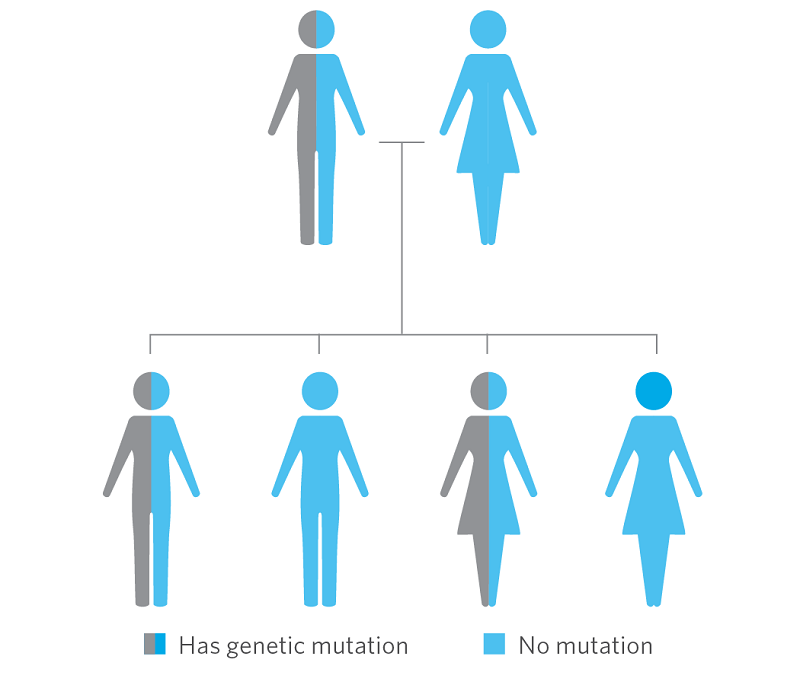
- Hereditary cancer (~5–10%). Caused by a pathogenic germline mutation present in every cell of the body, inherited from a parent, and potentially transmissible to children. These mutations confer high lifetime cancer risk — often 25–80%+ — and are what genetic testing detects.
The distinction drives management: sporadic → standard screening; familial → earlier/more frequent standard screening; hereditary → specialist surveillance, risk-reducing options, cascade testing of relatives.
How Much Does Family History Actually Raise Risk?
First-Degree vs Second-Degree Relatives and Age at Diagnosis
A first-degree relative (FDR) — parent, sibling, or child — shares 50% of your genetic material and is the most clinically significant signal. A second-degree relative — grandparent, aunt/uncle, half-sibling — shares 25% and carries less but still meaningful weight. Age at diagnosis is critical: a relative diagnosed before 50 is a much stronger risk signal than one diagnosed at 75 — younger onset reflects heritable susceptibility, older onset is more consistent with sporadic mutation accumulation.
| Cancer | 1 FDR affected | 2 FDRs affected | Hereditary syndrome lifetime risk |
|---|---|---|---|
| Breast | ~2× lifetime risk | ~4–6× | BRCA1: 50–72%; BRCA2: 45–69% |
| Colorectal | ~2–3× | ~3–4× | Lynch: 25–75%; FAP: ~100% |
| Ovarian | ~3–4× | Higher | BRCA1: ~44%; BRCA2: ~17% |
| Prostate | ~2× | Higher | BRCA2: 2–8× elevated |
| Pancreatic | ~2× | Higher | BRCA2/PALB2: 2–6× |
| Gastric | ~2–3× | Higher | CDH1: >70% |
| Melanoma | ~2× | Higher | CDKN2A: 60–90% |
Red Flags: When Family History Suggests a Hereditary Syndrome
Not every family with cancer cases harbors a high-penetrance mutation. These seven features specifically suggest a hereditary syndrome and warrant genetic evaluation:
- Cancer at unusually young age: Breast before 50, colorectal before 50, endometrial before 50 — any cancer significantly earlier than typical population onset.
- Multiple primary cancers in one person: Bilateral breast cancer; breast plus ovarian in the same individual; two separate colorectal cancers.
- Multiple relatives on the same side of the family with the same or biologically related cancers — not isolated single cases scattered across branches.
- Three or more generations affected by the same or related cancers.
- Rare cancer types: Male breast cancer (~20% involve BRCA2), adrenocortical carcinoma (Li-Fraumeni), retinoblastoma (RB1), medullary thyroid cancer (RET).
- Ashkenazi Jewish ancestry: BRCA1/2 founder mutations occur in approximately 1 in 40 Ashkenazi Jewish individuals — vs ~1 in 300–500 in the general population. A substantially lower evidence threshold triggers genetic evaluation in this population.
- Known pathogenic variant in a family member: Once one person tests positive, all first-degree relatives should be offered targeted testing.
The Major Hereditary Cancer Syndromes
BRCA1 and BRCA2
Both encode proteins involved in homologous recombination DNA repair. When one inherited copy is inactivated and the second copy is lost somatically, DNA repair failure leads to genomic instability and cancer. Prevalence: ~0.3% general population; ~2% Ashkenazi Jewish population.
- BRCA1: Lifetime breast cancer risk 50–72%; ovarian 44%; also pancreatic cancer
- BRCA2: Lifetime breast cancer risk 45–69%; ovarian 17%; also pancreatic, prostate, male breast, melanoma
Lynch Syndrome
Caused by pathogenic variants in DNA mismatch repair genes (MLH1, MSH2, MSH6, PMS2, EPCAM). Accounts for 3–5% of all colorectal cancer. Lynch tumors show microsatellite instability (MSI-H) — now triggering routine Lynch screening in all newly diagnosed CRC and endometrial cancers.
- Colorectal cancer: 25–75% (gene-dependent)
- Endometrial cancer: 25–60%
- Also: ovarian, gastric, urinary tract, small bowel
Familial Adenomatous Polyposis (FAP)
APC gene mutations cause hundreds to thousands of colorectal adenomas developing in the second and third decades. Without prophylactic total colectomy, colorectal cancer is essentially inevitable by age 40–50.
Li-Fraumeni Syndrome
Germline TP53 mutations. Because TP53 governs cell cycle arrest, DNA repair, and apoptosis in virtually all tissues, germline inactivation confers risk across tissue types. Lifetime cancer risk exceeds 90%. Cancer types: sarcomas, breast (often before 30), brain tumors, adrenocortical carcinoma, leukemia.
PALB2, CDKN2A, CDH1
PALB2 (partners with BRCA2): lifetime breast cancer risk 35–58%; also elevates pancreatic cancer risk (Antoniou et al., NEJM 2014). CDKN2A: 60–90% lifetime melanoma risk; also ~17% pancreatic cancer. CDH1: >70% lifetime diffuse gastric cancer risk — prophylactic total gastrectomy is often recommended because diffuse-type gastric cancer is undetectable at curable stages by endoscopy.
| Syndrome | Gene(s) | Key Cancers | Approx. Lifetime Risk |
|---|---|---|---|
| Hereditary Breast/Ovarian | BRCA1, BRCA2 | Breast, ovarian, pancreatic | Breast 50–72%; Ovarian 17–44% |
| Lynch Syndrome | MLH1, MSH2, MSH6, PMS2 | CRC, endometrial, ovarian | CRC 25–75%; Endometrial 25–60% |
| FAP | APC | Colorectal, duodenal | CRC ~100% without colectomy |
| Li-Fraumeni | TP53 | Sarcoma, breast, brain, adrenal | >90% lifetime cancer |
| PALB2 | PALB2 | Breast, pancreatic | Breast 35–58% |
| FAMMM/Melanoma | CDKN2A | Melanoma, pancreatic | Melanoma 60–90% |
| Hereditary Diffuse Gastric | CDH1 | Diffuse gastric | Gastric >70% |
Surveillance and Prevention by Risk Category
Elevated Family History Risk (No Mutation Identified)
Breast: Annual mammogram from age 40 (or 10 years before the youngest relative’s diagnosis age). Add MRI if calculated lifetime risk ≥20%. Chemoprevention — tamoxifen, raloxifene, or aromatase inhibitors — reduces breast cancer risk by approximately 50% in high-risk candidates.
Colorectal: One FDR <60, or two FDRs any age → colonoscopy at 40 (or 10 years before youngest dx), every 5 years. One FDR ≥60 → colonoscopy at 40, then standard interval.
Prostate: PSA from 40–45 if one FDR diagnosed before 65, or multiple relatives affected.
Confirmed Hereditary Mutation
- BRCA1/2: Annual MRI + mammogram from 25–30; discuss risk-reducing salpingo-oophorectomy (RRSO) at 35–40 (BRCA1) or 40–45 (BRCA2); discuss risk-reducing mastectomy
- Lynch syndrome: Colonoscopy every 1–2 years from age 20–25; annual endometrial sampling for female carriers from 30–35; aspirin 600mg/day reduced Lynch CRC by ~50% in the CAPP2 trial (Burn et al., Lancet 2011)
- FAP: Endoscopy from age 10–12; colectomy planning as polyp burden increases
- Li-Fraumeni: Toronto Protocol — annual whole-body MRI + brain MRI; annual breast MRI; minimize medical ionizing radiation
Genetic Counseling and Testing
A genetic counselor constructs a detailed multi-generational pedigree, calculates pre-test probability using validated models, discusses test options and implications — including the possibility of variants of uncertain significance — and coordinates testing. Equally important: addressing insurance implications, the impact on family members who may not want to know their status, and the emotional dimensions of results.
Variants of Uncertain Significance (VUS) are found in 10–40% of genetic tests depending on the gene and population. A VUS is neither a positive nor a negative result. Management is not changed based on VUS alone. As evidence accumulates, most VUS are eventually reclassified — typically to benign. A negative result does not eliminate hereditary risk — it means no pathogenic variant was found in tested genes. If the clinical family history is strong, surveillance follows the clinical picture, not the test result.
Frequently Asked Questions
If my mother had breast cancer, will I get it?
Probably not — and this framing matters. One first-degree relative with breast cancer approximately doubles lifetime risk, from ~12% population baseline to around 20–25%. That still represents a 75–80% probability of not developing breast cancer. The risk is higher if the diagnosis was before 50, if multiple relatives are affected, or if a BRCA mutation is identified. The appropriate response is earlier, more attentive screening — not an assumption of certainty.
What is the difference between hereditary and familial cancer?
Hereditary cancer is caused by a specific identifiable germline mutation (like BRCA1), detectable by genetic testing, carrying high cancer risk, and passing predictably through generations. Familial cancer describes above-average clustering without a single detectable high-penetrance mutation — risk comes from polygenic susceptibility plus shared lifestyle. Familial cancer carries modestly elevated risk and does not require the intensive protocols used for hereditary syndromes.
Should I get genetic testing if I have a family history of cancer?
It depends on specifics. Genetic testing adds value when family history includes features of a hereditary syndrome: multiple relatives affected, young age at diagnosis, rare cancer types, or a known mutation in a family member. A single case of a common cancer in a relative diagnosed at 70 does not necessarily warrant testing. Genetic counseling — not testing as a first step — is the right starting point.
Does family history on my father’s side count for breast cancer?
Completely. BRCA1 and BRCA2 are on autosomal (non-sex) chromosomes and are inherited equally from either parent. A father can carry a BRCA2 mutation without developing breast cancer himself (though BRCA2 men have elevated prostate and male breast cancer risk) and can transmit it to his daughters. Paternal family history of breast, ovarian, or pancreatic cancer should be taken as seriously as maternal history.
If no one in my family has cancer, am I at low risk?
Lower risk, but not zero. Approximately 70–80% of cancers are sporadic — arising from random mutations unrelated to inheritance. Everyone faces baseline cancer risk regardless of family history. Additionally, small or young families may not yet have expressed a heritable risk that exists. Standard age-appropriate cancer screening applies to everyone.
What cancers are most strongly linked to family history?
The strongest hereditary associations: breast and ovarian cancer (BRCA1/2), colorectal and endometrial cancer (Lynch syndrome), melanoma (CDKN2A), diffuse gastric cancer (CDH1), and sarcoma/breast/brain cancers (Li-Fraumeni). Prostate, pancreatic, and kidney cancers also have meaningful hereditary components. Lung cancer is primarily carcinogen-driven (tobacco); hereditary contributions are modest.
If I test negative for a mutation, do I still need extra screening?
Possibly. A negative genetic test means no pathogenic variant was found in tested genes — it does not eliminate hereditary risk. In families with a strong clinical pattern but no identified mutation, surveillance follows the clinical family history, not the test result. A genetic counselor can explain what a negative result does and does not mean in your specific family context.
The Bottom Line
Family history is one of the most important cancer risk inputs to understand — and one of the most consistently misread. It does not determine outcome: most relatives of cancer patients will not develop the same cancer, and most cancer occurs without obvious family clustering.
What family history does is calibrate the probability of a hereditary syndrome and inform the timing and intensity of surveillance. One relative with a common cancer at an older age warrants attentiveness, not alarm. Multiple relatives across generations with the same cancer at young ages warrants genetic counseling. A known pathogenic mutation in a family member warrants cascade testing and specialist-guided surveillance.
The detailed, multi-generational family history conversation between patient and clinician — going beyond a checkbox to ask specifically who had what, when, and at what age — is one of the highest-value preventive medicine interactions in cancer care.
This article is for educational purposes only and does not constitute medical advice. Individuals with concerns about cancer risk based on family history should consult a physician or certified genetic counselor.
- Kuchenbaecker KB, et al. Risks of Breast, Ovarian, and Contralateral Breast Cancer for BRCA1 and BRCA2 Mutation Carriers. JAMA. 2017;317(23):2402–2416.
- Hampel H, et al. Screening for the Lynch syndrome (hereditary nonpolyposis colorectal cancer). N Engl J Med. 2005;352(18):1851–1860.
- Antoniou AC, et al. Breast-cancer risk in families with mutations in PALB2. N Engl J Med. 2014;371(6):497–506.
- Burn J, et al. Effect of aspirin or resistant starch on colorectal neoplasia in the Lynch syndrome. Lancet. 2011;378(9809):2081–2087.
- Bonadona V, et al. Cancer risks associated with germline mutations in MLH1, MSH2, and MSH6 genes in Lynch syndrome. JAMA. 2011;305(22):2304–2310.
- Lynch HT, de la Chapelle A. Hereditary colorectal cancer. N Engl J Med. 2003;348(10):919–932.
- NCCN Clinical Practice Guidelines: Genetic/Familial High-Risk Assessment: Breast, Ovarian, and Pancreatic. Version 2024.
- NCCN Clinical Practice Guidelines: Genetic/Familial High-Risk Assessment: Colorectal. Version 2024.
Came across this while researching cancer and family history: what your for a family member. What I liked most was that the article didn’t just say what to avoid — it also gave alternatives. This is going into my health binder that I bring to every doctor’s visit.
Thank you for covering cancer and family history: what your so thoroughly without being overly technical. I especially valued the explanation of why these recommendations exist, not just what they are. This is going into my health binder that I bring to every doctor’s visit.
I shared this article on cancer and family history: what your with my doctor and they appreciated the level of detail. It is refreshing to see an article that acknowledges individual variation rather than giving one-size-fits-all advice. I wish I had found this article when I was first diagnosed — would have saved a lot of confusion.
This breakdown of cancer and family history: what your is exactly what patients need before a specialist appointment. I especially valued the explanation of why these recommendations exist, not just what they are. Looking forward to reading more articles from this website.
Finally a resource that explains cancer and family history: what your in plain language. The specific numbers and thresholds mentioned are exactly what I needed to understand my results. Appreciate the effort that went into researching and writing this — it shows.
I never fully understood cancer and family history: what your until I read this. The practical tips made this immediately actionable, not just theoretical. Looking forward to reading more articles from this website.