
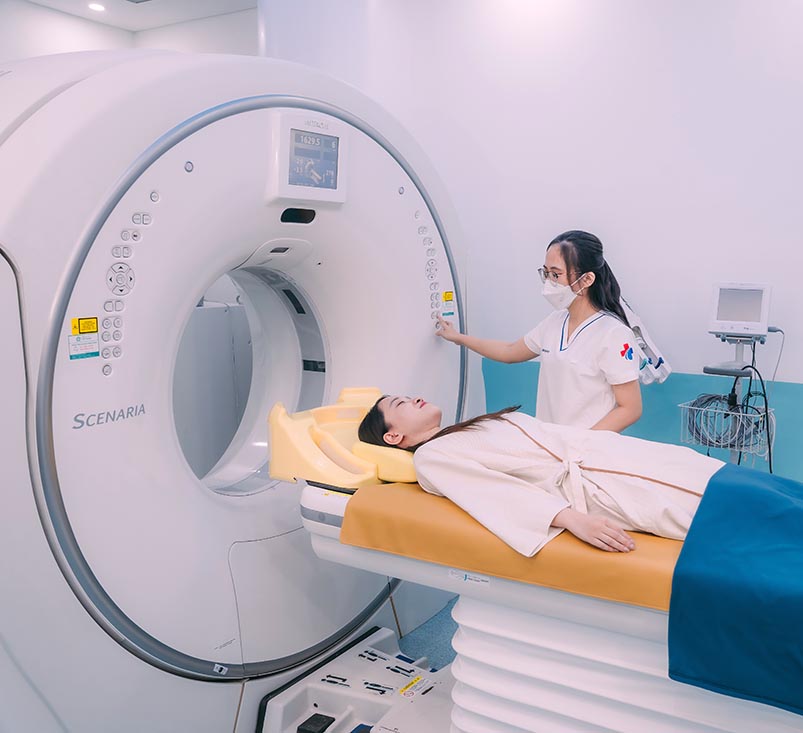
A CT scan for cancer is one of the most ordered tests in oncology — used to find tumors, determine how far cancer has spread, guide biopsies into suspicious lesions, and measure whether treatment is working. It is the primary staging tool for most solid tumors and the basis of the only proven lung cancer screening program.
CT uses a rotating X-ray source and multiple detectors to create detailed cross-sectional images of the body. A chest-abdomen-pelvis CT on a modern scanner takes less than 60 seconds of actual acquisition time. For a broader overview of all the imaging tools used in oncology — including MRI, PET-CT, ultrasound, and mammography — see our guide to imaging tests for cancer.
What a CT Scan for Cancer Shows
CT imaging assigns a density value (Hounsfield unit, or HU) to every point in the body. Air reads as approximately −1000 HU (black); fat as −100 HU; soft tissue as 20–80 HU; bone as 400–1000 HU (white). This density scale lets CT distinguish between tissues of different density — bone from soft tissue, fluid from solid, calcification from tumor.
The four roles of a CT scan for cancer:
- Staging — determining primary tumor size and extent, regional lymph node involvement, and distant metastases in a single chest-abdomen-pelvis examination
- Lung cancer screening — LDCT is the only imaging test with USPSTF Grade B endorsement for cancer screening (other than mammography and colonoscopy)
- Treatment monitoring — serial CT during therapy measures tumor response using RECIST 1.1 criteria
- Biopsy guidance — real-time CT visualization for needle placement in lung, retroperitoneal, adrenal, and bone lesions
LDCT for Lung Cancer Screening
Low-dose CT for lung cancer screening is the most evidence-supported cancer CT application — and for eligible patients, it can save lives.
USPSTF 2021 eligibility criteria (Grade B):
- Age: 50–80 years
- Smoking history: ≥20 pack-years (packs/day × years smoked)
- Smoking status: currently smoking OR quit within the past 15 years
- Annual screening while criteria remain met
The NLST trial (NEJM 2011) randomized 53,454 high-risk adults to annual LDCT vs. chest X-ray — LDCT reduced lung cancer mortality by 20%. The NELSON trial (NEJM 2020) showed 24% mortality reduction in men and 33% in women at 10-year follow-up.
| Lung-RADS | Category | Follow-Up Action |
|---|---|---|
| 1 | Negative — no nodules or definitively benign | Continue annual LDCT |
| 2 | Benign-appearing (<6 mm solid; <20 mm GGN) | Continue annual LDCT |
| 3 | Probably benign (6–7 mm solid; 20–30 mm GGN) | 6-month LDCT follow-up |
| 4A | Suspicious (≥8 mm solid; ≥30 mm GGN; new/growing) | 3-month LDCT or PET-CT |
| 4B | Very suspicious (≥15 mm solid; significant growth) | CT with contrast / PET-CT / biopsy |
| 4X | Additional features increasing suspicion | CT ± PET-CT ± biopsy |
LDCT radiation dose is approximately 1–2 mSv — roughly 4–8 months of background radiation, and far less than a standard diagnostic CT (8–14 mSv). If you meet the LDCT eligibility criteria, discussing screening at your next cancer checkup is the right starting point.
CT Scan for Cancer with Contrast — What It Does
Most CT scans for cancer staging are performed with iodinated intravenous contrast — a water-soluble solution that temporarily brightens blood vessels and vascular tumors, allowing radiologists to distinguish different lesion types based on their blood supply.
| Phase | Timing After Injection | Best For |
|---|---|---|
| Non-contrast (baseline) | Before injection | Hemorrhage, calcification, baseline organ density |
| Arterial | ~25–35 seconds | Hypervascular tumors: HCC, renal cell, carcinoid; aorta, hepatic artery |
| Portal venous | ~60–75 seconds | Most liver metastases, abdominal organs, the majority of solid tumors |
| Delayed | 3–5 minutes | Liver hemangiomas (fill-in), biliary system, bladder wall |
| Urographic | 7–10 minutes | Ureters, bladder, renal collecting systems (urothelial tumors) |
When contrast is not used: eGFR <30 mL/min (contrast nephropathy risk); prior severe contrast allergic reaction (anaphylaxis — relative contraindication, requires specialist review); active thyroid disease with planned radioiodine therapy (iodinated contrast suppresses thyroid iodine uptake for 2–8 weeks). Prior mild contrast reactions (hives, itching) → pre-medication with steroids and antihistamines before scan.
What to Expect During a CT Scan for Cancer
Many patients are more anxious about the procedure itself than about the results. Understanding what actually happens reduces this significantly.
Before the Scan
- Fasting: Nothing to eat or drink for ~4 hours before IV contrast CT; no restriction for non-contrast CT
- IV access: An 18–20 gauge IV catheter is placed in the arm for power injection of contrast at 3–5 mL/second
- Screening questions: Kidney function (eGFR), prior contrast reactions, metformin use, thyroid medications, pregnancy
- Oral contrast: Some abdominal CT protocols provide dilute barium or water to opacify the GI tract — given 60–90 minutes before scan
During the Scan
- Lie flat on a narrow table; arms raised above head for chest/abdominal CT (reduces image artifact)
- The table moves through the scanner ring (gantry); technologist gives breathing instructions through intercom
- Breath-hold: “Take a breath in… hold… breathe normally.” Lasts 10–30 seconds.
- With contrast injection: warm flushing sensation spreading from arm through chest; metallic or warm taste in mouth; sensation of urination in the groin area — all normal, all temporary, resolving within minutes. Patients do NOT actually urinate.
- Actual scan acquisition: <60 seconds. Total time in room: 10–15 minutes.
After the Scan
Drink fluids normally after contrast CT (no specific volume requirement for normal renal function). Metformin may need to be held 48 hours in patients with reduced renal function. Outpatient results are typically available in 24–72 hours.
CT for Specific Cancer Types — What Radiologists Look For
Lung Cancer
Lung CT categorizes nodules by composition:
- Ground glass opacity (GGO): Hazy density through which lung vessels remain visible — represents lepidic growth (early adenocarcinoma). Managed more conservatively than same-size solid nodules.
- Solid nodule: Completely opaque; higher suspicion above threshold sizes (>6 mm = Lung-RADS 3 or above)
- Part-solid nodule: Mixed GGO + solid component; the solid component size drives management — even small solid components ≥6 mm are highly suspicious
Liver Cancer and Metastases
In a cirrhotic liver, LI-RADS 5 criteria — arterial phase hyperenhancement (APHE) plus non-peripheral washout on portal venous or delayed phase — identify a lesion as highly suspicious for HCC. LI-RADS 5 lesions ≥1 cm are treated as HCC in clinical protocols. Colorectal liver metastases appear as rounded hypovascular (darker than liver) masses on portal venous phase. Hypervascular liver metastases (brighter on arterial phase) suggest breast, carcinoid, or renal cell origin.
Pancreatic Cancer
Pancreas protocol CT (thin slice, arterial + portal phases) shows PDAC as a hypoenhancing mass — darker than the brightly enhancing surrounding normal pancreas. Vascular involvement determines resectability: no SMA/celiac contact = resectable; ≤180° SMA/celiac or portal vein involvement = borderline; >180° SMA/celiac = locally advanced/unresectable.
Colorectal Cancer
CT chest-abdomen-pelvis provides the M component of TNM staging — detecting liver and lung metastases (the most common distant spread sites). For rectal cancer local staging (T and N), MRI is superior. For post-treatment CEA-guided surveillance, serial CT (every 3–6 months for the first 2–3 years) detects hepatic/pulmonary recurrence. See our cancer blood test guide for how CEA monitoring works alongside CT imaging.
Bone Metastases on CT
Lytic metastases (bone destruction) are typical of lung, renal cell, thyroid, and myeloma. Sclerotic metastases (increased density) are classic for prostate cancer. Breast cancer produces mixed lytic/sclerotic metastases. Note: multiple myeloma requires whole-body MRI or PET-CT — bone scan misses most myeloma bone lesions.
Understanding Your CT Scan Report for Cancer
| Term in Report | What It Means |
|---|---|
| Mass / lesion / finding | A discrete abnormality requiring characterization |
| Enhancing | Becomes brighter after contrast — indicates increased blood supply |
| Hypodense | Darker than surrounding tissue — lower density |
| Hyperdense | Brighter than surrounding tissue — can be hemorrhage, calcification, or hypervascular tumor |
| Ground glass opacity (GGO) | Hazy lung density; vessels still visible through it |
| Lymphadenopathy | Enlarged lymph nodes (>1 cm short axis is suspicious in mediastinum) |
| Pleural effusion | Fluid around the lung between lung and chest wall |
| Ascites | Fluid in the abdominal cavity — can indicate peritoneal disease |
| Indeterminate | Cannot be definitively characterized on CT — more workup needed; does NOT mean cancer |
| Stable | Unchanged from prior scan — generally reassuring during surveillance |
| LI-RADS 5 | Liver lesion in cirrhosis meeting HCC criteria on CT (APHE + washout) |
| Lung-RADS 4B | Highly suspicious lung nodule — requires diagnostic CT or biopsy workup |
“Indeterminate” does not mean cancer — it means the finding cannot be definitively classified as benign or malignant on CT alone. Many indeterminate lesions prove benign on follow-up MRI, PET-CT, or biopsy. If your CT report contains suspicious findings and your provider has referred you for biopsy, our biopsy for cancer guide explains what to expect at that next step.
CT Scan Radiation — Risk in Context
| Scan | Approximate Dose | Background Equivalent |
|---|---|---|
| Chest X-ray | 0.1 mSv | ~12 days |
| LDCT (lung cancer screening) | 1–2 mSv | ~4–8 months |
| Chest CT with contrast | ~7 mSv | ~2.3 years |
| Chest-abdomen-pelvis CT | 8–14 mSv | 3–5 years |
| PET-CT (FDG + CT) | ~14–25 mSv | 5–8 years |
The additional lifetime cancer risk from a single CT scan is approximately 1 in 2,000–10,000, depending on patient age and scan type. This is small relative to the baseline lifetime cancer risk of ~40% in the general population — and is vastly outweighed by the diagnostic value of a clinically indicated CT. Modern scanners use automated dose reduction; clinical teams aim to use the minimum dose needed for adequate image quality (the ALARA principle).
If you’re uncertain whether a CT scan is appropriate given your symptoms or cancer history, our cancer symptoms checklist can help you organize what to discuss with your provider.
Frequently Asked Questions
What does a CT scan for cancer look like?
CT produces gray-scale cross-sectional images showing organs, vessels, and bones at varying densities. Cancer appears as an abnormal mass or density change compared to surrounding normal tissue. A lung cancer appears as a white nodule against black air-filled lung. A liver metastasis appears as a darker, rounded mass within a normally gray-enhanced liver. Bone metastases appear as areas of density increase (sclerotic) or density loss (lytic). According to the National Cancer Institute, CT can detect abnormalities as small as a few millimeters, though definitive cancer diagnosis still requires tissue biopsy.
Can a CT scan detect all types of cancer?
No. CT is most reliable for chest, abdominal, and pelvic cancers when tumors are ≥8–10 mm and produce density differences from surrounding tissue. CT is less reliable for: brain tumors (MRI is superior); prostate cancer local evaluation (mpMRI preferred); early peritoneal metastases <5 mm; bone marrow infiltration (MRI more sensitive); and multiple myeloma (whole-body MRI or PET-CT preferred). A negative CT does not rule out cancer, particularly for early-stage or small tumors. CT is best understood as one component of a multi-step diagnostic evaluation.
How often should I get a CT scan for cancer?
Frequency depends on the indication. For lung cancer screening: annually, if you meet USPSTF 2021 LDCT criteria (age 50–80, ≥20 pack-years, currently smoking or quit <15 years). For treatment monitoring: typically every 2–3 treatment cycles or every 8–12 weeks. For post-treatment surveillance: often every 3–6 months for 2–3 years, then annually. There is no universal “cancer CT screening” interval — your provider determines the appropriate schedule based on your cancer type, treatment, and risk profile.
What is a low-dose CT (LDCT) scan for lung cancer?
LDCT uses lower radiation (~1–2 mSv vs. 8–14 mSv for standard CT) by reducing X-ray current. It is optimized to detect lung nodules, not for abdominal imaging or soft tissue detail. LDCT does not use IV contrast for screening. It is recommended annually for adults aged 50–80 with ≥20 pack-year smoking history who currently smoke or quit within the past 15 years (USPSTF 2021, Grade B). Results are reported using the ACR Lung-RADS system — categories 1–4X guide follow-up recommendations. Most positive findings (Lung-RADS 3–4) are followed with additional imaging rather than immediate biopsy.
Can a CT scan be wrong about cancer?
Yes — in both directions. False positives occur when benign lesions appear suspicious on CT. False negatives occur when cancer is present but below detection threshold or in a location where CT has poor sensitivity. “Indeterminate” findings on CT are not diagnoses — they require additional workup (repeat CT, MRI, PET-CT, or biopsy) to characterize definitively. A LI-RADS 4 liver lesion, for example, has a meaningful chance of being benign. All suspicious CT findings require interpretation alongside clinical history, tumor markers, and often tissue sampling.
What is a contrast CT scan and when is it used?
A contrast CT uses iodinated contrast injected intravenously to highlight blood vessels and vascular tumors, significantly improving tumor detection and characterization. It is used for most cancer staging and diagnostic CT scans. Non-contrast CT is used when contrast is contraindicated (eGFR <30, severe prior contrast allergy) or when the question doesn’t require it (LDCT lung screening, bone assessment). The warm flushing sensation, metallic taste, and urination sensation that occur during contrast injection are normal and temporary — they resolve within minutes and do not indicate a problem.
Sources & Further Reading
- NCI — CT Scans and Cancer Fact Sheet
- USPSTF — Lung Cancer Screening Recommendation (2021, Grade B)
- ACR — Lung-RADS Version 1.1 Assessment Categories
- Aberle DR et al. — NLST (Low-Dose CT vs. Chest X-Ray), NEJM 2011
- de Koning HJ et al. — NELSON Trial (LDCT lung cancer screening), NEJM 2020
- ACR LI-RADS Technical Success and CT/MRI Criteria (2023)
- NCCN Pancreatic Adenocarcinoma Guidelines — Resectability Staging
This article is for educational purposes only and does not constitute medical advice. CT scan indications, preparation, and result interpretation should be discussed with your radiologist and treating healthcare provider.
Pingback: MRI for Cancer: What It Shows and When You Need One - Horizon Health Guide
Finally a resource that explains ct scan for cancer: what to in plain language. I have tried following advice from several sources but this is the most consistent with what my specialist told me. Appreciate the effort that went into researching and writing this — it shows.
Finally a resource that explains ct scan for cancer: what to in plain language. The article answered questions I didn’t even know I had until I started reading. This is going into my health binder that I bring to every doctor’s visit.
My cardiologist recommended I look into ct scan for cancer: what to and this article covered it perfectly. I especially valued the explanation of why these recommendations exist, not just what they are. This is going into my health binder that I bring to every doctor’s visit.
I have been reading about ct scan for cancer: what to for weeks and this is the most thorough guide I found. What I liked most was that the article didn’t just say what to avoid — it also gave alternatives. Will definitely be coming back to this site for more health information.
As someone dealing with this personally, the ct scan for cancer: what to section was very helpful. I have tried following advice from several sources but this is most consistent with what my specialist told me. This is going into my health folder that I bring to every doctor’s visit.
This breakdown of ct scan for cancer: what to is exactly what patients need before a specialist appointment. I have tried following advice from several sources but this is most consistent with what my specialist told me. I wish I had found this article earlier — would have saved a lot of confusion.