
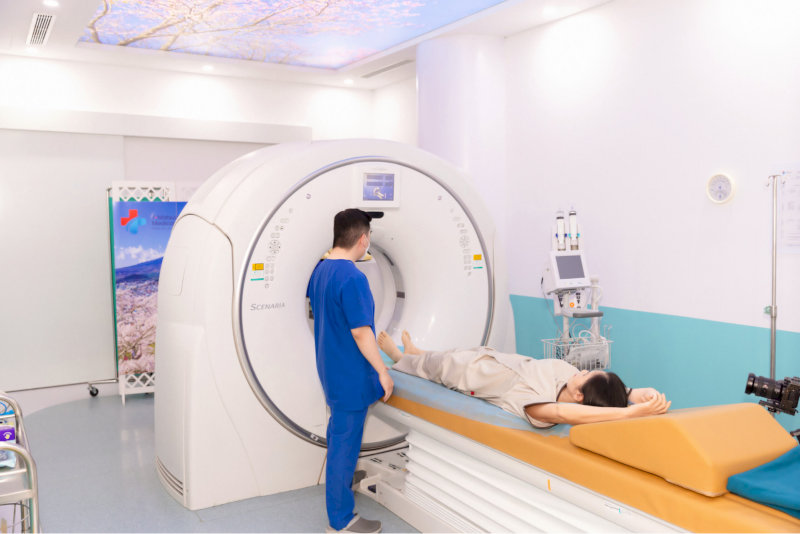
Imaging tests for cancer are the tools that allow clinicians to see inside the body without surgery — to find suspicious lesions, determine how far cancer has spread, and assess whether treatment is working. But none of the imaging tests used in oncology can diagnose cancer alone. Every imaging finding described as “suspicious for malignancy” requires tissue biopsy for confirmation before treatment begins.
Seven major imaging modalities are used in oncology: X-ray, CT, MRI, PET scan, ultrasound, bone scan, and mammography. Each uses a different physical principle to produce images of body structures, and each has specific clinical strengths and appropriate indications. Understanding which imaging tests for cancer are ordered — and why — can help you make sense of the diagnostic process. For how imaging and blood work together in the cancer workup, see our overview of cancer blood tests.
What Imaging Tests for Cancer Do — and Don’t Do
Imaging tests for cancer generate probability — not certainty. Radiology reports use standardized risk classification systems to communicate that probability:
- BI-RADS (breast imaging): 1–6 scale; BI-RADS 4 = suspicious, biopsy recommended
- LI-RADS (liver in cirrhosis): 1–5 scale; LI-RADS 5 = highly suspicious for HCC
- PI-RADS (prostate MRI): 1–5 scale; PI-RADS 4–5 = targeted biopsy recommended
- ACR TI-RADS (thyroid ultrasound): 1–5 scale guiding FNA biopsy decisions
RECIST 1.1 (Response Evaluation Criteria in Solid Tumors) is the standard framework for measuring tumor response to treatment on CT or MRI. A ≥30% decrease in the sum of target lesion diameters = partial response. A ≥20% increase = progressive disease. These terms appear in oncology reports and clinical trial results.
Imaging Tests for Cancer — CT Scan
CT (computed tomography) is the most widely ordered of all imaging tests for cancer. It uses multiple X-ray projections processed by computer into detailed cross-sectional images of the entire body in minutes.
CT for Lung Cancer Screening
The USPSTF (2021, Grade B) recommends annual low-dose CT (LDCT) for adults aged 50–80 with a 20 pack-year smoking history who currently smoke or quit within the past 15 years. The NLST trial (NEJM 2011) showed LDCT reduced lung cancer mortality by 20% vs. chest X-ray. The European NELSON trial (NEJM 2020) showed 24% mortality reduction in men and 33% in women. LDCT uses approximately 1–2 mSv — significantly less radiation than a standard diagnostic CT (8–14 mSv).
CT for Staging and Monitoring
Contrast-enhanced CT with iodinated IV contrast is the workhorse for staging most solid tumors: lung, colorectal, pancreatic, renal, gastric, and bladder cancer. Different contrast phases capture different tumor types — arterial phase (25–30 seconds) for hypervascular tumors (HCC, renal cell); portal venous phase (60–70 seconds) for most metastases.
In cirrhotic patients, a liver lesion ≥1 cm showing arterial hyperenhancement with venous washout is classified LI-RADS 5 — treated as HCC without biopsy in appropriate clinical protocols. CT colonography (virtual colonoscopy) achieves 96% sensitivity for polyps ≥10 mm (ACRIN 6664 trial) without sedation, though any positive finding requires optical colonoscopy follow-up.
Imaging Tests for Cancer — MRI
MRI uses radiofrequency pulses within a strong magnetic field to generate images based on hydrogen atom behavior in tissues. It produces outstanding soft tissue contrast and carries no ionizing radiation.
Brain Tumors
MRI with gadolinium is the gold standard for brain tumor imaging. Contrast enhancement identifies areas of blood-brain barrier breakdown (active tumor). Diffusion-weighted imaging (DWI) characterizes cellularity. MR spectroscopy adds metabolic profiling (elevated choline/creatinine ratio = tumor). MRI also distinguishes tumor recurrence from radiation necrosis — a distinction CT cannot reliably make.
Prostate — Multiparametric MRI (mpMRI)
mpMRI combines T2-weighted imaging (anatomy), DWI (cellularity), and dynamic contrast enhancement (vascularity) into a comprehensive prostate cancer evaluation. Results are scored on the PI-RADS scale (1–5). The PROMIS trial (Lancet 2017) showed mpMRI sensitivity of 93% for clinically significant prostate cancer — substantially better than systematic biopsy alone. AUA, NCCN, and EAU guidelines recommend mpMRI before prostate biopsy when available. Targeted MRI/ultrasound fusion biopsy of PI-RADS 4–5 lesions reduces overdiagnosis of insignificant cancers while improving detection of significant ones.
Breast MRI and Other Applications
ACS recommends annual breast MRI alongside mammography for women with lifetime breast cancer risk ≥20–25%, including BRCA1/2 carriers. Breast MRI sensitivity is 77–90% in high-risk women — higher than mammography but with more false positives, requiring careful patient selection.
MRI is also the most accurate tool for rectal cancer local staging (T stage, mesorectal fascia involvement, lymph nodes — guiding preoperative radiation and surgical planning), and for sarcoma extent assessment (neurovascular involvement, bone marrow infiltration).
Imaging Tests for Cancer — PET-CT
PET uses radioactive glucose (F-18 FDG) to image metabolic activity. Cancer cells are hypermetabolic — they take up significantly more glucose — appearing as bright “hot spots.” PET is always combined with CT (PET-CT) in modern practice: CT provides anatomy; PET maps metabolism.
Where PET-CT excels:
- Lymphoma: FDG-avid lymphomas (Hodgkin’s, DLBCL) are ideally imaged by PET. Deauville scale (1–5) scores response: 1–2 = complete metabolic response; 4–5 = residual disease. Interim PET after 2 ABVD cycles in Hodgkin’s guides escalation or de-escalation (RATHL trial)
- Lung cancer: Initial staging, mediastinal lymph node assessment, treatment response, recurrence
- Colorectal cancer recurrence: CEA-directed restaging; detects hepatic, pulmonary, pelvic relapse
- Esophageal and gastric cancer: Staging and neoadjuvant response
- Head and neck cancer: Initial staging, treatment response, recurrence
Specialized PET tracers beyond FDG:
- PSMA PET (Ga-68 or F-18, FDA-approved 2020–2021): Detects prostate cancer recurrence even at PSA 0.2–2.0 ng/mL — a range where conventional CT and bone scan are insensitive. Now incorporated into major prostate cancer guidelines.
- Ga-68 DOTATATE PET: Gold standard for neuroendocrine tumor staging. Superior whole-body sensitivity vs. CT alone or octreotide scintigraphy.
Mammography — Breast Cancer Screening Standard
Mammography is the only imaging test with demonstrated breast cancer mortality reduction from randomized controlled trials. The USPSTF (2024) recommends mammography screening every other year starting at age 40 (Grade B). The American Cancer Society recommends annual mammography starting at 40.
Digital breast tomosynthesis (DBT/3D mammography) takes multiple low-dose images at different angles reconstructed into thin slices, reducing the tissue overlap that causes false-positive recalls. DBT detects approximately 20–30% more invasive cancers than 2D mammography while reducing recall rates by 15–25%.
Women with extremely dense breasts have reduced mammography sensitivity and may benefit from supplemental ultrasound or breast MRI screening. BI-RADS 4 (suspicious) findings prompt biopsy; BI-RADS 3 (probably benign, <2% malignancy risk) typically warrants 6-month follow-up imaging.
Ultrasound — Real-Time, Radiation-Free
Ultrasound uses high-frequency sound waves to produce real-time images without ionizing radiation. It is the most widely available of the imaging tests for cancer — and the most operator-dependent.
Cancer applications:
- Breast: Characterizes mammographic findings (solid vs. cystic); guides core needle biopsy in real time
- Thyroid: First-line imaging for nodules; ACR TI-RADS scoring guides FNA decisions
- Liver: HCC surveillance in cirrhosis/chronic HBV — every 6 months with AFP (sensitivity ~63% at expert centers)
- Testicular masses: First-line imaging; intratesticular solid masses are malignant until proven otherwise
Limitations: operator-dependent; cannot evaluate lungs or structures behind bone; limited by bowel gas for deep abdominal structures.
Bone Scan and Nuclear Medicine
Technetium-99m MDP bone scan detects areas of high bone turnover — osteoblastic metastases appear as “hot spots.” Used for screening bone metastases in prostate, breast, and lung cancers. SPECT-CT (combined with CT) improves localization vs. planar imaging.
Key limitations: Hot spots occur with arthritis, fractures, and infection (non-specific). Multiple myeloma produces purely lytic lesions with minimal osteoblastic response — bone scan is unreliable for myeloma; whole-body MRI or PET-CT is preferred. PSMA PET has replaced conventional bone scan for prostate cancer restaging in many centers; Ga-68 DOTATATE PET has replaced octreotide scintigraphy for neuroendocrine tumors.
Choosing the Right Imaging Test for Cancer
| Cancer Type / Clinical Question | Best Imaging Test |
|---|---|
| Lung cancer screening (50–80, ≥20 pack-years) | Annual LDCT |
| Lung cancer staging | CT chest-abdomen-pelvis ± PET-CT |
| Brain tumor (primary or metastatic) | MRI brain with gadolinium |
| Breast cancer screening (average risk) | Annual mammography (± DBT) |
| Breast cancer screening (BRCA carrier / high-risk) | Annual mammography + breast MRI |
| Prostate cancer staging / pre-biopsy evaluation | mpMRI prostate; PSMA PET-CT for advanced staging |
| Prostate cancer biochemical recurrence | PSMA PET-CT |
| Rectal cancer local staging | MRI pelvis |
| Colorectal cancer staging and recurrence | CT chest-abdomen-pelvis ± PET-CT |
| Liver mass in cirrhosis | Multiphase CT or MRI liver (LI-RADS) |
| Lymphoma staging and response | PET-CT (Deauville criteria) |
| Thyroid nodule evaluation | Ultrasound (TI-RADS) |
| Testicular mass | Scrotal ultrasound |
| Bone metastases (prostate/breast) | Bone scan; PSMA PET for prostate |
| Neuroendocrine tumors | Ga-68 DOTATATE PET-CT |
| Soft tissue sarcoma staging | MRI extremity/primary site |
For a detailed look at what happens during a CT scan — preparation, contrast, what the report means — see our dedicated guide to the CT scan for cancer. For how imaging leads to biopsy, see our biopsy for cancer guide. If you’re still in the symptom-evaluation stage, our cancer symptoms checklist explains which symptoms typically prompt imaging workup.
Frequently Asked Questions
What imaging tests are used to diagnose cancer?
The major imaging tests for cancer include CT scan, MRI, PET-CT, ultrasound, mammography, and bone scan. No imaging test alone diagnoses cancer — imaging identifies suspicious lesions that require biopsy for pathologic confirmation. However, imaging guides where to biopsy, stages cancer extent, and monitors treatment response. According to the American Cancer Society, imaging is used at every phase of cancer care — from initial screening through survivorship monitoring.
Which is better for cancer — CT or MRI?
Neither is universally better — it depends on the organ and clinical question. CT is faster, more widely available, and superior for staging most solid tumors (lung, colorectal, pancreatic). MRI offers superior soft tissue contrast, making it preferred for brain tumors, rectal cancer local staging, prostate cancer evaluation (mpMRI), soft tissue sarcomas, and breast cancer screening in high-risk women. Many cancer workups use both modalities for different questions. CT involves radiation; MRI does not.
What does a PET scan show in cancer?
A PET scan (usually combined with CT as PET-CT) maps metabolic activity — regions where cells consume glucose at an accelerated rate. Most cancer cells are hypermetabolic and appear as bright “hot spots.” PET-CT is particularly valuable for lymphoma staging and response assessment (Deauville criteria), lung cancer staging, colorectal cancer recurrence detection, and — with PSMA tracer — prostate cancer restaging. FDG PET is not cancer-specific: inflammation, infection, and physiologic brain and cardiac activity also appear bright. According to the NCI, PET is used alongside CT and MRI to provide metabolic and anatomic information together.
Is CT scanning safe? What about radiation?
CT scanning uses ionizing radiation. A standard chest-abdomen-pelvis CT delivers approximately 8–14 mSv — equivalent to roughly 3–5 years of background radiation. Low-dose CT (LDCT) for lung cancer screening uses approximately 1–2 mSv. The absolute additional cancer risk from a single CT scan is very small and generally well-justified by the diagnostic information obtained. The risk increases with repeated scanning, so clinical teams should minimize unnecessary repeat CT. Radiation-free alternatives (MRI, ultrasound) are used when appropriately indicated.
What is the best imaging test for early cancer detection?
No single imaging test detects all cancers early. Validated early-detection imaging tests for cancer include: annual LDCT for high-risk lung cancer (USPSTF Grade B for ages 50–80 with ≥20 pack-year history — see the full USPSTF lung cancer screening criteria); annual mammography for breast cancer (USPSTF 2024 Grade B, starting at 40); colonoscopy/CT colonography for colorectal cancer; ultrasound + AFP every 6 months for HCC in cirrhosis. Breast MRI is added for high-risk women. PET scan and routine body MRI are not general population screening tools.
What does “RECIST” mean in a cancer imaging report?
RECIST (Response Evaluation Criteria in Solid Tumors, version 1.1) is the standardized framework for measuring tumor response to treatment on CT or MRI. Up to 5 target lesions are measured (sum of longest diameters). Complete response (CR) = all lesions disappeared. Partial response (PR) = ≥30% decrease. Stable disease (SD) = neither PR nor progressive disease. Progressive disease (PD) = ≥20% increase in sum or appearance of new lesions. RECIST terms appear in radiology reports and clinical trial results to communicate whether your cancer is responding, stable, or progressing during treatment.
Sources & Further Reading
- NCI — RECIST and Imaging in Cancer Staging
- ACS — Imaging Tests for Cancer
- USPSTF — Lung Cancer Screening Recommendation (2021, Grade B)
- NLST Research Team — LDCT vs. Chest X-Ray, NEJM 2011
- de Koning HJ et al. — NELSON Trial, NEJM 2020
- Ahmed HU et al. — PROMIS Trial (mpMRI Prostate), Lancet 2017
- Johnson P et al. — RATHL Trial (Hodgkin’s Interim PET), NEJM 2016
- Eisenhauer EA et al. — RECIST 1.1, European Journal of Cancer 2009
This article is for educational purposes only and does not constitute medical advice. Imaging test selection should be discussed with your healthcare provider based on your specific clinical situation.
Pingback: CT Scan for Cancer: What to Expect and What It Shows - Horizon Health Guide
Pingback: MRI for Cancer: What It Shows and When You Need One - Horizon Health Guide
Pingback: PET Scan for Cancer: What It Detects and What to Expect - Horizon Health Guide
Pingback: Ultrasound for Cancer: What It Detects and When It's Used - Horizon Health Guide
Pingback: Cancer Staging: What the Numbers and Letters Mean - Horizon Health Guide
Really well-written article on imaging tests for cancer: ct, mri,. The section on managing this condition day-to-day was especially useful for meal planning. I wish I had found this article when I was first diagnosed — would have saved a lot of confusion.
I have been reading about imaging tests for cancer: ct, mri, for weeks and this is the most thorough guide I have found. It is refreshing to see an article that acknowledges individual variation rather than giving one-size-fits-all advice. I wish I had found this article when I was first diagnosed — would have saved a lot of confusion.
Came across this while researching imaging tests for cancer: ct, mri, for a family member. It is refreshing to see an article that acknowledges individual variation rather than giving one-size-fits-all advice. Exactly the kind of evidence-based information that is hard to find in one place.
Bookmarked this article on imaging tests for cancer: ct, mri, immediately — going to reference it regularly. The practical tips made this immediately actionable, not just theoretical. Will definitely be coming back to this site for more health information.
This is one of the clearest explanations of imaging tests for cancer: ct, mri, I have found. I appreciate that the article is careful about distinguishing between what is known and what is still being researched. Thank you for making complex medical information accessible without dumbing it down.
This breakdown of imaging tests for cancer: ct, mri, is exactly what patients need before a specialist appointment. It is refreshing to see an article that acknowledges individual variation rather than one-size-fits-all advice. This is exactly why I prefer this website over generic health platforms.