
Colorectal cancer is the second most common cause of cancer death in the United States — and it is also one of the most preventable. The difference between those two facts is colorectal cancer screening: a set of tests that, when done on schedule, can either prevent colorectal cancer from developing or catch it at the stage where it is most curable. The cancer that kills people is almost always one that was never screened for, or that had a positive result but no follow-up.
Colorectal cancer screening occupies a unique position among cancer screening programs because its best test — colonoscopy — doesn’t just find cancer early. It finds and removes the precancerous polyps that would have become cancer, eliminating the cancer before it ever forms. No other routine cancer screening test does this.
Yet despite this, only about 72% of eligible adults in the United States are screened on schedule. Millions remain unscreened — often not by choice, but because no one brought it up or explained what the options actually are.
When Should You Start Colorectal Cancer Screening?
The United States Preventive Services Task Force updated its recommendation in 2021: average-risk adults should begin colorectal cancer screening at age 45. This lowered the start age from 50, reflecting the documented rise in colorectal cancer among adults under 50 — a trend that has made the five-year gap impossible to ignore.
The recommendation applies through age 75 for average-risk adults. Between ages 76 and 85, screening becomes an individualized decision based on life expectancy, overall health, and prior screening history. At age 85 and older, the benefits of screening generally no longer outweigh the risks, and routine screening is not recommended.
Average risk means no personal history of colorectal cancer or colorectal polyps, no family history of colorectal cancer in first-degree relatives, no known hereditary syndrome, and no inflammatory bowel disease.
High-risk populations should start screening earlier:
- Family history (one first-degree relative with CRC or advanced polyp): Begin at age 40, or ten years before the youngest relative’s diagnosis, whichever comes first; repeat every five years
- Lynch syndrome (confirmed MMR gene mutation): Colonoscopy every one to two years starting at age 20–25
- Familial adenomatous polyposis (FAP): Annual sigmoidoscopy or colonoscopy starting at age 10–15
- Inflammatory bowel disease (Crohn’s colitis or ulcerative colitis): Colonoscopy every one to three years beginning eight years after diagnosis of extensive disease
- Personal history of colorectal cancer: Colonoscopy one year after resection, then per surveillance schedule based on findings
One important distinction worth stating clearly: colorectal cancer screening is for people with no current symptoms. A new change in bowel habits, rectal bleeding, or unexplained weight loss should prompt evaluation regardless of age — that is not screening, that is a diagnostic workup for symptoms, and it should happen sooner.
Colonoscopy — The Only Test That Prevents Cancer
Colonoscopy is the gold standard for colorectal cancer screening, and it holds a position no other test has matched: it finds and removes precancerous polyps in a single procedure, preventing the cancer before it ever forms. Every other screening test — stool tests, blood tests, CT imaging — detects cancer or signs of cancer. Only colonoscopy prevents it.
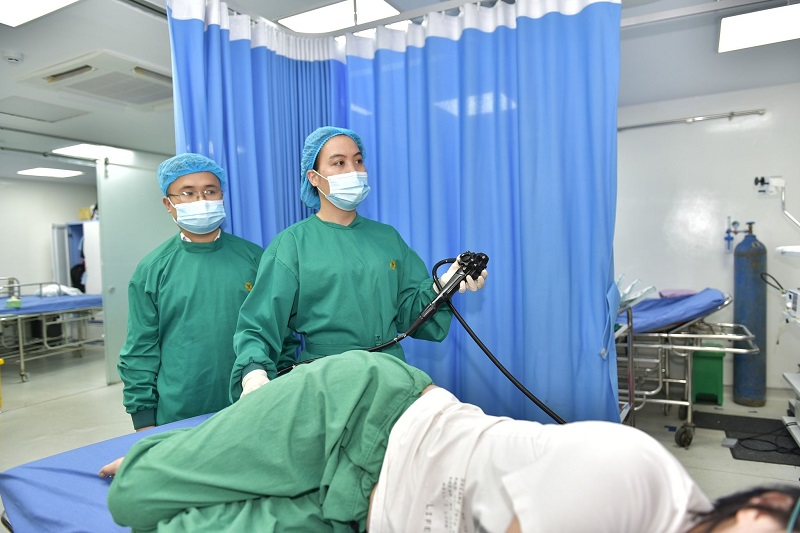
During a colonoscopy, a gastroenterologist or colorectal surgeon passes a flexible, camera-equipped tube through the entire colon, from the rectum to the cecum. The procedure takes approximately 20 to 45 minutes under sedation. When polyps are found — which happens in roughly 20–30% of screening colonoscopies — they are removed immediately. The pathology report on the removed polyps then determines when the next colonoscopy should happen.
If the colonoscopy is completely clean — no polyps, no abnormalities — the next scheduled scope is ten years later. This is the source of the common advice to “get a colonoscopy every ten years starting at 45 or 50.”
Colonoscopy requires bowel preparation the day before: a laxative solution that clears the colon so the camera has unobstructed visibility. Modern preparations come in split-dose formulations — half the evening before, half the morning of the procedure — that most patients find more manageable than older single-dose regimens. Preparation and sedation require a day off work and someone to drive home.
Sensitivity for cancer is greater than 95%. For large polyps (10mm or larger), sensitivity is also very high. For smaller adenomas (6–9mm), it drops to approximately 70–80%. For flat, sessile serrated lesions — which are pale and easily missed against the colon lining — sensitivity is lower, and operator quality matters: endoscopists with higher adenoma detection rates find more lesions and produce better outcomes for patients.
Complications are uncommon but real: perforation in approximately 1 in 1,000 procedures; post-polypectomy bleeding in approximately 1%. These rates are higher in elderly patients and those on anticoagulation, and should be weighed against the benefit of the procedure for each individual patient.

Stool Tests — FIT, gFOBT, and Cologuard
Stool-based tests offer a non-invasive alternative for patients who decline colonoscopy, face access barriers, or prefer to avoid preparation and sedation. Their key limitation is that a positive result requires a follow-up colonoscopy — and they do not prevent cancer, only detect it.
FIT (fecal immunochemical test): Done annually, FIT detects human hemoglobin in stool using species-specific antibodies. It requires no dietary restriction and no bowel preparation, and is done at home with a simple stool collection kit. Sensitivity for colorectal cancer is approximately 79% per round, with specificity around 95%. The most important thing about FIT is that it must be done every year without exception — missing even a single year meaningfully reduces cumulative protection.
gFOBT (guaiac FOBT): An older test that detects heme rather than human-specific hemoglobin, requiring three days of dietary restriction before testing. Largely superseded by FIT in most clinical settings due to inferior specificity and more demanding requirements.
Cologuard (multitarget stool DNA test): Cologuard combines FIT with stool DNA markers — KRAS mutations and methylated biomarkers — that colon cancers shed. Done every one to three years. Sensitivity for colorectal cancer is approximately 92%, and for advanced adenomas approximately 42% — better than FIT for catching cancer. However, specificity is approximately 87%, meaning roughly 13% of people without cancer or significant polyps will have a positive result, leading to colonoscopies they don’t need.
The follow-up gap: A positive stool test means nothing without a follow-up colonoscopy. Studies consistently find that 20–50% of patients with a positive FIT result do not receive a follow-up colonoscopy within six months. This gap converts a potentially life-saving early detection into a missed opportunity — and it is one of the most preventable causes of colorectal cancer death.
CT Colonography and the Shield Blood Test
Two additional options serve specific patient populations.
CT colonography (virtual colonoscopy): Done every five years, CT colonography uses computed tomography imaging to create three-dimensional images of the colon after it is inflated with carbon dioxide. No sedation is required. Sensitivity for polyps 10mm or larger is approximately 96%, comparable to conventional colonoscopy for large lesions. For polyps 6–9mm, sensitivity decreases to approximately 73%, and flat sessile serrated lesions are not well detected. Bowel preparation is required. Importantly, CT colonography finds incidental findings in other organs — kidneys, ovaries, aorta — in 40–70% of scans. Most are benign, but each one triggers additional workup, cost, and anxiety. Any polyp 6mm or larger found on CT colonography requires follow-up with conventional colonoscopy.
Shield (cell-free DNA blood test): The first blood-based colorectal cancer screening test approved by the FDA, cleared in July 2024. Shield detects circulating cell-free DNA shed by cancers into the bloodstream. Sensitivity is approximately 83% for colorectal cancer with specificity approximately 90%. It does not effectively detect precancerous polyps — in the ECLIPSE trial, sensitivity for advanced precancerous lesions was only about 13%. Shield is a cancer detection tool, not a cancer prevention tool. Its only requirement is a blood draw: no bowel preparation, no stool collection, no sedation. It is most appropriate as an option for patients who have declined every other form of colorectal cancer screening.
The principle is the same across all non-invasive tests: any screening is better than no screening. A patient who declines colonoscopy but agrees to annual FIT is substantially better protected than a patient who declines everything.
What Happens After a Positive Screening Result?
A positive result on any non-invasive test — FIT, Cologuard, Shield, or CT colonography — requires a follow-up colonoscopy. This is not optional or deferrable. The positive result indicates that cancer or a significant polyp may be present; confirming or excluding that finding requires direct visualization.
One billing distinction that surprises many patients: the follow-up colonoscopy after a positive stool test is classified as a “diagnostic colonoscopy,” not a “screening colonoscopy.” Under the Affordable Care Act, screening colonoscopies are covered without cost-sharing for most insurance plans. Diagnostic colonoscopies may be subject to deductibles and copays. Patients should ask their insurer about this distinction before the procedure.
A related issue is what is sometimes called the “colonoscopy loophole” or the upgrade problem: if a patient has a routine screening colonoscopy and polyps are removed, some insurance plans reclassify the procedure as diagnostic — triggering out-of-pocket costs even though the patient came in for routine screening. Federal rules finalized in 2023 require ACA-compliant plans to cover incidental polypectomy during a screening colonoscopy as a preventive service, effective for plan years starting in 2024. However, grandfathered plans and some Medicare Advantage plans may still apply cost-sharing. Verifying coverage in advance is worth the phone call.
Timing matters: a positive FIT result should be followed by a colonoscopy within three to six months. Studies show that delays beyond six months are associated with worse outcomes. The urgency of a positive screening test is real.
Surveillance After Polyps Are Found
When a colonoscopy finds and removes polyps, the next colonoscopy is scheduled based on what was found — not on a fixed ten-year timeline. The pathology report from each scope determines the next interval. Per current ACG and USMSTF 2020 guidelines:
- No polyps found: 10 years
- 1–2 small tubular adenomas (less than 10mm): 7–10 years
- 3–4 tubular adenomas, or 1 adenoma 10–19mm, or adenoma with tubulovillous/villous features or high-grade dysplasia: 3 years
- 5–10 adenomas, or any adenoma 20mm or larger: 1–3 years
- More than 10 adenomas: 1 year; consider genetic counseling referral
- Sessile serrated lesion less than 10mm, no dysplasia: 5 years
- Sessile serrated lesion 10mm or larger, or with dysplasia: 3 years
These intervals are not arbitrary. They reflect the time needed for a residual or new polyp to progress to a stage where it carries meaningful cancer risk. A patient who had one small tubular adenoma removed does not need another colonoscopy for seven to ten years. A patient who had five adenomas removed, including a large one, needs closer surveillance.
The most common misunderstanding in surveillance is assuming that a clean follow-up scope means the slate has been cleared permanently. It hasn’t. A colonoscopy that finds nothing after a history of high-risk polyps is reassuring — but surveillance continues on the schedule determined by the highest-risk prior finding, not by the most recent clean result.
Frequently Asked Questions
Does colonoscopy hurt?
No — most patients report no pain or discomfort. The procedure is performed under sedation, and patients are typically asleep or deeply relaxed throughout. The bowel preparation the day before can cause cramping and urgency, but the procedure itself is painless. Many patients say that the anxiety beforehand was far worse than the experience.
What if I’m afraid of the prep?
The bowel preparation is the most common reason patients delay or avoid colonoscopy. Modern preparations have improved significantly: split-dose protocols — half the evening before, half the morning of the procedure — are better tolerated than older single-dose regimens. Low-volume options exist for patients who struggle with large volumes. It is one uncomfortable evening in exchange for ten years of protection. Talking to your doctor about the available preparation options often changes the calculation.
Can I do a blood test instead of a colonoscopy?
Yes — the Shield blood test is FDA-approved for colorectal cancer screening and requires only a blood draw. However, it detects cancer with 83% sensitivity (compared to more than 95% for colonoscopy), does not detect polyps, and does not prevent cancer. Annual FIT or Cologuard every one to three years are better-supported non-invasive options for patients who want meaningful protection without colonoscopy. Shield is most useful as an entry point for patients who have declined every other form of screening.
Sources: USPSTF 2021; Davidson KW et al., JAMA 2021; Imperiale TF et al., NEJM 2014 (Cologuard); Chung DC et al., NEJM 2024 (Shield/ECLIPSE); Gupta S et al., ACG/USMSTF Colorectal Cancer Surveillance Guidelines, Gastroenterology 2020.
Making the Decision: Which Screening Test Is Right for You?
Current guidelines endorse multiple colorectal cancer screening options, recognizing that the “best” test is the one that is acceptable to the patient and will be completed consistently. The decision between colonoscopy and stool-based testing involves weighing test performance, convenience, invasiveness, and follow-through commitment.
Colonoscopy every 10 years offers the highest sensitivity and the ability to remove polyps at the same procedure, but requires bowel preparation and sedation, and carries small procedural risks. For patients who prefer non-invasive annual testing, FIT (fecal immunochemical test) annually is a validated alternative; its effectiveness depends on annual completion and prompt colonoscopy follow-up of any positive result. For patients who want a longer interval than annual FIT but prefer to avoid colonoscopy, Cologuard (stool DNA test) every 1–3 years is another FDA-approved option with higher sensitivity than FIT but a higher false-positive rate.
For patients with high-risk features — family history of colorectal cancer or advanced adenomas in a first-degree relative before age 60, personal history of inflammatory bowel disease, or a known hereditary syndrome (Lynch syndrome, FAP) — earlier and more frequent colonoscopy is recommended regardless of preference. For context on the symptom that most commonly triggers diagnostic colorectal evaluation, see our article on blood in stool and colon cancer. For an explanation of what is found on colonoscopy and what the surveillance implications are, see our guide to colon polyps. For the full colorectal cancer disease framework, see our main guide to colorectal cancer.
Disparities in Colorectal Cancer Screening
Colorectal cancer screening rates in the United States fall short of targets, with significant disparities by age, income, insurance status, and race/ethnicity. Black Americans have the highest colorectal cancer incidence and mortality of any racial group in the US — partly driven by higher rates of proximal (right-sided) cancers that are less likely to bleed and therefore less likely to be detected by stool tests. Both ACS and USPSTF have updated their guidelines to recommend screening starting at age 45 (rather than 50) partly in response to rising colorectal cancer incidence in younger adults, and partly to close the coverage gap for high-risk groups. Federally qualified health centers (FQHCs) and the CDC’s Colorectal Cancer Control Program (CRCCP) provide free or low-cost colorectal cancer screening to uninsured and underinsured patients.
Key Resources
- USPSTF — Colorectal Cancer Screening Recommendation
- American Cancer Society — Colorectal Cancer Screening Guidelines
- American College of Gastroenterology — Colorectal Cancer Screening
Lifestyle Factors and Colorectal Cancer Risk
Beyond screening, understanding the modifiable lifestyle factors that influence colorectal cancer risk provides patients with actionable prevention strategies that complement regular colonoscopy or stool-based testing programs. Colorectal cancer is one of the cancers most strongly linked to modifiable risk factors, and the evidence for several preventive behaviors is substantial enough to have influenced clinical guidelines.
Diet: A diet high in red and processed meat is one of the most consistently documented dietary risk factors for colorectal cancer. The International Agency for Research on Cancer (IARC) classifies processed meat (bacon, sausage, hot dogs, deli meats) as a Group 1 carcinogen for colorectal cancer, and red meat as a Group 2A probable carcinogen. The mechanism involves N-nitroso compounds, heme iron, and heterocyclic amines formed during high-temperature cooking. Conversely, diets high in dietary fiber — particularly from whole grains, legumes, fruits, and vegetables — are associated with reduced colorectal cancer risk, likely through effects on fecal transit time, gut microbiome composition, and fermentation of fiber to short-chain fatty acids (SCFAs) that promote colonocyte health.
Physical activity: Regular physical activity is associated with a 20–25% reduction in colorectal cancer risk in prospective cohort studies. The protective effect appears strongest for colon cancer compared to rectal cancer, and for vigorous activity compared to light activity. Physical activity may reduce colorectal cancer risk through effects on insulin resistance, inflammatory markers, prostaglandin synthesis, and bowel transit time. The ACS recommends at least 150–300 minutes of moderate-intensity activity or 75–150 minutes of vigorous activity per week for cancer prevention.
Body weight: Obesity — particularly central adiposity — is a significant colorectal cancer risk factor. Adipose tissue produces inflammatory cytokines and increases circulating insulin and insulin-like growth factor 1 (IGF-1), which promote colonic epithelial proliferation. Weight loss in overweight individuals is associated with reduced colorectal cancer risk, though the magnitude of risk reduction depends on the degree and duration of weight loss.
Alcohol: Alcohol consumption is associated with increased colorectal cancer risk in a dose-dependent manner. The ACS classifies alcohol as a Group 1 carcinogen for colorectal cancer; even moderate drinking (1–2 drinks/day) is associated with a measurable increase in risk. The mechanism involves acetaldehyde (a toxic alcohol metabolite), folate depletion (alcohol impairs folate absorption and metabolism), and oxidative stress.
Aspirin and NSAIDs: Regular aspirin use has been shown to reduce colorectal cancer incidence and mortality in observational studies and several randomized trials. The protective effect of aspirin on colorectal cancer is attributed to inhibition of cyclooxygenase-2 (COX-2), which mediates prostaglandin E2 synthesis — a key driver of colorectal tumor proliferation. However, USPSTF does not recommend aspirin specifically for colorectal cancer prevention because of the bleeding risk, and the decision to use aspirin should be based on the individual’s cardiovascular risk-benefit profile in consultation with their physician.
For patients who receive an abnormal colorectal cancer screening result — whether a positive FIT, a positive Cologuard, or an elevated Shield blood test score — the next step is always a diagnostic colonoscopy. The importance of prompt follow-up cannot be overstated: studies show that delays of six months or more between a positive stool test and follow-up colonoscopy are associated with significantly worse colorectal cancer outcomes compared to follow-up within three months. If you have received a positive stool-based screening result, contact your healthcare provider immediately to schedule a colonoscopy — do not wait until your next routine appointment. For complete guidance on the colonoscopy procedure and what to expect, see our detailed article on colonoscopy.
I shared this article on colorectal cancer screening: tests, age, and with my doctor and they appreciated the level of detail. I appreciated how the article addressed both the clinical side and the practical lifestyle adjustments. Thank you for making complex medical information accessible without dumbing it down.
Came across this while researching colorectal cancer screening: tests, age, and for a family member. I have tried following advice from several sources but this is the most consistent with what my specialist told me. Will definitely be coming back to this site for more health information.
Really well-written article on colorectal cancer screening: tests, age, and. It is refreshing to see an article that acknowledges individual variation rather than giving one-size-fits-all advice. Thank you for making complex medical information accessible without dumbing it down.
Came across this while researching colorectal cancer screening: tests, age, and for a family member. The section on managing this condition day-to-day was especially useful for planning. This is going into my health folder that I bring to every doctor’s visit.
I have been reading about colorectal cancer screening: tests, age, and for weeks and this is the most thorough guide I found. The article answered questions I didn’t even know I had until I started reading. This is going into my health folder that I bring to every doctor’s visit.
Really well-written article on colorectal cancer screening: tests, age, and. I appreciate that the article is careful about distinguishing between what is known and what is still being researched. Exactly the kind of evidence-based information that is hard to find in one place.