

Adults with diabetes travel everywhere — on business, for holidays, for family visits, for adventure. Diabetes does not prevent travel. It requires preparation that travelers without diabetes don’t need. The preparation investment is modest relative to the disruption it prevents: a glucose crisis in an unfamiliar city, without supplies or documentation, in a language you don’t speak, is a preventable medical emergency. This guide covers the complete pre-travel preparation process, airport and transit management, glucose management in unfamiliar food environments, time zone adjustment for medication timing, and what to do when diabetes-related problems occur away from home.
The most important principle of travel with diabetes is simple: carry everything in your carry-on luggage, bring twice as much as you think you need, and have a plan for glucose emergencies before you need it. Everything else follows from that foundation.
Pre-Travel Preparation — The Four Weeks Before Departure
The Medical Appointment — At Least 4 Weeks Before Travel
Schedule a pre-travel appointment with your diabetes care team at least 4 weeks before departure. The appointment should cover four specific topics. First, medication adequacy: ensure prescriptions are current and can be filled with enough supply for the trip plus 50% backup. Second, documentation: obtain a letter on practice letterhead listing your diagnosis, all medications with generic names and doses, and a statement that you carry syringes, pen needles, lancets, or other sharps for medical use. This letter is essential for airport security and for accessing medication at a foreign pharmacy if needed. Third, destination-specific guidance: some destinations — high altitude, tropical climates, very hot or very cold environments — require specific medication adjustments. High altitude can affect insulin absorption. Extreme heat degrades insulin. Your care team can advise on destination-specific adjustments. Fourth, time zone medication adjustment: for trips crossing more than 3 time zones, get specific guidance on how to adjust medication timing during travel and in the destination time zone. Our doctor visit checklist for diabetes guide covers how to prepare for and get the most from your pre-travel appointment, including the complete question list to bring.
The Travel Supply List
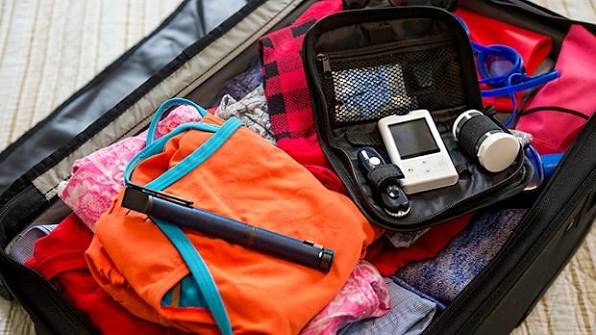
Pack all diabetes supplies in carry-on luggage — never in checked baggage, which can be lost, delayed, or damaged. Pack at minimum twice the expected need of every supply:
- All medications: insulin (in original pharmacy packaging with label), oral medications, GLP-1 medications
- Blood glucose monitoring supplies: meter, test strips, lancets, lancing device — double supply
- CGM supplies if applicable: sensors, transmitters, receiver — extra sensors beyond expected need
- Insulin delivery supplies: syringes or pen needles beyond expected need; insulin pump supplies including extra infusion sets, reservoirs, and batteries
- Fast-acting glucose sources: glucose tablets (at least 3–4 tubes), juice boxes, or glucose gel — in accessible pockets, not buried in the bottom of a bag
- Ketone testing strips (especially for Type 1 adults)
- Glucagon emergency kit or nasal glucagon
- Medical identification jewelry or card
- Doctor’s letter and insurance documentation copies
- List of generic medication names for foreign pharmacy access
- Insulated medication case for temperature-sensitive medications
Airport and Air Travel — Managing Security and In-Flight Glucose
Navigating Airport Security With Diabetes Supplies
Airport security in most countries accommodates diabetes supplies with the doctor’s letter and proper packaging. In the US, the TSA specifically permits insulin, syringes, glucagon kits, glucose meters and test strips, CGM devices, insulin pumps, and liquid glucose sources (juice, glucose gel) through security with the medical letter. Declare all diabetes supplies to security before screening begins. Do not put CGM sensors, insulin pumps, or receivers through X-ray machines if possible — request a manual pat-down instead, as repeated X-ray or millimeter wave exposure may damage some devices. Check the manufacturer’s guidance for your specific device before travel. International airports vary in security procedures — the doctor’s letter in the local language significantly reduces friction at foreign airports.
In-Flight Glucose Management
Air travel affects blood glucose in several ways. Cabin pressure changes, dehydration from recycled cabin air, disrupted meal timing, reduced physical activity, and stress of transit all influence glucose. On flights over 3 hours, check glucose every 2–3 hours. Keep fast-acting glucose immediately accessible — in a seat pocket, not in the overhead bin — for the duration of the flight. Inflight meals are typically high in refined carbohydrates. If the flight meal significantly raises glucose, a 15-minute aisle walk after eating reduces the post-meal spike — the same mechanism as our walking after meals for blood sugar guide covers for home environments. Request a diabetic meal option when booking — many airlines offer lower-carbohydrate meal options that require advance selection. Drink water consistently throughout the flight. Dehydration concentrates blood glucose and worsens the effects of any hyperglycemia that develops during travel.
Time Zone Changes and Medication Timing
Adjusting Insulin Timing Across Time Zones
Time zone changes create the most complex diabetes management challenge of international travel. The approach depends on the type of insulin or medication, the direction of travel (eastward or westward), and the number of time zones crossed. For westward travel — which extends the day — the general approach is to take basal insulin at the usual local time in the destination (which arrives later than the home departure time), and add small supplemental rapid-acting insulin doses to cover the extended period if glucose rises. For eastward travel — which shortens the day — the general approach is to skip or reduce the basal insulin dose that falls in the transition period, taking it at the usual time in the destination (which arrives earlier than home timing). These are general principles — your care team should provide specific written guidance for your medication regimen and trip direction before departure. Follow their instructions, not general guidance, for insulin timing specifically.
Oral Medications and Non-Insulin Diabetes Medications
Most oral diabetes medications (metformin, sulfonylureas, SGLT-2 inhibitors) are taken once or twice daily and adjust to destination time zone simply by shifting to local meal times upon arrival. The transition day — when schedules overlap across time zones — may require taking a dose slightly early or late to maintain approximately the correct interval. A gap of 4–6 hours from the usual interval on the transition day is generally acceptable for most oral medications, but confirm with your care team or pharmacist for your specific medications. GLP-1 receptor agonists taken weekly (semaglutide, dulaglutide) are minimally affected by time zone changes — the weekly interval accommodates a few hours of shift without clinical significance.
Food and Glucose Management in Unfamiliar Food Environments
Eating in Unfamiliar Cuisines
One of the genuine pleasures of travel is experiencing local food — and diabetes should not prevent this. The practical approach is to apply the same principles that work at home: prioritize protein and non-starchy vegetables as the base of the meal, limit white rice, bread, and noodles to smaller portions, and check glucose 2 hours after new foods to understand their glycemic impact. Some cuisines that appear high-carbohydrate produce less glucose elevation than expected — the fiber content, cooking method, and glycemic index of traditional foods vary significantly from processed Western food equivalents. Checking glucose after new meals provides direct feedback about which local foods need portion adjustment and which are manageable. The blood sugar monitoring and logging approach for understanding individual food responses is covered in our blood sugar log and tracking guide.
Restaurant Strategies — Practical Ordering Approaches
In restaurants while traveling, the same basic strategies apply regardless of cuisine type. Ask for sauces and dressings on the side — many restaurant sauces contain unexpected sugar. Request extra vegetables as a side substitution where available. Choose grilled, baked, or steamed preparations over fried or breaded. For portions that are very large — common in American restaurants and some tourist destinations — plan to eat half and save the rest, or share with a travel companion. If the language barrier makes special requests difficult, the simplest request in the local language — “without sauce” or “more vegetables” — is worth learning before departure. Our stress eating and blood sugar guide covers how the stress of travel — disrupted schedules, unfamiliar environments, logistical pressure — can drive emotional eating patterns that affect glucose management during trips, alongside practical strategies for managing stress-driven food choices in travel environments.
Managing Diabetes Emergencies While Traveling
Hypoglycemia Away From Home
Hypoglycemia while traveling is the most common diabetes emergency in travel settings. Treat it identically to home: 15 grams of fast-acting carbohydrate, wait 15 minutes, recheck glucose. Always carry glucose tablets in an accessible outer pocket — not buried in luggage. In tourist areas, pharmacies and convenience stores usually stock juice or regular soda. Glucose tablets, once found, should be stocked in local supply as well as carry-on. Tell travel companions about the symptoms of hypoglycemia and what to do if you become confused or unresponsive — including where you carry fast-acting glucose and where the glucagon emergency kit is stored.
Finding Medical Care Abroad
Know before you leave how to access diabetes medication and medical care at your destination if needed. The international SOS service, your travel insurance emergency line, and embassy medical referral services can all direct you to English-speaking physicians or pharmacies in most countries. Most developed countries’ pharmacies can supply basic diabetes medications with the doctor’s letter — though brand names differ and some insulins may not be available in exactly the same formulation as at home. The generic medication names on your doctor’s letter allow pharmacists to identify the closest available equivalent. Our sick-day planning for diabetes guide covers what to do when illness compounds the glucose management challenge during travel — including when to seek emergency care versus manage at the accommodation. The family support guide covering how travel companions can provide genuinely helpful support during travel — including how to help manage glucose emergencies without taking over autonomous management — is in our family support for diabetes management guide. The building healthy habits guide that covers the habit maintenance approach during travel — preserving the essential behaviors while suspending non-essential ones — is in our building healthy habits with diabetes guide. The emotional health guide covering the burnout-prevention approach for adults who find travel particularly depleting due to the compound demands of diabetes management in unfamiliar environments is in our emotional health and diabetes management guide. The annual care checklist that includes a pre-travel review slot alongside standard annual clinical metrics is in our annual diabetes care checklist. The ADA’s traveling with insulin guide covers insulin storage, security navigation, and international travel specifics for insulin-dependent adults with diabetes. The NIDDK’s diabetes management overview covers the clinical framework for diabetes management during travel and lifestyle disruption. The CDC’s travelers with diabetes health notice covers destination-specific considerations and preventive health guidance for international travel with diabetes.
Insulin Storage During Travel — Temperature Management
How Temperature Affects Insulin
Insulin is temperature-sensitive. Opened insulin kept at room temperature (below 77°F / 25°C) remains stable for 28–30 days in most formulations. Unopened insulin must be refrigerated (36–46°F / 2–8°C). Insulin exposed to temperatures above 86°F (30°C) — or to freezing temperatures — degrades and loses potency. In hot climates, a car parked in direct sun reaches temperatures well above 100°F within minutes — insulin left in a glove compartment or center console can be destroyed in a single afternoon. Travel to tropical or desert destinations requires an insulated medication case with ice packs (that are kept cold, not frozen solid). Airports in hot climates, outdoor excursion vehicles, and hotel rooms without reliable air conditioning all pose temperature risks for insulin storage. Insulin that has been heat-degraded typically appears cloudy when it should be clear, or has visible particles — though degradation is not always visible. If insulin quality is suspected, use a new vial or pen and recheck glucose 2–3 hours after administration to confirm efficacy. FRIO cooling wallets — fabric pouches that use water-activated evaporative cooling — are highly practical for travel insulin storage without requiring ice or refrigeration, and are designed specifically for the temperature ranges that standard travel produces.
Pump Users — Additional Considerations
Adults using continuous subcutaneous insulin infusion (insulin pump) face additional travel logistics. Security screening: request a manual pat-down rather than passing the pump through the X-ray scanner — most manufacturers advise against X-ray exposure. The pump’s insulin reservoir and all infusion set components should be packed in carry-on luggage with the same double-supply standard as other diabetes supplies. Altitude changes — on airplanes — can create small air bubbles in insulin pump tubing that affect delivery accuracy. Priming the pump after landing and rechecking glucose confirms accurate delivery in the post-flight period. Battery supply for the pump controller must be packed — standard AA or AAA batteries are widely available internationally, but lithium or specialty batteries may not be. Pump users traveling internationally for the first time should contact the pump manufacturer’s support line before departure to ask about destination-specific considerations, regional support availability, and what to do if the pump fails during travel. Our safe exercise with diabetes guide covers pump management during physical activity — relevant for active travel that includes hiking, swimming, or high-altitude trekking.
CGM Use During Travel — Calibration and Accuracy
Altitude, Pressure, and CGM Accuracy
Continuous glucose monitors (CGMs) are accurate for most standard travel conditions. High altitude — above 8,000 feet — can affect sensor accuracy in some CGM systems. If traveling to high-altitude destinations (mountain hiking, high-altitude cities), verify your CGM model’s stated altitude limitation in the product specifications. During the initial days at high altitude, confirm CGM readings with fingerstick testing more frequently than usual. Airplane cabin pressure is generally equivalent to 6,000–8,000 feet altitude — within the operating range of most CGMs — though some users notice brief reading fluctuations during takeoff and landing. These are transient and self-correct without intervention. Sensor adhesion is a practical travel concern in hot, humid climates or swimming environments. Bring additional overlay patches or skin prep wipes (IV3000, SkinTac) to extend sensor adhesion in high-perspiration environments. Sensor changes during travel should be timed to avoid the sensor warm-up period during active transit segments — a sensor in the 2-hour warm-up period requires fingerstick backup testing during that time, which adds complexity to an already demanding transit environment.
Long-Term Travel — Extended Trips With Diabetes
Trips of 2 Weeks or Longer
Extended travel — multiple weeks or months, common in remote work, sabbatical, or retirement travel — requires additional preparation beyond the standard pre-trip checklist. For trips of 2 weeks or longer: identify a diabetes-experienced physician at the destination in advance, through international medical networks or the destination country’s diabetes association. Establish medication resupply channels — confirm whether your medications are available locally, under what brand names, and at what cost. Register with your home country’s embassy or consular service at the destination — for emergencies requiring medical evacuation or emergency consular assistance. If traveling to a country where your health insurance doesn’t apply, purchase comprehensive travel health insurance with evacuation coverage before departure — the cost of air evacuation from a developing country can exceed $50,000 USD without insurance. Research diabetes support communities at the destination: online groups for expatriates with diabetes often have practical, destination-specific guidance that no travel guide can match. The building healthy habits guide that covers how to maintain essential self-care routines during extended periods away from the established home environment — when all the familiar cues and supports for diabetes habits are absent — is in our building healthy habits with diabetes guide. The sick-day planning guide that covers what to do when illness strikes during extended travel — when the home care team is unavailable and local medical resources are unfamiliar — is in our sick-day planning for diabetes guide. The diabetes burnout guide that covers the emotional exhaustion that extended travel can trigger for adults who find the combined demands of travel management and diabetes management cumulative — is in our diabetes burnout guide. The family support guide covering how to coordinate with family members who are providing remote support during travel — monitoring communication schedules, knowing when to escalate concern, and how to help without controlling — is in our family support for diabetes management guide. The emotional health guide that covers stress management techniques specifically for the high-stress, routine-disrupting environment of extended travel is in our emotional health and diabetes management guide.
Managing Exercise and Activity During Travel
Increased Physical Activity — Holiday Walking and Glucose
Travel typically involves significantly more walking than a normal day at home — hours of sightseeing, navigating airports, exploring cities. This increased physical activity generally lowers blood glucose — which is a benefit, but requires awareness to prevent hypoglycemia. Adults who take insulin should monitor glucose more frequently on high-activity travel days and have fast-acting glucose accessible at all times. If using insulin doses calibrated to a sedentary home lifestyle, activity significantly higher than usual may require a temporary reduction in basal insulin or correction boluses. This adjustment should be discussed with your care team before departure. Adults on oral medications that don’t cause hypoglycemia (metformin, SGLT-2 inhibitors) can generally increase activity freely without hypoglycemia concern — though increased activity with SGLT-2 inhibitors in hot, sweaty conditions requires careful hydration to avoid the dehydration that increases DKA risk with this medication class. The exercise physiology and glucose management framework for different exercise types and intensities is covered in our safe exercise with diabetes guide. For post-meal walking as a specific glucose management tool during restaurant meals in travel — a highly effective strategy for managing the higher-carbohydrate restaurant meals common in travel — the mechanism and timing protocol is in our walking after meals for blood sugar guide.
High-Risk Activities — Scuba Diving, High Altitude, Endurance Sports
Some travel activities carry elevated diabetes risk and require specific pre-trip preparation and medical clearance. Scuba diving: hypoglycemia underwater is life-threatening and scuba-certifying agencies have specific fitness requirements for divers with diabetes. The Divers Alert Network (DAN) has published guidelines for diving with diabetes. Consult your care team and review DAN guidance before planning a dive trip. High-altitude trekking: altitude affects insulin absorption and glucose meter accuracy. Acclimatization also affects glucose. Adults planning trekking above 10,000 feet should receive specific altitude-related guidance from a physician with wilderness medicine or high-altitude medicine experience. Endurance sports during travel (long cycling routes, multi-day hiking): the combination of extended exertion, unfamiliar food, irregular timing, and travel stress requires a detailed glucose management plan developed specifically for the activity, not the standard travel plan. The blood glucose monitoring framework for exercise intensity and duration — the foundation for any active travel plan — is in our blood sugar and exercise guide. The annual care checklist that includes a pre-travel clearance review for higher-risk activities alongside standard clinical metrics is in our annual diabetes care checklist.
Sources: American Diabetes Association Standards of Care in Diabetes 2024; TSA Medical Conditions and Special Circumstances Guidelines 2024; CDC Travelers with Diabetes 2024; NIDDK Diabetes Management Overview 2024; International Society for Travel Medicine Diabetes Travel Guidance 2023.
Thank you for covering traveling with diabetes so thoroughly without being overly technical. I have tried following advice from several sources but this is most consistent with what my specialist told me. Appreciate the effort that went into researching and writing this — it shows.
Really well-written article on traveling with diabetes. The specific numbers and thresholds mentioned are exactly what I needed to understand my results. Will definitely be coming back to this site for more health information.
This is one of the clearest explanations of traveling with diabetes I have found. What I liked most was that the article didn’t just say what to avoid — it also gave alternatives. Looking forward to reading more articles from this website.