

Seeing blood in the toilet — on the toilet paper, in the bowl, or mixed into your stool — is frightening. It is also one of the most significant warning signs your body can produce. And yet, more often than not, people explain it away: “It must be hemorrhoids.” “I was constipated.” “It’s probably just a little irritation.”
This understandable impulse to self-reassure is responsible for thousands of delayed colorectal cancer diagnoses every year. Colorectal cancer — the third most diagnosed cancer and second leading cause of cancer death in the United States — frequently announces itself through rectal bleeding. Catching that signal early changes everything.
Types of Blood in Stool: What Each Means
Hematochezia — bright red blood — indicates a source in the lower gastrointestinal tract: the sigmoid colon, rectum, or anus. It can also occur with a massive upper GI bleed that moves through the colon too quickly to be digested. Bright red blood on toilet paper, dripping into the bowl, or coating the outside of stool points to the lower GI tract.
Melena — black, tarry, malodorous stool — indicates an upper GI source: the esophagus, stomach, or duodenum. Blood darkens as it travels through the intestine because hemoglobin is chemically altered by digestive enzymes. Melena has a distinctive appearance and smell that clinicians recognize immediately.
Occult blood — invisible to the naked eye but detectable by fecal occult blood testing (FOBT) or fecal immunochemical testing (FIT). This slow, repetitive seeping from a tumor surface is the most common form of colorectal cancer-associated bleeding and the basis of the most effective colorectal cancer screening programs.
Coffee-ground emesis — vomited material resembling coffee grounds — is partially digested blood from upper GI bleeding and requires urgent evaluation.
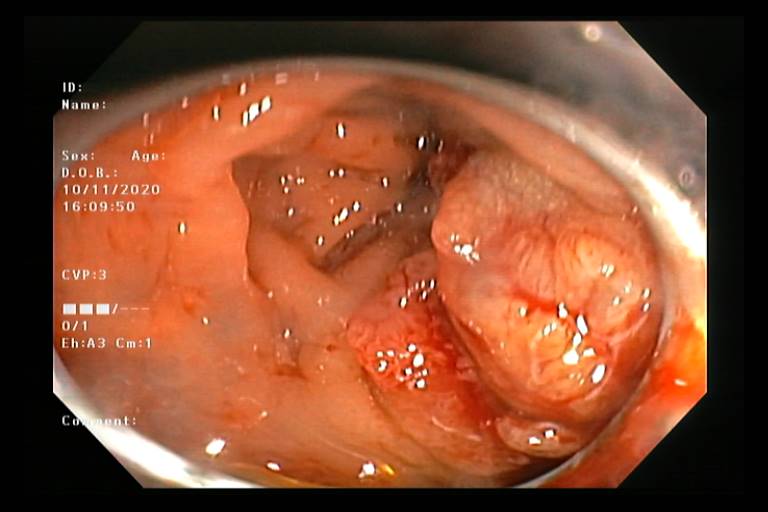
Colorectal Cancer: The Most Important Diagnosis to Rule Out
Approximately 153,000 Americans are diagnosed with colorectal cancer annually. It is the third most common cancer diagnosis and the second leading cause of cancer death. Approximately 80 percent of colorectal cancer patients have some form of gastrointestinal bleeding — overt rectal bleeding or occult blood detectable by testing.
| Location | Bleeding Presentation | Other Symptoms |
|---|---|---|
| Left-sided CRC (sigmoid, rectum) |
Visible bright red rectal bleeding; blood coating formed stool | Narrowed stool caliber, tenesmus, change in bowel habits |
| Right-sided CRC (cecum, ascending) |
Occult blood only; iron deficiency anemia | Fatigue, pallor, breathlessness; weight loss |
| Anal cancer | Bright red rectal bleeding; anal mass | Anal pain; change in bowel habits; HPV history |
| Gastric cancer | Melena; coffee-ground vomiting; hematemesis | Epigastric pain, early satiety, weight loss |
| Small bowel (GIST / lymphoma) | Intermittent dark or bright red bleeding | Obscure GI bleeding; may require capsule endoscopy |
Hemorrhoids are extraordinarily common. But hemorrhoids and colorectal cancer can coexist in the same patient. The presence of a bleeding hemorrhoid does not exclude a concurrent colorectal cancer. The clinical rule is unambiguous: any adult 45 or older with unexplained rectal bleeding who has not had an adequate colonoscopy should have a colonoscopy — not reassurance and suppositories.
Hemorrhoids do not cause weight loss. They do not cause change in bowel habits. They do not cause anemia. When rectal bleeding is accompanied by any of these features, the threshold for urgent colonoscopy is even lower.
Gastric and Esophageal Cancer: Upper GI Bleeding
Gastric cancer — cancer of the stomach — kills approximately 11,000 Americans annually. Its presentation is insidious: early-stage gastric cancer often causes no symptoms, or subtle symptoms easily attributed to GERD — bloating, upper abdominal discomfort, early satiety. As gastric cancer grows and ulcerates, bleeding develops: melena, coffee-ground emesis, or frank hematemesis with more acute bleeding, and iron deficiency anemia from chronic occult loss.
The critical rule for upper GI symptoms: any combination of epigastric pain, early satiety, or weight loss with upper GI bleeding requires upper endoscopy (EGD). PPIs and H. pylori treatment should not be initiated for upper GI alarm symptoms without first ruling out malignancy.
Esophageal cancer causes bleeding primarily when advanced — tumor erosion into adjacent vessels or tracheoesophageal fistula in late-stage disease. Odynophagia (painful swallowing) with hematemesis in any adult is an indication for urgent upper endoscopy.
Occult Blood: The Invisible Signal Behind Colorectal Cancer Screening
The most common form of colorectal cancer-related bleeding is invisible. FIT (fecal immunochemical test) detects human hemoglobin in stool using antibodies — a highly specific test that detects colorectal blood without detecting bleeding from dietary meat or other GI sites. Annual FIT is the most widely validated stool-based colorectal cancer screening test.
A positive FIT is not a minor finding to be rechecked or observed. It is an indication for colonoscopy within one to three months. Every year of delay after a positive FIT result is associated with increased colorectal cancer stage at diagnosis.
New iron deficiency anemia in any adult male or post-menopausal woman = GI malignancy until proven otherwise. Right-sided colorectal cancer classically presents this way — slow, invisible bleeding over months producing fatigue, pallor, and breathlessness without any visible rectal bleeding. Workup requires bidirectional endoscopy: both upper endoscopy (EGD) and colonoscopy.
Colorectal Cancer Screening: Prevention Is Better Than Early Detection
Colorectal cancer is among the most preventable cancers. Adenomatous polyps take 10 to 15 years to develop into invasive cancer. Colonoscopy both detects and removes these precursors in the same procedure — breaking the natural history before it reaches cancer.
- Colonoscopy: every 10 years from age 45 (average risk)
- FIT (fecal immunochemical test): annually; positive result requires colonoscopy within 1–3 months
- Cologuard (stool DNA test): every 3 years; positive result requires colonoscopy
- High-risk groups: first-degree relative with CRC before 60, prior adenomatous polyps, Lynch syndrome, IBD — start earlier and screen more frequently
When GI Bleeding Requires Emergency Evaluation
The following presentations require immediate emergency department evaluation:
- Frank hematemesis (vomiting bright red blood)
- Coffee-ground vomiting with dizziness, rapid heart rate, or low blood pressure
- Melena with hemodynamic instability
- Massive rectal bleeding with hemodynamic changes (shock)
Frequently Asked Questions
References
- Siegel RL, et al. Colorectal Cancer Statistics, 2023. CA Cancer J Clin. 2023.
- NCCN Clinical Practice Guidelines: Colon Cancer; Rectal Cancer; Anal Carcinoma. 2024.
- American Cancer Society. Colorectal Cancer Screening Guidelines. 2018.
- Rex DK, et al. Colorectal cancer screening recommendations. Am J Gastroenterol. 2017.
- USPSTF. Colorectal Cancer Screening. JAMA. 2021.
- Paskett ED, et al. Association of annual FIT with colorectal cancer detection. JAMA Oncol. 2020.
Really well-written article on blood in stool and cancer: why. The specific numbers and thresholds mentioned are exactly what I needed to understand my lab results. This gave me real confidence going into my next specialist appointment.
Really well-written article on blood in stool and cancer: why. It is refreshing to see an article that acknowledges individual variation rather than giving one-size-fits-all advice. Looking forward to reading more articles from this website.
Bookmarked this article on blood in stool and cancer: why immediately — going to reference it regularly. The article answered questions I didn’t even know I had until I started reading. Exactly the kind of evidence-based information that is hard to find in one place.
Thank you for covering blood in stool and cancer: why so thoroughly without being overly technical. I appreciate that the article is careful about distinguishing between what is known and what is still being researched. Keep up this kind of thorough health journalism — it genuinely helps patients like me.
As someone dealing with this personally, the blood in stool and cancer: why section was very helpful. The practical tips made this immediately actionable, not just theoretical. Keep up this kind of thorough health journalism — it genuinely helps patients like me.
This is one of the clearest explanations of blood in stool and cancer: why I have found. The practical tips made this immediately actionable, not just theoretical. I wish I had found this article earlier — would have saved a lot of confusion.