

Blood Thinners: Why They Are Used
The term “blood thinners” is one of the most widely used but poorly understood phrases in cardiovascular medicine. These medications do not literally thin the blood — they do not change blood viscosity or make it more watery. What they do is reduce the blood’s tendency to form clots, through two distinct pharmacological mechanisms targeting either the coagulation cascade (anticoagulants) or platelet aggregation (antiplatelet agents). Understanding which type of blood thinner you take, why it was prescribed, and what makes it appropriate for your specific condition is essential for using these medications safely and effectively.
Blood thinners are among the most commonly prescribed medications in cardiovascular care — and among the most consequential. They prevent life-threatening strokes in atrial fibrillation, treat deep vein thrombosis before it becomes a pulmonary embolism, and reduce the risk of stent thrombosis after coronary procedures. They also carry the most significant bleeding risks of any regularly prescribed medication class. This article explains the major blood thinner types, the evidence behind each, the conditions they treat, and the safety considerations that matter most for patients taking them.
Why Blood Thinners Are Prescribed
Blood thinners are prescribed whenever the risk of pathological clot formation outweighs the risk of bleeding from the anticoagulant or antiplatelet agent itself. The balance of these risks differs substantially by condition.
Atrial fibrillation (AF) is the most common indication for long-term anticoagulation. In AF, the chaotic electrical activity in the atria causes ineffective atrial contraction — blood pools in the left atrium and left atrial appendage, where it can stagnate and form clots. If those clots embolize to the cerebral circulation, the result is an ischemic stroke. AF increases stroke risk approximately five-fold compared to the general population, and AF-associated strokes are particularly large and disabling because the clots originate from the heart rather than from small intracranial arteries. The CHA2DS2-VASc scoring system (assigning points for congestive heart failure, hypertension, age 75+, diabetes, prior stroke, vascular disease, age 65-74, and female sex) is used to estimate individual stroke risk and guide anticoagulation decisions. A CHA2DS2-VASc score of 0 in a male patient warrants no anticoagulation; a score of 1 in men or 2 in women indicates that anticoagulation benefit likely outweighs risk for most patients.
Deep vein thrombosis (DVT) and pulmonary embolism (PE) — collectively venous thromboembolism (VTE) — are the second major indication for anticoagulant therapy. DVT forms in the deep veins of the legs (and less commonly the arms or pelvis) when blood flow slows and coagulation is activated — typically from prolonged immobility, surgery, cancer, inherited clotting disorders, or other hypercoagulable states. DVT itself causes leg pain, swelling, and warmth, but its most dangerous complication is pulmonary embolism, where a clot breaks off and lodges in the pulmonary arteries, compromising oxygenation and right heart function. Anticoagulation prevents clot extension and new clot formation, allowing the body’s fibrinolytic system to gradually dissolve the existing clot over weeks to months.
Mechanical heart valves require lifelong anticoagulation because the mechanical surfaces generate turbulent blood flow and trigger platelet activation and clot formation. This is one of the few remaining indications where warfarin is definitively required over DOACs — more on this below.
Post-coronary intervention: After coronary stenting, the bare metal or drug-coated stent surface is thrombogenic until the vessel wall has grown over it. Dual antiplatelet therapy (DAPT) — combining aspirin with a P2Y12 inhibitor — is prescribed for 6 to 12 months after stenting to prevent stent thrombosis, which can cause sudden, complete coronary occlusion and acute MI.
Warfarin — The Original Anticoagulant
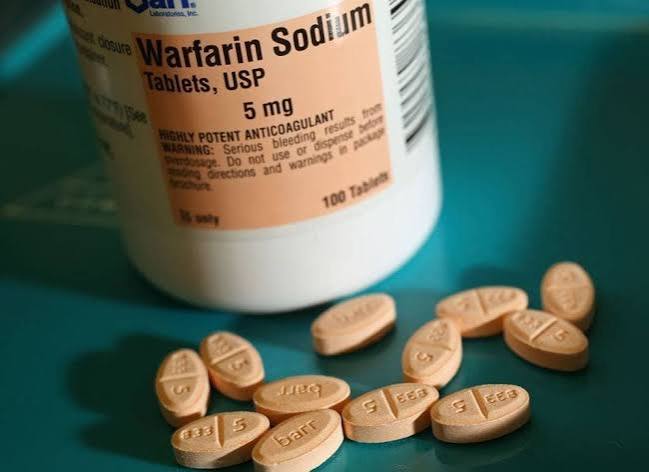
Warfarin (Coumadin) has been used as an anticoagulant for over 60 years and remains clinically essential for certain specific indications. It is a vitamin K antagonist — it inhibits the enzyme VKORC1 that recycles vitamin K, which is required for the synthesis of clotting factors II, VII, IX, and X as well as the natural anticoagulant proteins C and S. Reduced clotting factor production extends the time it takes blood to clot.
Warfarin’s primary clinical challenge is its highly variable and unpredictable pharmacokinetics. Hundreds of medications and dietary factors affect warfarin’s activity, making dose management a continuous balancing act. Regular INR (international normalized ratio) monitoring is mandatory — the INR measures how long it takes blood to clot relative to normal, with a target of 2.0 to 3.0 for most indications (atrial fibrillation, DVT/PE treatment) and 2.5 to 3.5 for mechanical mitral valve replacement. Time in therapeutic range (TTR) — the percentage of INR readings within the target range — should ideally exceed 65 to 70% for effective anticoagulation and to justify maintaining warfarin over switching to a DOAC. Below this TTR, the risk of both stroke (when INR is low) and bleeding (when INR is high) increases significantly.
Warfarin reversal: in cases of life-threatening bleeding or urgent surgery, warfarin can be reversed with vitamin K (administered orally or intravenously — takes several hours), four-factor prothrombin complex concentrate (4-factor PCC, which directly replaces the depleted clotting factors within minutes), or fresh frozen plasma (slower, requires larger volumes). Vitamin K alone is insufficient for emergencies requiring immediate reversal.
Direct Oral Anticoagulants (DOACs) — Modern Anticoagulation
Direct oral anticoagulants have largely replaced warfarin for most anticoagulation indications over the past 15 years, based on large randomized trials showing equivalent or superior efficacy with significantly better safety profiles, particularly for the most feared complication — intracranial hemorrhage.
Four DOACs are currently approved for atrial fibrillation stroke prevention and VTE: apixaban (Eliquis), rivaroxaban (Xarelto), dabigatran (Pradaxa), and edoxaban (Savaysa). The first three are factor Xa inhibitors (blocking the factor that converts prothrombin to thrombin, the final step in fibrin clot formation); dabigatran directly inhibits thrombin itself. All four share advantages over warfarin: fixed dosing without INR monitoring, fewer food and drug interactions, more predictable pharmacokinetics, and rapid onset and offset of action (which simplifies perioperative management).
The pivotal AF trials: ARISTOTLE (apixaban vs. warfarin in 18,201 AF patients) found apixaban superior to warfarin on every major clinical endpoint — 21% fewer strokes and systemic embolism, 31% less major bleeding, and 11% lower all-cause mortality over 1.8 years of follow-up. ROCKET-AF (rivaroxaban, 14,264 patients) found non-inferiority to warfarin for stroke prevention. RE-LY (dabigatran, 18,113 patients) found that dabigatran 150 mg reduced strokes by 34% versus warfarin with similar major bleeding, while 110 mg provided equivalent stroke prevention with 20% less major bleeding — giving physicians a choice based on individual bleeding risk.
When Warfarin Is Still Required
Despite the clear advantages of DOACs, warfarin remains the only anticoagulant proven effective for certain high-risk populations. The most critical indication is mechanical heart valves. The RE-ALIGN trial specifically tested dabigatran in patients with mechanical prosthetic valves and was terminated early due to significantly more thromboembolic events (strokes, valve thrombosis) and more major bleeding in the dabigatran group compared to warfarin. This trial established that DOACs are absolutely contraindicated in mechanical prosthetic valve patients — warfarin with INR monitoring remains the only standard of care for this population.
Warfarin is also preferred in patients with moderate-to-severe mitral stenosis with AF (high thromboembolic risk from the stenotic valve itself), in patients with severe chronic kidney disease (creatinine clearance below 15 to 30 mL/min, depending on the DOAC — most DOACs are substantially renally cleared and accumulate in severe CKD), and in patients with antiphospholipid syndrome with triple-positive antibodies, where warfarin has demonstrated superiority over rivaroxaban in randomized trials.
Antiplatelet Agents — For Arterial Clot Prevention
Antiplatelet agents are the appropriate blood thinners for arterial thrombotic events — situations where clots form on disrupted arterial plaques through platelet aggregation rather than through the coagulation cascade. They are the cornerstone of secondary cardiovascular prevention in patients with established coronary artery disease.
Aspirin irreversibly inhibits platelet COX-1, permanently blocking thromboxane A2 production for the platelet’s 7 to 10 day lifespan. It remains appropriate for secondary prevention in patients with established atherosclerotic cardiovascular disease (prior heart attack, prior coronary stenting, established coronary artery disease). For primary prevention — patients without established cardiovascular disease — the 2018 evidence from ASPREE, ARRIVE, and ASCEND trials showed no net cardiovascular benefit from routine aspirin in average-risk adults, with GI bleeding and hemorrhagic stroke risks outweighing any reduction in atherosclerotic events.
P2Y12 inhibitors block the platelet ADP receptor, providing antiplatelet activity through a complementary mechanism. In combination with aspirin (dual antiplatelet therapy, DAPT), they are essential after acute coronary syndromes and coronary stent placement. The PLATO trial (18,624 post-ACS patients) found that ticagrelor (Brilinta) reduced cardiovascular death, MI, and stroke by 16% compared to clopidogrel, with no significant difference in major bleeding — establishing ticagrelor as the preferred P2Y12 inhibitor in ACS. Prasugrel (Effient) is more potent than clopidogrel and superior in patients undergoing PCI, but carries higher bleeding risk and should be avoided in patients with prior stroke or TIA, those over 75 years, or those under 60 kg. The standard DAPT duration is 12 months after ACS and 6 months after elective stenting.
Bleeding Risk and Practical Safety
Every patient on blood thinners carries some increased bleeding risk. The HAS-BLED score assesses this risk in AF patients: uncontrolled Hypertension, Abnormal renal or liver function, Stroke history, Bleeding history or predisposition, Labile INR (for warfarin patients), Elderly (age above 65), and Drug or alcohol use (specifically NSAIDs, antiplatelet agents in combination, or excess alcohol). A score of 3 or above indicates high bleeding risk — but importantly, this should prompt modification of bleeding risk factors (controlling hypertension, stopping unnecessary antiplatelet or NSAID co-therapy, reducing alcohol intake) rather than automatic anticoagulation discontinuation. In most AF patients with high stroke risk, the stroke prevention benefit of anticoagulation significantly exceeds the bleeding risk even at HAS-BLED scores of 3 or 4.
Signs that require immediate medical evaluation in patients on blood thinners: blood in the urine (pink, red, or brown), blood in the stool (red blood or black tarry stools), unexplained severe bruising, unusual headache or visual changes (which could indicate intracranial bleeding), and any bleeding that does not stop within 10 to 15 minutes with direct pressure. Do not stop blood thinners without physician consultation except in an emergency — the risk of stopping anticoagulation abruptly can be significant, particularly in patients with mechanical valves or high-risk AF.
Conclusion
Blood thinners prevent life-threatening clotting events across a range of cardiovascular conditions — from the 5-fold stroke risk in atrial fibrillation to the immediate thrombosis risk after coronary stenting. The choice between anticoagulants (warfarin or DOACs) and antiplatelet agents depends on the mechanism and location of the clotting risk. For most modern indications, DOACs have replaced warfarin due to their superior or equivalent efficacy with better safety profiles and simpler management — while warfarin remains non-negotiable for mechanical heart valves and a few other specific situations. Understanding why your blood thinner was prescribed, what signs of bleeding to watch for, and when to seek immediate care transforms these powerful medications from a mystery into a manageable part of cardiovascular disease care.
Managing Blood Thinners Around Surgery and Procedures
One of the most common practical challenges for patients on blood thinners is navigating the perioperative period — what to do when a dental procedure, colonoscopy, joint replacement, or other surgical intervention is planned. The approach depends on the specific blood thinner, the bleeding risk of the procedure, and the underlying clotting risk that led to anticoagulation in the first place.
For warfarin, the traditional approach for high-bleeding-risk procedures is to stop warfarin five days before surgery (allowing INR to fall below 1.5), perform the procedure, and restart warfarin 12 to 24 hours afterward when surgical bleeding risk has subsided. In patients with high thromboembolic risk (mechanical heart valve, recent VTE within three months, high-risk AF), bridging therapy with low-molecular-weight heparin (LMWH) injections may be administered during the warfarin gap to provide temporary anticoagulation — though the BRIDGE trial found no benefit from bridging in most AF patients and significantly more procedural bleeding with bridging.
For DOACs, perioperative management is simpler due to their predictable pharmacokinetics and shorter half-lives. Standard guidance: for procedures with low bleeding risk (most dental procedures, cataract surgery, minor dermatological procedures), skip one or two doses around the procedure time. For procedures with high bleeding risk, stop the DOAC 48 to 72 hours before surgery and restart 24 to 48 hours after. No bridging therapy is needed or recommended for DOACs. The DOAC should always be stopped under physician guidance — do not independently stop or restart anticoagulation before a procedure without consulting both your cardiologist and the proceduralist.
For antiplatelet agents, the approach depends on the procedure and the reason for antiplatelet therapy. Aspirin is typically continued through most procedures — its antiplatelet effect is modest, and the risk of stopping secondary cardiovascular prevention is often greater than the incremental bleeding from continuing it. P2Y12 inhibitors carry a higher bleeding risk and are typically stopped 5 days (ticagrelor) to 7 days (clopidogrel, prasugrel) before high-bleeding-risk surgery, if the indication allows it. Stopping P2Y12 inhibitors within 30 days of coronary stenting is high-risk — this decision requires direct communication between the patient’s cardiologist and surgeon to weigh stent thrombosis risk against surgical bleeding risk.
Blood Thinners During Pregnancy
Pregnancy creates a specific anticoagulation challenge. Both warfarin and DOACs are contraindicated during pregnancy — warfarin crosses the placenta and causes “warfarin embryopathy” (a pattern of fetal abnormalities including nasal hypoplasia and bone defects) when used in the first trimester, and fetal bleeding complications in the second and third trimesters. DOACs also cross the placenta and have been associated with fetal harm in animal studies; their safety in human pregnancy has not been established, and their use is contraindicated.
The appropriate anticoagulant during pregnancy is low-molecular-weight heparin (LMWH, such as enoxaparin), which does not cross the placenta and is safe for the fetus. Subcutaneous LMWH injections are used throughout pregnancy for women with mechanical heart valves (the highest-risk group), a history of VTE in the current pregnancy, or other high-risk clotting conditions. In the peripartum period, LMWH is typically switched to unfractionated intravenous heparin (which can be stopped rapidly before delivery) and then restarted postpartum before transitioning back to LMWH or oral anticoagulation. Warfarin can be used safely while breastfeeding, as negligible amounts transfer to breast milk — making it a reasonable postpartum choice for women who require mechanical valve anticoagulation and have stopped breastfeeding. DOACs should be avoided while breastfeeding given insufficient safety data.
Cancer and Blood Clots
Cancer is one of the strongest independent risk factors for venous thromboembolism. Malignant tumors activate the coagulation system through tissue factor expression, inflammatory cytokines, and direct invasion of blood vessels — creating a chronic hypercoagulable state that makes DVT and PE approximately four to seven times more common in cancer patients than in the general population. Certain cancers carry particularly high VTE risk: pancreatic, gastric, and lung cancers are among the most thrombogenic, while localized prostate and breast cancers carry lower baseline VTE risk.
For cancer-associated VTE, low-molecular-weight heparin was long the standard treatment due to warfarin’s erratic INR control in cancer patients (fluctuating from systemic inflammation, chemotherapy effects, nutrition changes, and drug interactions). However, the HOKUSAI-VTE Cancer and CARAVAGGIO trials established that DOACs — specifically edoxaban and apixaban — are non-inferior to LMWH for cancer-associated VTE treatment with similar bleeding rates and the obvious practical advantage of oral administration versus daily injections. Apixaban is now often preferred for cancer-associated VTE given its low GI bleeding risk (an important consideration in gastrointestinal cancers, which carry elevated GI bleeding risk with rivaroxaban and edoxaban). The appropriate duration of anticoagulation for cancer-associated VTE is typically as long as the cancer is active and treatment is ongoing.
Related Topics on Horizon Health Guide
- Common Heart Medications Explained — a broader overview of all major cardiovascular drug classes, including where blood thinners fit within a complete cardiac medication regimen
- Cholesterol Medications: What Adults Should Know — statins, ezetimibe, and PCSK9 inhibitors: how cholesterol medications complement blood thinners in reducing total cardiovascular risk
- Blood Pressure Medications: Types and Purpose — how antihypertensive therapy and anticoagulation interact, including drug combinations requiring careful management
- Alcohol and Heart Health — how alcohol interacts with warfarin (elevating INR unpredictably) and with antiplatelet agents (increasing GI bleeding risk)
- Walking for Heart Health — physical activity considerations for patients on blood thinners, including fall risk and bleeding implications
Clinical References and Further Reading
- ARISTOTLE Trial — NEJM 2011: apixaban vs. warfarin in 18,201 AF patients — apixaban superior for stroke prevention, major bleeding, and all-cause mortality
- RE-LY Trial — NEJM 2009: dabigatran vs. warfarin in 18,113 AF patients — 150mg superior for stroke prevention; 110mg equivalent with less bleeding
- PLATO Trial — NEJM 2009: ticagrelor vs. clopidogrel in 18,624 ACS patients — 16% lower cardiovascular events with ticagrelor
Missed Doses and Travel Tips
Missing a dose of a blood thinner requires different responses depending on the medication. For once-daily DOACs (rivaroxaban, edoxaban), a missed dose can be taken the same day if remembered within 12 hours of the scheduled time — do not double up the next day. For twice-daily DOACs (apixaban, dabigatran), take the missed dose only if there are at least 6 hours until the next scheduled dose. For warfarin, take the missed dose the same day if remembered, skip it entirely if not remembered until the next day, and notify your anticoagulation clinic so the missed dose is factored into the next INR result. Never take two doses of any anticoagulant on the same day to make up for a missed dose.
Long-distance travel — particularly flights exceeding 6 to 8 hours — increases VTE risk in the general population due to prolonged immobility, dehydration, and changes in cabin pressure. Patients already on anticoagulants for other indications are typically adequately protected. Patients not on anticoagulation but at elevated VTE risk (prior VTE, active cancer, inherited clotting disorders) should discuss travel with their physician before long flights — compression stockings and movement every 1 to 2 hours are minimum precautions, and prophylactic anticoagulation may occasionally be warranted for the very highest-risk travelers.
Pingback: Aspirin and Heart Health: What to Know
Pingback: Medication Safety for Heart Patients
Pingback: Heart Health After Age 70
Pingback: Why You Should Not Stop Heart Medication Suddenly
Finally a resource that explains blood thinners: why they are used in plain language. I have tried following advice from several sources but this is the most consistent with what my specialist told me. Thank you for making complex medical information accessible without dumbing it down.
I shared this article on blood thinners: why they are used with my doctor and they appreciated the level of detail. The connection between diet, lifestyle, and long-term outcomes is explained clearly here. Forwarding this to others in my support group who are dealing with similar issues.
My cardiologist recommended I look into blood thinners: why they are used and this article covered it perfectly. The practical tips at the end made this immediately actionable, not just theoretical. Exactly the kind of evidence-based information that is hard to find in one place.
Bookmarked this article on blood thinners: why they are used immediately — going to reference it regularly. I have tried following advice from several sources but this is most consistent with what my specialist told me. Will definitely be coming back to this site for more health information.
I never fully understood blood thinners: why they are used until I read this. The connection between lifestyle choices and long-term outcomes is explained clearly here. Appreciate the effort that went into researching and writing this — it shows.
Really well-written article on blood thinners: why they are used. The specific numbers and thresholds mentioned are exactly what I needed to understand my results. Thank you for making complex medical information accessible without dumbing it down.