
Prostate cancer is the most common cancer in men apart from skin cancer, but that single fact conceals the enormous range of disease it describes. A man with a Grade Group 1 tumor confined to the prostate has a condition that may never cause symptoms, require treatment, or shorten his life. A man with metastatic, castration-resistant prostate cancer faces one of the more challenging diagnoses in oncology. Understanding where a prostate cancer falls on this spectrum is the central question from the moment of diagnosis.
Nearly all prostate cancers detected today are found in the localized stage, when survival rates approach 100%. The variable that matters most is not whether you have prostate cancer, but what grade and stage it is — information that comes from the PSA level, the biopsy, and the pathology report.
What Is Prostate Cancer?
The prostate is a small, walnut-sized gland in men, located below the bladder and surrounding the upper part of the urethra. Its primary function is to produce part of the seminal fluid that transports sperm. Cancer arises when prostate cells begin to divide and grow abnormally — a process that may unfold slowly over many years or behave aggressively depending on the tumor’s biology.
More than 95% of prostate cancers are adenocarcinomas, arising from the glandular cells that line the prostate ducts. A small minority are more aggressive subtypes: ductal adenocarcinoma, mucinous carcinoma, or small cell neuroendocrine carcinoma, which requires different treatment than standard adenocarcinoma.
One important distinction: benign prostatic hyperplasia (BPH) — the prostate enlargement that commonly affects men over 50 and causes urinary symptoms — is not cancer and does not become cancer. Having BPH elevates PSA and may complicate cancer screening, but it is an entirely separate condition.
Risk Factors for Prostate Cancer
Age is the dominant risk factor. Prostate cancer is rare under 50 and rises sharply in prevalence afterward; approximately 60% of diagnoses occur in men over 65. Screening conversations begin at 55 for average-risk men.
Race and ethnicity create one of the most pronounced disparities in cancer medicine. Black men in the United States develop prostate cancer approximately 60% more often than white men and die from it at approximately twice the rate. The reasons are incompletely understood and likely involve both biological differences in tumor behavior and barriers to timely screening and care. The clinical implication is that Black men should have prostate cancer screening discussions starting at age 40 to 45 rather than 55.
Family history doubles the risk when a first-degree relative (father or brother) has been diagnosed. Two affected first-degree relatives raise the risk five- to eleven-fold.
Hereditary mutations play a more significant role than previously recognized. BRCA2 mutations — best known for raising breast and ovarian cancer risk in women — substantially increase prostate cancer risk in men and are associated with more aggressive, higher-grade disease. BRCA1 mutations carry a smaller but real increase. Lynch syndrome (mismatch repair gene mutations) is also associated with elevated prostate cancer risk. Men with known BRCA2 or Lynch syndrome variants typically begin screening at 40.
Lifestyle factors: Evidence is less definitive than for other cancers. Obesity is associated with higher-grade disease at diagnosis. No single dietary intervention has been proven to reliably prevent prostate cancer.
Prostate Cancer Symptoms
The majority of localized prostate cancers — those confined to the prostate gland — produce no symptoms at all. This is the reason PSA screening was developed: early, curable prostate cancer gives no warning.
Locally advanced prostate cancer, which has grown to involve the urethra or bladder neck, may cause urinary symptoms:
- Weak or interrupted urine flow
- Frequent urination, especially at night (nocturia)
- Difficulty starting or stopping urination
- Blood in the urine or in the semen
- Painful ejaculation
These symptoms are not specific to prostate cancer — benign prostatic hyperplasia (BPH) produces identical urinary symptoms and is far more common. A man with urinary symptoms needs evaluation to distinguish BPH, prostatitis, or cancer, not an assumption that cancer is present.
Metastatic prostate cancer produces symptoms at the sites of spread:
- Bone pain — especially back, hips, and pelvis (the most common sites of bone metastases)
- Pathological fractures from bone involvement
- Spinal cord compression — back pain with leg weakness, numbness, or loss of bladder/bowel control; this is an oncological emergency requiring immediate evaluation
- Fatigue, weight loss, and lower extremity edema with advanced disease
PSA Testing and Prostate Cancer Diagnosis
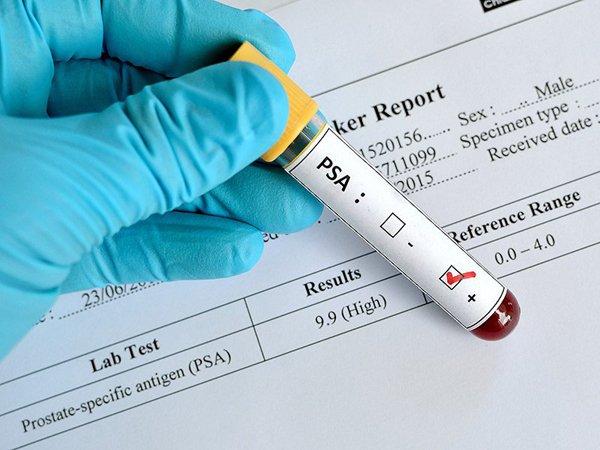
What PSA measures: Prostate-specific antigen is a protein produced by all prostate cells — normal prostate epithelium, BPH tissue, and cancer alike. It is organ-specific, not cancer-specific. PSA levels are elevated by BPH, prostatitis, recent ejaculation, biopsy, and urinary tract infections, as well as by cancer. This is why a single elevated PSA does not diagnose prostate cancer.
Interpreting PSA: A traditional cutoff of 4 ng/mL has been widely used, but age-adjusted ranges are more precise. Additional metrics improve interpretation:
- PSA density: PSA level divided by prostate volume; higher density suggests cancer even with a modestly elevated overall PSA
- PSA velocity: Rate of rise over serial measurements; a rising PSA is more concerning than a stable elevated level
- Free-to-total PSA ratio: Lower percentage of free PSA correlates with higher cancer probability
USPSTF 2018: For men ages 55–69, PSA-based screening is a personal decision made after discussion of potential benefits (earlier detection) and harms (false positives, unnecessary biopsies, overtreatment of indolent cancer). Routine screening is not recommended after age 70.
Multiparametric MRI (mpMRI) is increasingly used before biopsy to identify suspicious lesions. MRI assigns a PI-RADS score from 1 (likely benign) to 5 (likely malignant). A PI-RADS 4 or 5 lesion warrants targeted biopsy.
Prostate biopsy: Tissue sampling confirms diagnosis. Transrectal ultrasound (TRUS)-guided biopsy has been traditional; transperineal biopsy (approaching through the perineum) avoids rectal bacteria and significantly reduces infection risk. Fusion biopsy combines real-time ultrasound with prior MRI images to target suspicious zones while still sampling the rest of the gland.
Gleason Score and Grade Groups
The pathologist who examines biopsy tissue assigns a Gleason grade — the single most important prognostic factor in prostate cancer.
Gleason grading: Prostate cancer cells are graded 3 (most similar to normal; slowest-growing) to 5 (least differentiated; most aggressive). The predominant pattern (primary grade) and the next most common pattern (secondary grade) are summed to give the Gleason score.
Grade Groups (ISUP 2014):
- Grade Group 1 — Gleason 6 (3+3): Cells resemble normal prostate tissue; very slow-growing; excellent prognosis
- Grade Group 2 — Gleason 7 (3+4): Favorable intermediate; mostly well-differentiated cells
- Grade Group 3 — Gleason 7 (4+3): Unfavorable intermediate; majority of cells poorly differentiated
- Grade Group 4 — Gleason 8: High risk; aggressive behavior
- Grade Group 5 — Gleason 9–10: Very high risk; most aggressive
A Gleason score of 6 is NOT a low score for normal cells — it is the lowest score cancer can receive. Gleason grading begins at 3 (the lowest cancer grade); a Gleason 6 means the tumor has the best possible cancer grade, not that cancer is borderline or absent. Most Grade Group 1 prostate cancers are managed with active surveillance rather than immediate treatment.
Stages and Risk Categories
Prostate cancer staging uses the TNM system: T (tumor extent) describes whether the cancer is confined to the prostate (T1–T2) or has grown beyond it (T3–T4); N (nodes) describes lymph node involvement; M (metastasis) describes distant spread.
NCCN risk categories translate staging and pathology into clinically actionable groupings:
- Very low and Low risk: Localized tumor, Grade Group 1, PSA less than 10 ng/mL, limited biopsy core involvement
- Favorable intermediate: Single intermediate-risk factor (PSA 10–20, or GG2, or T2b–T2c); no high-volume or cribriform features
- Unfavorable intermediate: Multiple intermediate-risk factors, Grade Group 3, majority of biopsy cores positive
- High and Very high risk: PSA above 20 ng/mL, Grade Group 4–5, extracapsular extension (T3a), seminal vesicle invasion (T3b), or bladder involvement (T4)
- Metastatic — hormone-sensitive (mHSPC): Distant spread, cancer still responding to testosterone suppression
- Metastatic — castration-resistant (mCRPC): Cancer progresses despite castrate testosterone; different treatment strategy required
PSMA PET-CT has become the most sensitive imaging tool for detecting metastatic prostate cancer, identifying small lymph node metastases and bone lesions invisible on conventional CT or bone scan.
Treatment Options for Prostate Cancer
Treatment is determined by risk category, age, and patient preferences regarding side effects that affect urinary continence, sexual function, and bowel function.
Active surveillance is standard care for most Grade Group 1 (very low and low risk) prostate cancers and selected favorable intermediate-risk cases. Serial PSA testing, repeat biopsies at intervals, and MRI monitoring track the disease without treating it immediately. The PROTECT trial — a 15-year randomized controlled trial — found no significant difference in prostate cancer-specific mortality at 10 years between active monitoring, surgery, and radiation for low-to-intermediate risk disease. Active surveillance preserves quality of life while remaining ready to intervene if the cancer progresses.
Radical prostatectomy removes the entire prostate gland and seminal vesicles. Robotic-assisted radical prostatectomy (RARP) is standard at high-volume centers. Nerve-sparing techniques preserve erection-related nerves when tumor location permits. After surgery, PSA should become undetectable. Major side effects include urinary incontinence (long-term rates approximately 5–15%) and erectile dysfunction (more common without nerve sparing).
Radiation therapy options include external beam radiation therapy (EBRT/IMRT or SBRT), brachytherapy (permanent seed implants for low-to-intermediate risk), and combined radiation + ADT for intermediate and high-risk disease. High-risk disease requires 18–36 months of concurrent ADT. Side effects include urinary irritation, bowel urgency, and — with delayed onset — erectile dysfunction.
Androgen deprivation therapy (ADT) reduces testosterone to castrate levels using LHRH agonists or antagonists. ADT is combined with radiation for intermediate-to-high-risk disease and is the primary systemic treatment for metastatic disease. Long-term ADT causes hot flashes, bone loss, metabolic syndrome, cardiovascular effects, fatigue, and cognitive changes.
Metastatic hormone-sensitive prostate cancer (mHSPC): ADT combined with intensification agents has become standard:
- ADT + abiraterone (LATITUDE trial)
- ADT + enzalutamide (ENZAMET, ARCHES trials)
- ADT + apalutamide (TITAN trial)
- ADT + darolutamide + docetaxel — triplet therapy (ARASENS trial)
Triplet therapy is now preferred for patients with high-volume metastatic disease.
Metastatic castration-resistant prostate cancer (mCRPC): Options include abiraterone, enzalutamide, docetaxel, cabazitaxel, PARP inhibitors (olaparib, rucaparib) for BRCA2 or homologous recombination repair gene mutations, lutetium-177-PSMA-617 (VISION trial), radium-223 (for bone-predominant disease), and sipuleucel-T.
Prostate Cancer Survival Rates
- Localized (confined to prostate): Nearly 100% 5-year relative survival
- Regional (lymph node involvement): Approaches 100% 5-year survival
- Distant (metastatic): Approximately 34% 5-year relative survival
- All stages combined: Approximately 97% 5-year relative survival
Survival trends have improved substantially over 30 years due to earlier detection and more effective treatments for advanced disease.
Frequently Asked Questions
Is all prostate cancer serious?
No — this is one of the most important nuances in prostate cancer medicine. Grade Group 1 prostate cancer (Gleason 6) is biologically distinct from Grade Group 4 or 5. Many Grade Group 1 cancers are managed with active surveillance for years without progression; some may never require treatment during a man’s lifetime. The goal of modern risk stratification is precisely to avoid overtreatment of low-risk disease while aggressively treating high-risk disease. The grade and stage of your specific cancer are what matter, not the diagnosis alone.
What is the difference between a high PSA and prostate cancer?
PSA is produced by all prostate tissue, not just cancer. An elevated PSA can be caused by BPH, prostatitis, urinary tract infection, or recent sexual activity — in addition to cancer. An elevated PSA warrants further evaluation, but it does not confirm cancer. Conversely, a normal PSA does not definitively exclude cancer — some prostate cancers produce relatively little PSA. The PSA is a starting point, not a diagnosis.
Sources: ACS Cancer Facts & Figures 2023; USPSTF Prostate Cancer Screening 2018; NCCN Prostate Cancer Guidelines 2024; Hamdy FC et al. NEJM 2023 (PROTECT trial); Fizazi K et al. NEJM 2017 (LATITUDE trial); Smith MR et al. NEJM 2022 (ARASENS trial); Sartor O et al. NEJM 2021 (VISION trial); Epstein JI et al. Eur Urol 2016 (Grade Groups).
Where to Learn More About Prostate Cancer
Understanding prostate cancer requires looking at the full picture — from early symptoms to diagnosis, screening, and treatment decisions. The following resources and related articles provide deeper context for the most important questions patients and families face.
Recognizing warning signs: Most early-stage prostate cancer causes no symptoms. When urinary symptoms do appear — increased frequency, weak stream, urgency, or difficulty starting — they are often caused by benign prostatic hyperplasia (BPH) rather than cancer. However, any new urinary changes in men over 50 warrant evaluation. Our guide to prostate cancer symptoms explains which signs are most associated with cancer versus benign enlargement, and when to consult a urologist.
Urinary symptoms in detail: The overlap between BPH and prostate cancer in terms of lower urinary tract symptoms (LUTS) is substantial. Both conditions can cause nocturia (waking at night to urinate), urinary hesitancy, and a reduced force of urinary stream. The key clinical distinction is that BPH symptoms reflect outflow obstruction, while prostate cancer causing urinary symptoms typically indicates locally advanced disease — because early prostate cancer, growing within the gland, rarely causes obstruction. Our detailed article on urinary symptoms in prostate cancer covers this distinction in depth.
Frequent urination specifically: Frequent urination is one of the most commonly reported symptoms that brings men to a physician, where prostate cancer or BPH is subsequently investigated. For a focused explanation of how frequent urination relates to prostate pathology, see our article on frequent urination and prostate cancer.
PSA testing: Prostate-specific antigen (PSA) testing is the primary blood test used to screen for and monitor prostate cancer. Understanding what PSA levels mean — including what elevates PSA beyond cancer (BPH, infection, recent ejaculation) and how age-adjusted reference ranges work — is essential for interpreting results. Our article on the PSA test covers the test’s mechanics, reference ranges, velocity and density calculations, and what a high PSA means in practice.
Screening decisions: The decision of whether to undergo PSA screening is one of the most nuanced in preventive medicine. USPSTF recommends shared decision-making for men 55–69 and does not recommend screening for men 70 and older. ACS recommends offering the discussion at age 50 for average-risk men, 45 for high-risk men (Black men and first-degree relatives diagnosed with prostate cancer before 65), and 40 for the highest-risk men. For the full framework for deciding whether to screen, see our guide to prostate cancer screening.
Key Authoritative Resources on Prostate Cancer
The following organizations provide evidence-based information on prostate cancer diagnosis, treatment, and research:
- American Cancer Society — Prostate Cancer: comprehensive patient guides covering all stages and treatment options
- National Cancer Institute — Prostate Cancer: NCI PDQ treatment summaries and clinical trial information
- American Urological Association — Prostate Cancer Guidelines: clinical practice guidelines for diagnosis, staging, and treatment
Advances in Prostate Cancer Treatment
The landscape of prostate cancer treatment has evolved substantially over the past decade, with new systemic therapies improving outcomes for both localized and metastatic disease. Understanding these advances helps patients participate meaningfully in treatment discussions with their oncologists.
Active surveillance refinements: Genomic biomarker tests — including Oncotype DX Genomic Prostate Score, Decipher Prostate, Prolaris, and ProMark — help stratify men with low- and intermediate-risk prostate cancer for active surveillance versus immediate treatment. These tests measure the expression of cancer-relevant genes in biopsy tissue, providing a molecular risk estimate that complements clinical staging and Gleason grade group. Men with favorable molecular profiles may be better candidates for active surveillance with greater confidence that they are not undertreatating a biologically aggressive tumor.
PARP inhibitors in metastatic castration-resistant prostate cancer (mCRPC): Approximately 25–30% of mCRPC patients harbor mutations in homologous recombination repair (HRR) genes, most commonly BRCA2. Olaparib (approved by FDA in 2020 based on the PROfound trial) and rucaparib are PARP inhibitors approved for mCRPC with HRR mutations, demonstrating improved radiographic progression-free survival compared to enzalutamide or abiraterone. Genetic testing for BRCA2, BRCA1, and other HRR genes is now standard in advanced prostate cancer.
PSMA-targeted therapies: Prostate-specific membrane antigen (PSMA) is overexpressed on prostate cancer cells and serves as a target for both imaging and therapy. Lutetium-177 PSMA-617 (Lu-PSMA), approved by the FDA in 2022 based on the VISION trial, is a radioligand therapy that delivers targeted radiation to PSMA-expressing metastatic lesions in mCRPC patients who have progressed on standard therapies. PSMA PET imaging (gallium-68 PSMA or fluorine-18 PSMA) has also transformed staging of prostate cancer, identifying metastatic sites not visible on conventional CT or bone scan.
Talking to Your Doctor About Prostate Cancer
Navigating prostate cancer discussions with a healthcare provider can feel overwhelming, particularly given the genuine complexity around screening decisions, active surveillance, and treatment choice. Preparing specific questions before appointments helps ensure that conversations are productive and that patients leave with clarity on what comes next.
About PSA screening: Should I have a PSA test given my age and risk profile? I am Black or have a father with prostate cancer — should I start screening earlier than average-risk men? My PSA has been rising over the past few years — at what point does the rate of rise (PSA velocity) become concerning? My PSA is 4.5 ng/mL — what do you recommend as the next step?
About biopsy and diagnosis: My PSA is elevated and my DRE is abnormal — should I have a prostate MRI before biopsy? What is the difference between systematic biopsy and MRI-targeted biopsy, and which do you recommend? My biopsy came back as Gleason Grade Group 2 in 3 out of 12 cores — what does this mean for my treatment options?
About treatment choice: Given my stage and grade, what treatment options should I consider? What are the short-term and long-term side effects of surgery versus radiation? Am I a candidate for active surveillance, and what would that involve? How does my age and overall health affect which treatment is most appropriate?
About monitoring and follow-up: If I choose active surveillance, how often will I need PSA tests, MRIs, and biopsies? What PSA value or MRI finding would trigger reclassification and lead you to recommend treatment? If I had radical prostatectomy, what PSA level constitutes biochemical recurrence?
Being an active participant in these conversations — rather than passively receiving recommendations — leads to better treatment adherence and satisfaction with the decision-making process. Many cancer centers offer access to patient navigators, nurse practitioners with specialized oncology training, and multidisciplinary tumor boards that can help with particularly complex decisions.
I shared this article on prostate cancer: symptoms, stages, and treatment with my doctor and they appreciated the level of detail. The connection between diet, lifestyle, and long-term outcomes is explained clearly here. This is going into my health binder that I bring to every doctor’s visit.
Finally a resource that explains prostate cancer: symptoms, stages, and treatment in plain language. The practical tips at the end made this immediately actionable, not just theoretical. This is going into my health binder that I bring to every doctor’s visit.
Came across this while researching prostate cancer: symptoms, stages, and treatment for a family member. I especially valued the explanation of why these recommendations exist, not just what they are. This gave me real confidence going into my next specialist appointment.
Bookmarked this article on prostate cancer: symptoms, stages, and treatment immediately — going to reference it regularly. I appreciate that the article is careful about distinguishing between what is known and what is still being researched. Keep up this kind of thorough health journalism — it genuinely helps patients like me.
As someone dealing with this personally, the prostate cancer: symptoms, stages, and treatment section was very helpful. The article answered questions I didn’t even know I had until I started reading. This is going into my health folder that I bring to every doctor’s visit.
I have been reading about prostate cancer: symptoms, stages, and treatment for weeks and this is the most thorough guide I found. I have tried following advice from several sources but this is most consistent with what my specialist told me. I wish I had found this article earlier — would have saved a lot of confusion.