

Protein Intake and Kidney Health
Protein is the nutrient most directly connected to kidney workload. When protein is digested and metabolized, it produces nitrogen-containing waste — primarily urea — that the kidneys must filter and excrete. In healthy adults, this process is efficient and self-regulating: eating more protein increases urea production and GFR temporarily (a phenomenon called hyperfiltration), and the kidneys adapt. In people with reduced kidney function, this same hyperfiltration response accelerates the loss of remaining nephrons and drives faster progression toward kidney failure. For decades, low-protein diets have been studied as a tool for slowing CKD progression — and the evidence, while complex, remains relevant to every patient managing kidney disease.
Understanding the relationship between protein intake and kidney health requires distinguishing between different stages of kidney disease, different protein sources, and the real tradeoff between limiting protein (to reduce filtration burden) and maintaining adequate nutrition (to prevent protein-energy wasting, a serious complication of advanced CKD). The guidance has evolved considerably from the blanket “eat less protein” advice of earlier decades toward a more nuanced, stage-specific framework that most nephrologists now apply.
How Protein Affects Kidney Function
Every gram of dietary protein that is metabolized generates nitrogenous waste that must be cleared by the kidneys. Protein catabolism produces urea as the primary nitrogen-containing end product, along with smaller amounts of creatinine, uric acid, and other compounds. These substances are filtered at the glomerulus and, in the case of urea, partially reabsorbed in the tubules before final excretion in urine.
Hyperfiltration. High protein intake acutely increases GFR through several mechanisms: amino acids directly stimulate afferent arteriolar dilation; insulin-like growth factor-1 (IGF-1) released after protein consumption promotes renal vasodilation; and tubuloglomerular feedback is suppressed as the proximal tubule increases amino acid reabsorption, reducing the signal that would normally constrict the afferent arteriole. This acute hyperfiltration response — a GFR increase of 20–40% above baseline within hours of a high-protein meal — serves no beneficial purpose in people with CKD and may exacerbate glomerular hypertension and filtration-related injury in already-damaged glomeruli.
Uremic toxin accumulation. Beyond urea, protein metabolism generates indoxyl sulfate, p-cresyl sulfate, and other gut-derived uremic toxins produced when gut bacteria ferment protein — particularly animal protein — in the colon. These compounds are not efficiently cleared by dialysis, accumulate in CKD, and are independently associated with cardiovascular disease, kidney fibrosis, and mortality in dialysis patients. Plant proteins generate fewer of these toxins because the gut microbiome ferments plant amino acids differently and plant foods also provide fiber that supports beneficial bacterial strains. This is one of the mechanistic bases for the observed benefit of plant-dominant diets in CKD.
Acid load. Animal protein metabolism generates more acid equivalents than plant protein due to the sulfur-containing amino acids (methionine, cysteine) abundant in meat and dairy — sulfuric acid is the end product. The kidneys are the primary route of acid excretion; in CKD, the reduced capacity for acid excretion leads to metabolic acidosis, which in turn accelerates muscle protein breakdown (to generate bicarbonate from amino acid metabolism) and promotes kidney fibrosis. Protein from plant sources, particularly from fruits, vegetables, and legumes, generates a net alkaline load or near-neutral acid load and partially counteracts the acidosis that animal protein intake promotes in CKD.
Low-Protein Diet Evidence in CKD: What the Research Shows
The landmark MDRD (Modification of Diet in Renal Disease) Study — a randomized controlled trial published in 1994 — compared low-protein (0.58 g/kg/day) versus very low-protein (0.28 g/kg/day + ketoacid supplement) diets against usual protein intake in CKD patients with GFR 13–55. The primary finding was that protein restriction slowed the rate of GFR decline, with the largest effect in patients with higher baseline proteinuria. Subsequent meta-analyses consistently confirm: protein restriction in CKD stages 3–5 slows GFR decline by approximately 30–40% compared to unrestricted intake.
The current KDIGO recommendation for non-dialysis CKD patients with GFR <30 is a protein intake of 0.6–0.8 g/kg/day — a modest restriction compared to average Western intake of 1.2–1.5 g/kg/day. For patients at risk of protein-energy wasting (common in advanced CKD), a target at the higher end (0.8 g/kg/day) is preferred to avoid nutritional depletion. For dialysis patients, the calculation reverses: dialysis removes amino acids and increases protein catabolism, and the recommendation rises to 1.0–1.2 g/kg/day to prevent malnutrition. This stage-specific reversal is one of the most counterintuitive aspects of CKD nutrition and causes confusion when patients are advised differently at different stages.
Ketoacid-supplemented very low-protein diets (VLPD, 0.3–0.4 g/kg/day) remain a niche strategy used in some centers for patients with advanced CKD who want to delay dialysis initiation. Ketoacids provide essential amino acid equivalents without nitrogen, reducing urea production while maintaining nitrogen balance. The evidence for VLPD + ketoacids in delaying dialysis is encouraging but not definitive; these regimens require close monitoring by a renal dietitian and are not appropriate for all patients. The comprehensive approach to managing kidney disease progression is discussed in the guide to slowing kidney disease progression.
Protein Intake by CKD Stage: Practical Targets
Protein recommendations vary substantially by CKD stage and clinical context. The general framework below represents starting points for discussion with the care team and renal dietitian — individual targets should account for body weight, nutritional status, proteinuria level, and rate of GFR decline.
CKD stages 1–2 (GFR ≥60): No protein restriction is recommended at these stages. Patients should avoid excessive protein intake (more than 1.5 g/kg/day) but do not need to count grams. The primary dietary goals at this stage are sodium restriction and adequate hydration. The kidney disease prevention guide outlines the full framework of lifestyle modifications relevant to early CKD.
CKD stages 3a–3b (GFR 30–59): A modest restriction toward 0.8 g/kg/day is appropriate for patients with progressive CKD, significant proteinuria, or metabolic acidosis. Patients without these features may continue at usual intake with monitoring. Substituting animal protein with plant protein sources is a practical first step that reduces uremic toxin load and acid load without requiring dramatic dietary change.
CKD stages 4–5 (GFR <30, pre-dialysis): The 0.6–0.8 g/kg/day target is recommended, with individual adjustment based on nutritional status. Patients approaching dialysis initiation should be monitored closely for protein-energy wasting (weight loss, muscle loss, reduced albumin). Starting dialysis earlier rather than continuing aggressive protein restriction in a malnourished patient is sometimes the correct clinical decision. Close coordination between the nephrologist and renal dietitian is essential at this stage.
Dialysis patients (hemodialysis and peritoneal dialysis): The protein target increases to 1.0–1.2 g/kg/day due to amino acid losses during the dialysis procedure and increased catabolism. Adequate protein intake reduces the risk of protein-energy wasting, which is strongly associated with mortality in dialysis patients. The advanced CKD management guide covers the full scope of nutrition management in dialysis patients.
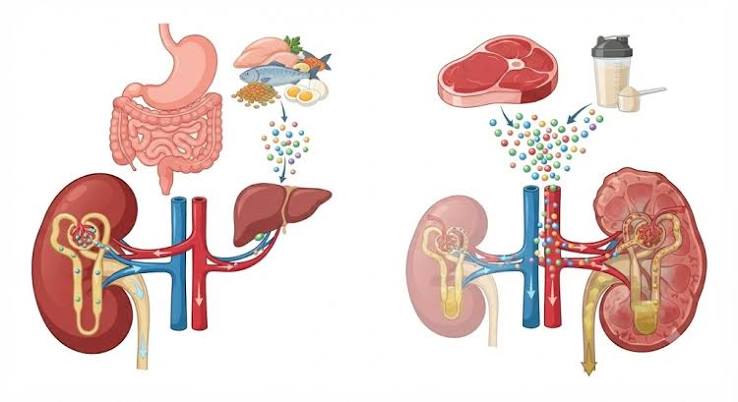
Animal vs. Plant Protein: Does the Source Matter?
Emerging evidence suggests that protein source matters as much as protein quantity in CKD management. Plant proteins — from legumes (lentils, chickpeas, beans), whole grains, nuts, and seeds — generate fewer uremic toxins, produce less acid load, contain more fiber (which supports the gut microbiome), and are associated with lower blood pressure compared to equivalent amounts of animal protein. Observational studies in CKD cohorts show that higher plant protein intake is associated with slower GFR decline and lower mortality, even when total protein intake is held constant.
The mechanisms are several: fermentation of plant fiber by colonic bacteria produces short-chain fatty acids (butyrate, propionate, acetate) that reduce intestinal uremic toxin absorption and reduce intestinal permeability; plant protein generates fewer indoxyl sulfate and p-cresyl sulfate precursors; and plant protein sources are generally higher in potassium and phosphorus than their animal equivalents — which is a complication that must be managed in advanced CKD where hyperkalemia and hyperphosphatemia become concerns.
A practical transition strategy for CKD patients who eat primarily animal protein: begin by replacing one animal protein serving per day with a plant equivalent (a handful of lentils instead of ground beef, hummus instead of cheese, tofu or tempeh instead of chicken), then expand from there based on tolerance and lab results. This gradual substitution preserves dietary satisfaction while shifting the protein load toward sources that are more kidney-compatible. The National Kidney Foundation provides protein intake guidance specifically tailored to each CKD stage. The NIDDK also offers detailed CKD-specific dietary guidance including protein recommendations.
High-Protein Diets and Kidney Risk: What the Evidence Shows
High-protein diets — including ketogenic diets, Atkins-style diets, and performance nutrition protocols recommending 1.5–2.5 g protein per kilogram body weight — have become widespread. For people with normal kidney function, the evidence for kidney harm from high protein is limited; short-term studies show hyperfiltration but no evidence of permanent GFR decline in healthy adults with intact autoregulation. The concern is primarily for people with pre-existing kidney disease, reduced kidney mass (a single functioning kidney, partial nephrectomy), diabetes, or hypertension — conditions that impair the autoregulatory mechanisms that buffer hyperfiltration in healthy kidneys.
For people with undiagnosed CKD — which affects approximately 90% of people who have it, since early CKD produces no symptoms — high-protein diets may be accelerating kidney damage without any awareness. CKD is estimated to affect 15% of the US adult population; most do not know their GFR or kidney status. This makes the “high protein is safe for healthy people” statement a probabilistic claim that applies to those who have actually verified kidney health through eGFR and albumin-to-creatinine ratio testing. Regular kidney function screening, particularly in those with diabetes, hypertension, obesity, or family history of kidney disease, is the recommended context in which dietary protein decisions should be made. The framework for kidney function testing is covered in the blood pressure and kidney protection guide.
Practical Protein Management for CKD Patients
Managing protein intake in CKD requires a different calculation than what most nutrition advice provides. Standard recommendations are in grams per kilogram of ideal body weight per day — not total grams without body weight adjustment. A 70 kg patient targeting 0.8 g/kg/day needs 56 grams of protein per day; a 90 kg patient at the same rate needs 72 grams. Using ideal body weight rather than actual weight for obese patients avoids over-restricting protein relative to the patient’s actual lean mass requirements.
Practical counting approach: protein is found in meat, fish, dairy, eggs, beans, lentils, nuts, and (in smaller amounts) grains and vegetables. Keeping a food diary for two weeks provides an accurate baseline of current intake. Common protein amounts: 3 oz cooked chicken ≈ 21 g protein; 1 cup cooked lentils ≈ 18 g protein; 1 egg ≈ 6 g; 1 oz cheese ≈ 7 g; 1 cup Greek yogurt ≈ 20 g. For a patient targeting 56 g/day, this is roughly 6 oz of protein-rich food plus plant protein sources throughout the day — a moderate, sustainable target that does not require eliminating protein entirely.
Working with a renal dietitian — rather than attempting to manage protein, sodium, potassium, phosphorus, and fluid intake simultaneously without professional guidance — is the most effective approach for CKD patients who need dietary modification. Renal dietitians can calculate personalized targets, provide specific food lists, identify high-risk items in the patient’s current diet, and adjust recommendations as lab values change with disease progression. The American Heart Association also provides guidance on protein quality and cardiovascular health — relevant to CKD patients whose primary cause of death is cardiovascular disease.
Conclusion
Protein intake and kidney health are connected through the direct metabolic burden that protein catabolism places on the kidneys — through hyperfiltration, uremic toxin generation, and acid loading. The evidence supports modest protein restriction (0.6–0.8 g/kg/day) in CKD stages 3–5 as a disease-modifying intervention that slows GFR decline, particularly in patients with proteinuria. Protein source matters alongside quantity: plant proteins generate fewer uremic toxins, less acid load, and appear to be more kidney-compatible than equivalent amounts of animal protein. The stage-specific reversal of protein targets — restriction in pre-dialysis CKD, increased intake in dialysis — requires personalized guidance from a renal dietitian who can balance the competing nutritional priorities that shift as kidney disease progresses. Managing protein intake within the broader framework of kidney-protective lifestyle choices — alongside sodium restriction, blood pressure control, and hydration — produces the most sustainable protection for residual kidney function.
Protein, Metabolic Acidosis, and Kidney Fibrosis
One of the most underappreciated consequences of high protein intake in CKD is its contribution to metabolic acidosis — a condition in which blood pH falls below normal due to insufficient renal acid excretion. The kidneys are the primary organ for acid excretion; as GFR declines, this capacity is progressively impaired. Animal protein metabolism — particularly from meat, fish, eggs, and dairy — generates sulfuric acid and organic acids as end products of amino acid catabolism. In healthy adults with full acid-excretion capacity, this acid load is cleared readily. In CKD patients, it accumulates.
Metabolic acidosis in CKD has multiple harmful effects beyond its direct metabolic consequences. Chronic acidosis stimulates the release of cortisol and aldosterone, which activate the ubiquitin-proteasome pathway in muscle — essentially signaling muscle tissue to break down to generate bicarbonate equivalents. This muscle wasting is one of the mechanisms driving protein-energy wasting in CKD. Acidosis also directly activates profibrotic pathways in the kidney: it stimulates endothelin-1 and aldosterone release, both of which promote interstitial fibrosis and tubular injury. Correcting acidosis — whether through dietary modification (shifting protein toward plant sources), sodium bicarbonate supplementation, or both — has been shown in multiple trials to slow GFR decline and reduce kidney fibrosis markers.
The BICARBONATE trial (de Brito-Ashurst I et al., JASN 2009) showed that sodium bicarbonate supplementation in CKD patients with metabolic acidosis slowed the rate of GFR decline by approximately 67% compared to controls — a dramatic effect size that highlights how consequential acidosis correction is in CKD management. For patients who cannot or will not reduce animal protein intake to the target level, sodium bicarbonate supplementation under medical guidance may partially offset the acid-generating effect of higher protein intake, though this is not a substitute for dietary modification in patients who can achieve it.
Plant-based proteins, in contrast, generate either neutral or net alkaline acid equivalents — fruits, vegetables, and legumes contain organic anions (citrate, malate) that are metabolized to bicarbonate equivalents in the liver, counteracting the acid load of residual animal protein intake. This is one reason why dietary patterns emphasizing plant protein in CKD show benefits on both uremic toxin load and acid-base balance simultaneously — and why substituting even a portion of animal protein with plant equivalents may produce measurable clinical benefit even without achieving full restriction targets.
Protein Intake, Muscle Mass, and the Wasting Risk in CKD
The tension between restricting protein to protect kidneys and maintaining adequate protein to prevent muscle wasting is the central nutritional dilemma of CKD management. Protein-energy wasting (PEW) — defined as loss of muscle mass and body protein stores — affects up to 40% of CKD stage 4–5 patients and 50–75% of dialysis patients. PEW is strongly associated with mortality in dialysis: patients who are malnourished at dialysis initiation have substantially higher cardiovascular event rates and shorter survival than nutritionally maintained patients.
The mechanisms are interconnected: chronic inflammation in CKD suppresses appetite (reducing spontaneous protein intake), metabolic acidosis accelerates muscle catabolism (as described above), and the underlying disease state itself increases protein turnover. Low protein intake in the setting of CKD-related inflammation and acidosis may therefore produce wasting even at intake levels above the restriction target — meaning that some patients who theoretically should be meeting a 0.8 g/kg/day target are still experiencing muscle loss because the biochemical environment is consuming protein faster than it is being replaced.
The clinical implication: protein restriction targets should always be implemented with nutritional status monitoring. Regular assessment of body weight, serum albumin and prealbumin (markers of protein stores and synthetic function), and mid-arm muscle circumference provides objective signals of whether protein restriction is being tolerated nutritionally. When a patient’s nutritional markers deteriorate while on a protein-restricted diet — even if the restriction is modest — the appropriate response is to relax the protein target, not to continue restriction in the face of wasting. Exercise, particularly resistance training, also helps preserve muscle mass during protein restriction by maintaining the anabolic signaling that converts dietary protein to muscle rather than allowing it to be catabolized. The exercise and CKD relationship is covered in detail in the exercise and kidney health guide.
Protein Supplements and Kidney Health: What CKD Patients Should Know
Protein supplements — whey protein shakes, casein powders, plant-based protein concentrates, and amino acid blends — are widely marketed as tools for muscle maintenance, athletic performance, and weight management. For the general population, these supplements are safe when used as directed. For CKD patients, they represent a significant and often unrecognized source of additional protein load that may push total intake well above the appropriate restriction target without the patient being aware of the contribution.
A standard single serving of whey protein powder contains 20–25 grams of protein. For a 70 kg CKD stage 4 patient with a target of 0.6 g/kg/day (42 g total), a single protein shake consumes more than half the daily protein allowance — leaving only 17–22 grams for all food-based protein for the rest of the day. Patients who add protein supplements to a diet that already contains meat, dairy, and eggs may be consuming 1.5–2 times their protein restriction target without realizing it. CKD patients who are currently using or considering protein supplements should discuss this specifically with their nephrologist and renal dietitian, who can evaluate whether supplementation is appropriate at the patient’s current stage and nutritional status, and if needed, recommend CKD-appropriate protein sources that provide amino acid support without excessive nitrogen load.
Ketoacid supplements — available in some countries as Ketosteril or similar formulations — provide essential amino acid carbon skeletons without nitrogen, making them a specialized tool for maximizing the protein restriction window in pre-dialysis CKD without risking essential amino acid deficiency. These are distinct from standard protein powders and are used under medical supervision in specific clinical protocols, not as general supplementation. Patients who see “ketoacid” or “alpha-keto acid” supplements marketed online should be aware that these require monitoring of calcium, phosphorus, and nitrogen balance and should be used only under nephrologist guidance, not self-prescribed from retail sources.
The broader context of how dietary choices — protein, sodium, phosphorus, potassium, and fluid — interact across the spectrum of CKD stages is addressed in the guide to slowing kidney disease progression, which frames protein management within the complete kidney-protective lifestyle framework. Understanding how each dietary variable contributes to kidney workload allows patients and care teams to prioritize the interventions with the most impact at each stage of disease.
Dietary protein management in CKD is not a static instruction set — it is a dynamic, stage-dependent intervention that must be adjusted as kidney function changes, nutritional status evolves, and dialysis timing approaches. The most effective approach combines personalized protein targets from a renal dietitian, regular monitoring of nutritional status and acid-base balance, strategic substitution of plant for animal protein sources, and awareness of supplement contributions to total protein load. Together, these elements create a dietary protein strategy that protects residual kidney function without compromising the nutritional status that is equally essential to long-term CKD outcomes. Understanding the interconnected roles of protein, hydration, sodium, and other dietary variables in CKD management allows patients to approach their diet as a system of protective choices rather than a collection of separate restrictions.
Sources: National Kidney Foundation (kidney.org); NIDDK (niddk.nih.gov); American Heart Association (heart.org); Klahr S et al., “The Effects of Dietary Protein Restriction and Blood-Pressure Control on the Progression of CKD,” NEJM 1994 (MDRD Study); KDIGO CKD Clinical Practice Guidelines 2012/2024.
Pingback: Foods to Limit for Kidney Health - Horizon Health Guide
Pingback: Potassium and Kidney Disease: What to Know - Horizon Health Guide
Finally a resource that explains protein intake and kidney health in plain language. What I liked most was that the article didn’t just say what to avoid — it also gave alternatives. This gave me real confidence going into my next specialist appointment.
Came across this while researching protein intake and kidney health for a family member. The specific numbers and thresholds mentioned are exactly what I needed to understand my results. Will definitely be coming back to this site for more health information.
This breakdown of protein intake and kidney health is exactly what patients need before a specialist appointment. The connection between lifestyle choices and long-term outcomes is explained clearly here. This is going into my health folder that I bring to every doctor’s visit.