
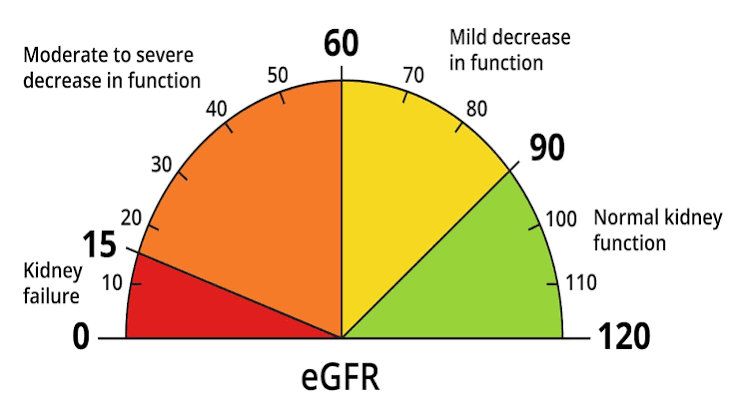
The eGFR (estimated glomerular filtration rate) is the primary measure of kidney filtration function used in diabetes monitoring — the number that tells how well the kidneys are removing waste and excess fluid from the blood. In adults with diabetes, the eGFR is measured annually alongside the urine albumin-to-creatinine ratio (uACR) to track kidney health and identify chronic kidney disease (CKD) at the earliest stage when interventions are most effective. While many adults with diabetes have heard of eGFR and know it relates to kidney function, far fewer understand what the number actually represents, what the different CKD stages it defines mean for their health and medication management, how rapidly their eGFR is declining over time (which matters as much as the current value), or when a specific eGFR level requires medication adjustment, nephrology referral, or preparation for kidney replacement therapy. This guide addresses all of these questions — covering how eGFR is calculated, what each stage of CKD means, what eGFR thresholds trigger specific clinical actions, and how the eGFR trend over time provides more clinical information than any single measurement.
The glomerular filtration rate (GFR) measures how much blood the glomeruli — the microscopic filtering units in the kidneys — are collectively filtering per minute, expressed as milliliters per minute per 1.73 square meters of body surface area (mL/min/1.73m²). Healthy kidneys in a young adult filter approximately 90–120 mL per minute. The eGFR (estimated GFR) is calculated from serum creatinine — a waste product of muscle metabolism that is filtered by the kidneys — using equations (CKD-EPI or MDRD) that also account for age, sex, and in some historical versions, race. As kidney damage reduces the number of functioning nephrons, creatinine accumulates in the blood and the eGFR calculation yields a lower number. An eGFR of 60 means the kidneys are filtering at approximately 60% of the expected rate for a young adult of normal body surface area; an eGFR of 30 means approximately 30% filtration rate remaining.
CKD Stages Defined by eGFR: What Each Stage Means in Diabetes
The current KDIGO (Kidney Disease: Improving Global Outcomes) classification system divides kidney function into five eGFR-based stages (G1 through G5), each corresponding to different clinical thresholds for monitoring frequency, medication adjustment, and specialty referral:
- Stage G1 — eGFR above 90 mL/min/1.73m² (normal or high filtration with kidney damage): An eGFR above 90 with an elevated uACR confirms CKD Stage G1 in adults with diabetes — kidney function is normal or near-normal by filtration rate, but the elevated uACR shows that glomerular damage is present. Adults at this stage often feel entirely well and have no symptoms. The clinical significance of Stage G1 is that this is the optimal point to intervene — before any significant filtration function has been lost — with blood glucose control, blood pressure management, and ACE inhibitor or ARB therapy. Adults who achieve durable uACR reduction at Stage G1 can often maintain stable kidney function for many years without progressing to more advanced CKD. The urine albumin monitoring that identifies Stage G1 is in our urine albumin test and diabetes guide.
- Stage G2 — eGFR 60–89 mL/min/1.73m² (mildly reduced filtration with kidney damage): As with Stage G1, Stage G2 CKD in adults with diabetes requires both a mildly reduced eGFR (60–89) AND evidence of kidney damage (elevated uACR, or other markers of structural kidney damage). Most diabetes medications work normally at this stage. Annual monitoring is appropriate for stable eGFR in this range. Clinical management focuses on slowing progression through the same interventions as G1 — blood glucose and blood pressure control, RAAS blockade with ACE inhibitor or ARB, and SGLT2 inhibitor therapy where indicated.
- Stage G3a (60–45) and G3b (45–30) — mildly to moderately reduced kidney function: Stage G3 is often when adults with diabetes first receive an explicit CKD diagnosis that may prompt management changes beyond what was already in place. At eGFR below 45 mL/min/1.73m², several important medication adjustments become necessary: metformin dose should be reduced or discontinued (FDA labeling recommends discontinuation at eGFR below 30, but some guidelines recommend dose reduction at below 45 and caution beginning at 45–60); SGLT2 inhibitors have reduced glucose-lowering efficacy below eGFR 45 (though kidney-protective benefit remains); GLP-1 receptor agonists remain safe and effective. Monitoring frequency should increase to every 3–6 months for both eGFR and uACR at Stage G3. The medication safety thresholds relevant to eGFR decline are covered in our diabetes medication safety guide.
- Stage G4 — eGFR 15–29 mL/min/1.73m² (severely reduced kidney function): At Stage G4, the kidneys are functioning at 15–29% of normal filtration capacity. Management complexity increases substantially: multiple medications require dose adjustment or discontinuation (NSAIDs are contraindicated, many oral diabetes medications are unsafe, metformin must be stopped); anemia of CKD often develops and may require erythropoiesis-stimulating agents; mineral and bone metabolism abnormalities (phosphate accumulation, calcium-phosphate product, PTH elevation) require monitoring and treatment; metabolic acidosis becomes increasingly common and may require sodium bicarbonate supplementation. Nephrology co-management is standard of care at Stage G4, and preparation for kidney replacement therapy — dialysis planning, arteriovenous fistula creation, transplant evaluation — should begin at this stage rather than waiting for Stage G5.
- Stage G5 — eGFR below 15 mL/min/1.73m² (kidney failure): Stage G5 represents kidney failure — the kidneys can no longer maintain fluid balance, electrolyte homeostasis, or adequate waste removal without assistance. Most adults who reach Stage G5 require dialysis (hemodialysis or peritoneal dialysis) or kidney transplantation to survive. For adults with diabetes who reach this stage, managing the complications of both advanced CKD and diabetes simultaneously (fluid balance, potassium, phosphate, blood glucose without safe oral medications) requires multi-specialist care. The complete diabetes monitoring that coordinates all care components including kidney monitoring is in our annual diabetes care checklist and diabetes checkups: what to expect guide. The NIDDK’s diabetic kidney disease resources, the National Kidney Foundation’s CKD staging guide, and the KDIGO guidelines for diabetes and CKD provide the authoritative clinical basis for eGFR-based CKD staging and management in adults with diabetes.

Why the eGFR Trend Over Time Matters More Than Any Single Value
A single eGFR measurement tells you where kidney function is right now — but the trend over 2–5 years of consecutive measurements tells the clinically more important story of whether kidney function is stable, slowly declining, or rapidly declining:
- What constitutes a concerning eGFR decline rate: The current KDIGO definition of CKD progression includes any of: eGFR decline of more than 5 mL/min/1.73m² within 1 year, eGFR decline of more than 10 mL/min/1.73m² within 5 years, or sustained eGFR decline that crosses from one CKD stage to a lower one. For context: an adult with an eGFR of 65 who has declined 8 mL/min over the past 2 years is on a trajectory to reach Stage G3b (eGFR 30–44) within approximately 5–8 years if the decline rate is not slowed. An adult with an eGFR of 48 that has been stable at 45–52 for 5 years is at much lower immediate risk despite the lower absolute eGFR. The trend matters as much as the number.
- What can cause acute drops in eGFR that are reversible: Not every drop in eGFR represents permanent kidney damage. Acute dehydration, use of NSAIDs, initiation of an ACE inhibitor or ARB (which causes an expected 10–15% initial eGFR drop due to hemodynamic changes that is reversible and does not indicate true nephron loss), contrast dye exposure (contrast-induced nephropathy), acute illness, or any acute kidney injury (AKI) can cause temporary eGFR decline that recovers fully with appropriate management. If eGFR drops significantly between two consecutive tests, the clinician will consider whether an acute, reversible cause explains the change before concluding that CKD has progressed. Repeating the eGFR 4–8 weeks after any acute illness before interpreting the result as permanent is standard clinical practice.
- How to track your eGFR trend: Adults with diabetes should ask for their eGFR result at every clinical visit where kidney function was tested and note it in a personal health log alongside the date. Comparing the current value to the values from 1, 2, and 3 years ago — even approximately — gives the most clinically useful information about whether kidney function is stable. A patient who brings a log of their last five eGFR readings to a nephrology appointment enables the nephrologist to directly assess the trajectory rather than relying on whatever results are available in the electronic record. The blood pressure monitoring that directly affects eGFR trajectory is in our blood pressure monitoring in diabetes guide. The cholesterol monitoring that reduces cardiovascular risk alongside kidney protection is in our cholesterol monitoring in diabetes guide. The A1C monitoring that tracks blood glucose control as a primary driver of CKD progression is in our A1C testing schedule guide. The complete annual diabetes monitoring schedule that places eGFR within all other required monitoring is our annual diabetes care checklist. The NIDDK’s kidney disease monitoring resources, the National Kidney Foundation’s eGFR information, and the KDIGO guidelines on eGFR and CKD management provide the authoritative clinical framework for eGFR-based kidney monitoring in adults with diabetes.
How eGFR Is Calculated and What Affects the Result
Understanding how the eGFR is calculated helps explain why the result may vary between tests and why certain conditions can cause it to be misleading:
- The CKD-EPI equation (the current standard): The estimated GFR is calculated from serum creatinine using the CKD-EPI (Chronic Kidney Disease Epidemiology Collaboration) equation, which incorporates serum creatinine, age, and sex. The 2021 updated CKD-EPI equation removed race as a variable — a change made after evidence showed that the race coefficient previously included was based on flawed assumptions about average muscle mass differences between Black and non-Black adults, and that removing it produced more equitable and clinically accurate eGFR estimates across all racial groups. Many laboratories now report eGFR using the 2021 race-free CKD-EPI equation, though the transition is not yet complete in all health systems.
- Muscle mass affects the eGFR calculation: Creatinine is produced by muscle metabolism at a rate proportional to muscle mass. Adults with very low muscle mass — frail elderly adults, adults with muscle-wasting conditions, adults who are severely underweight, or adults on long-term corticosteroids that cause muscle loss — will have lower serum creatinine levels and consequently higher eGFR estimates than their true filtration rate, because the equation assumes a “typical” creatinine production rate. This can make kidney function appear better than it actually is in sarcopenic individuals. Cystatin C, an alternative kidney biomarker that is not affected by muscle mass, is increasingly used alongside or instead of creatinine-based eGFR in situations where muscle mass may be significantly atypical. The 2021 CKD-EPI cystatin C equation and the combined creatinine-cystatin C equation provide more accurate eGFR estimates in these situations.
- Dietary protein intake affects serum creatinine: High dietary protein intake — particularly from meat — transiently raises serum creatinine after eating (because meat contains creatine and creatinine), which can lower the eGFR estimate in a blood draw taken shortly after a high-protein meal. Labs recommend fasting before eGFR testing for this reason, though the effect is generally modest and does not typically cause a clinically meaningful misclassification. Very high-protein dietary supplements (creatine supplements used by athletes or bodybuilders) can substantially raise creatinine and produce artificially low eGFR estimates, and should be disclosed to the clinician when kidney tests are being reviewed.
- The serum creatinine “creatinine blind spot” at early CKD: The eGFR calculation is less sensitive at early kidney disease than at advanced disease, because the kidneys have substantial reserve capacity — eGFR can decline from 120 to 90 mL/min/1.73m² (a 25% reduction in filtration function) with very little change in serum creatinine, because the remaining nephrons compensate through hyperfiltration. This is why the uACR is so important alongside eGFR — a normal eGFR does not exclude early diabetic nephropathy, and the uACR can detect glomerular damage years before eGFR begins to fall. At advanced CKD (eGFR below 30), the eGFR-creatinine relationship is very sensitive — small creatinine changes correspond to large eGFR changes, and the eGFR is highly responsive to treatment effects at this stage. The urine albumin test that detects nephropathy when eGFR is still normal is in our urine albumin test and diabetes guide.
Medications That Must Be Adjusted Based on eGFR in Diabetes
One of the most important practical consequences of knowing your eGFR as an adult with diabetes is understanding which medications in your regimen require dose adjustment or discontinuation as kidney function declines. Here are the key thresholds for medications commonly used in diabetes care:
- Metformin — dose reduce at eGFR 30–45, discontinue below 30: Metformin is primarily eliminated by the kidneys unchanged. When eGFR is reduced, metformin accumulates to higher blood levels than intended, and in severe kidney impairment (eGFR below 30 mL/min/1.73m²) or during acute kidney injury, this accumulation can trigger lactic acidosis — a rare but potentially life-threatening complication. FDA labeling specifies: metformin is contraindicated when eGFR is below 30 mL/min/1.73m², requires a prescriber assessment and possibly dose reduction when eGFR is 30–45, and should be used with caution in the 45–60 range. The ADA recommends holding metformin during any acute illness associated with dehydration or risk of AKI, and avoiding it before contrast-dye procedures. Adults with diabetes on metformin should know their current eGFR and whether any dose adjustments have been made as eGFR has changed over time. The complete medication safety context for eGFR-dependent dose adjustments is in our diabetes medication safety guide.
- SGLT2 inhibitors — reduced efficacy below eGFR 45, generally stop below eGFR 20–25: SGLT2 inhibitors work by blocking glucose reabsorption in the proximal tubule — a mechanism that is progressively less effective as eGFR declines (less glucose is being filtered, so less can be blocked). Below eGFR 45 mL/min/1.73m², SGLT2 inhibitors have reduced glucose-lowering efficacy. However, the DAPA-CKD and EMPA-KIDNEY trials demonstrated that their kidney-protective and cardiovascular-protective effects persist to lower eGFR ranges (down to approximately eGFR 20–25 mL/min/1.73m²). Current KDIGO and ADA guidelines recommend continuing SGLT2 inhibitors for kidney protection even when eGFR is too low for effective glucose lowering, and discontinuing only when eGFR falls below approximately 20 mL/min/1.73m² or at the initiation of dialysis. Specific dose-adjustment thresholds vary by individual SGLT2 inhibitor drug labeling.
- GLP-1 receptor agonists — generally safe across CKD stages, but with caution in severe impairment: GLP-1 receptor agonists (semaglutide, liraglutide, dulaglutide, exenatide) are not primarily renally eliminated and do not require dose adjustment based on eGFR for most agents. However, GLP-1 agonists can cause nausea and reduced fluid intake, which can contribute to dehydration and acute kidney injury in susceptible patients — a consideration in adults with advanced CKD. Dulaglutide has cardiovascular and kidney protective trial evidence (AWARD-7) in adults with moderate-to-severe CKD and is considered safe in this population.
- Sulfonylureas — most require caution or avoidance in moderate-advanced CKD: Sulfonylureas (glipizide, glyburide, glimepiride) stimulate insulin secretion independent of blood glucose — a mechanism that causes hypoglycemia risk that worsens with declining eGFR because kidney disease impairs both insulin metabolism and drug clearance. Glyburide is contraindicated in CKD because its active metabolites accumulate. Glipizide is the preferred shorter-acting sulfonylurea if one must be used in CKD. Glimepiride requires caution in advanced CKD. The broader diabetes monitoring context that ensures eGFR results drive appropriate medication management is in our kidney tests for diabetes monitoring guide. The blood pressure monitoring that directly affects eGFR trajectory through blood pressure control is in our blood pressure monitoring in diabetes guide. The A1C monitoring that tracks blood glucose control as a primary driver of eGFR decline is in our A1C testing schedule guide. The complete annual monitoring schedule that coordinates all diabetes care components is in our annual diabetes care checklist. The NIDDK’s diabetic kidney disease resources, the National Kidney Foundation’s CKD guide, and the KDIGO guidelines for diabetes and CKD provide the authoritative clinical basis for eGFR monitoring and management in adults with diabetes.
Understanding your eGFR and what it means for your kidney function in diabetes puts you in a fundamentally stronger position to protect your health over the long term. The adults with diabetes who fare best in terms of kidney outcomes are those who know their current eGFR, know whether it is declining or stable by tracking it over multiple years, understand which CKD stage they are in and what that stage means for their medication management, and work actively with their clinician to address each modifiable driver of kidney disease progression — blood glucose, blood pressure, proteinuria, and medication selection. The eGFR is not just a number in a lab report; it is a summary of how much kidney function has been preserved so far, and an indicator of how urgently the interventions that protect it need to be applied. Each additional year of preserved kidney function — each year that eGFR is maintained rather than declining — is a year without dialysis, without the cardiovascular complications that accelerate at advanced CKD, and without the dramatic reduction in quality of life that advanced kidney failure produces. Adults who take their eGFR results seriously are making one of the most important long-term investments available in diabetes self-management. Asking at every diabetes visit — “What is my eGFR compared to last year, and is it stable?” — is one of the most important questions an adult with diabetes can ask for their long-term wellbeing.
Sources: American Diabetes Association — Standards of Medical Care in Diabetes, eGFR monitoring frequency and CKD management in diabetes; KDIGO — Chronic Kidney Disease Evaluation and Management Guidelines, CKD staging (G1–G5) by eGFR and uACR; KDIGO Diabetes Management in CKD Guidelines; NIDDK — diabetic kidney disease overview and eGFR information; National Kidney Foundation — CKD staging and eGFR patient education; CKD-EPI (Chronic Kidney Disease Epidemiology Collaboration) eGFR calculation equation; serum creatinine and eGFR relationship; creatinine-based versus cystatin C-based eGFR equations and race variable removal (2021 CKD-EPI revision); acute kidney injury causes and reversible eGFR decline — dehydration, NSAIDs, contrast nephropathy, ACE inhibitor hemodynamic effect; eGFR thresholds for metformin dose adjustment and discontinuation; SGLT2 inhibitor kidney protective effects across eGFR ranges (CREDENCE, DAPA-CKD, EMPA-KIDNEY trials); nephrology referral criteria at CKD Stage G4 and rapidly declining eGFR.
I never fully understood egfr and kidney function in diabetes until I read this. I have tried following advice from several sources but this is most consistent with what my specialist told me. Exactly the kind of evidence-based information that is hard to find in one place.
This is one of the clearest explanations of egfr and kidney function in diabetes I have found. I have tried following advice from several sources but this is most consistent with what my specialist told me. This is going into my health folder that I bring to every doctor’s visit.
As someone dealing with this personally, the egfr and kidney function in diabetes section was very helpful. It is refreshing to see an article that acknowledges individual variation rather than one-size-fits-all advice. This is exactly why I prefer this website over generic health platforms.